Haiti and Kenya independence · 1791
Did the French Revolution cause the Haitian Revolution?
The Declaration of the Rights of Man reached Saint-Domingue in 1789 as a dispute over who counted as a citizen. Planters claimed self-government, free people of colour equality; Vincent Ogé’s revolt of October 1790 ended with his public execution at Le Cap in February 1791, and in August 1791 the enslaved of the north rose.
WW2 is free in full, and chapter 1 of every atlas is free. A free account opens 3 more chapters a day. Starter, at $9 a month, opens all 21 with no daily limit — see the plans.
Free printable Haiti and Kenya independence study guide, sent by email ↓
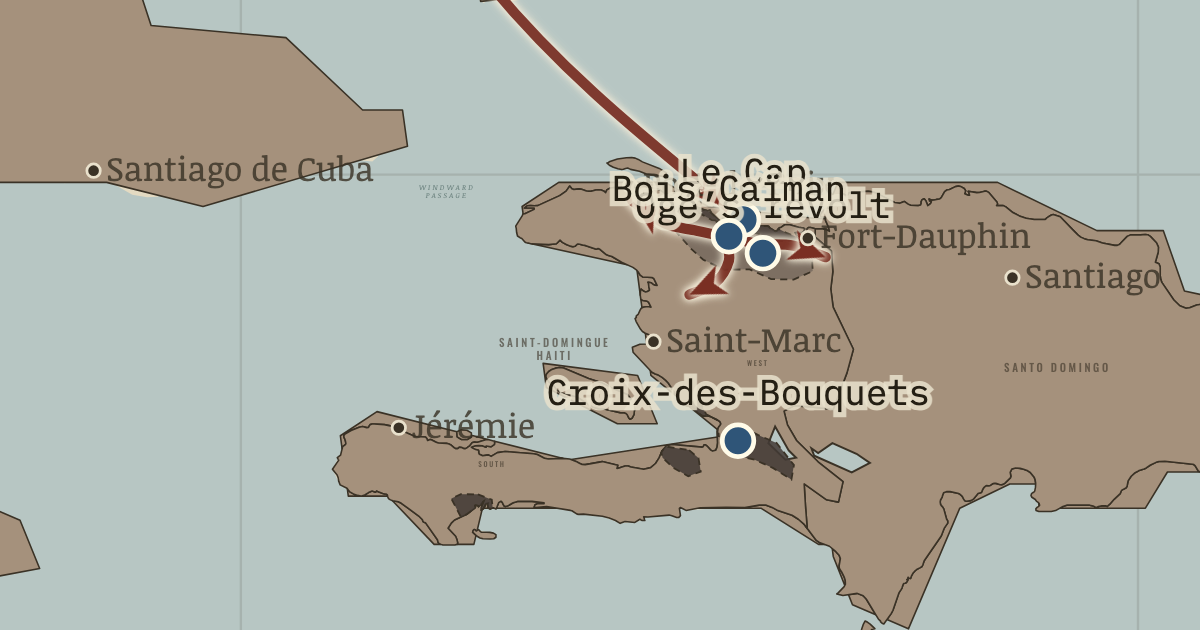
The Declaration gave Saint-Domingue's free groups a common language without giving them a common purpose. White planters elected colonial assemblies, councils rather like state legislatures, and the boldest at Saint-Marc in 1790 demanded control over colonial laws, including slavery and race. In Paris the Society of the Friends of the Blacks, an anti-slavery club founded in 1788, lobbied for the rights of free people of colour as a modern campaign group might lobby parliament. The planters' lobby fought those claims. Vincent Ogé, a merchant of colour who had argued for equality in Paris, returned secretly by the route shown by the northern arrow. In October 1790 he raised a few hundred armed men near Grande-Rivière; he did not call for abolition. Defeated within days, Ogé and his comrade Jean-Baptiste Chavannes escaped into Spanish Santo Domingo, whose officials handed them back. In February 1791 Ogé and Chavannes were broken on the wheel at Le Cap. The spectacle was meant to warn others; it also made the men martyrs.
The short answer
- Rights declared for all and applied to few. The Assembly proclaimed rights for all men while depending on colonial trade and hesitating to apply that principle in Saint-Domingue. Its 1790 and 1791 decrees offered free people of colour limited rights and then withdrew them. Excluded people could point to the Declaration itself when challenging their exclusion. The gap supplied both a reason to resist and a language in which to make the claim.
- Masters at war with each other. By 1791 planters were defying royal officials, poor whites were attacking free people of colour, and free people of colour had taken up arms for equality. The colony's forces were divided three ways; troops from France were few and unreliable. Those held in slavery could see that their rulers were fighting one another. This division gave a general rising room to begin.
- A conspiracy built on the estates. The organizers needed ways to connect many parishes for a rising on one night. Drivers managed gangs and traveled between estates, coachmen carried news, and Sunday markets and religious gatherings brought people from different plantations together. Planters overlooked these networks, partly because they believed the enslaved incapable of planning a revolution. That belief helped conceal the preparations.
- Mountains and a border. The northern plain offered more than one route of survival. Insurgents could retreat into neighboring mountains, regroup and grow food; across the border lay Spanish Santo Domingo, ready by 1793 to supply weapons in return for help against France. Risings on smaller, flatter Caribbean islands had been crushed within weeks. Here rebels could survive a defeat and return to fight.
THE TURNING POINT
Bois Caïman and the night of 22 August 1791. Before August 1791 the future of Saint-Domingue was disputed by free people in Paris and the colonial assemblies. The rising following Bois Caïman brought enslaved people into that contest as its largest army. They failed to take Le Cap, and their early demands were modest, but they survived the winter. Restoring the old order would now require a French government to reconquer the colony. Every later turn of the Haitian revolution depended on the insurgents having kept that possibility open.
What it changed
War across the North. The insurgent armies held much of the northern plain and mountains through 1792 against colonial militias and troops from France. Leaders emerged and competed. One was a freedman in his late forties, an aide to Biassou who would soon call himself Toussaint Louverture. The next chapter follows his rise and the advantage gained by turning insurgent bands into a disciplined army.
Paris sends commissioners and soldiers. France sent civil commissioners led by Léger-Félicité Sonthonax to enforce the equality granted to free people of colour on 4 April 1792. They landed at Le Cap in September with about 6,000 troops, intending to restore order and preserve slavery. In less than a year, invasion and civil war would lead Sonthonax himself to abolish slavery in the North.
Rival empires see an opening. Spain in neighboring Santo Domingo and Britain in Jamaica saw an opportunity in France's burning colony. When both went to war with revolutionary France in 1793, Spain armed the northern insurgents and Britain landed troops at the invitation of planters. Competition between great powers gave insurgents bargaining power, which they used brilliantly.
The full answer, argued
The French Revolution opened the way for a Haitian revolution. It weakened royal authority, divided the free population and sent decrees that raised and then dashed expectations. Free people of colour and later formerly enslaved people made powerful use of its language of rights. Yet the Assembly had ignored the people who planned the August 1791 rising on the estates. Their networks, religious bonds and military experience came from Africa and life in the colony; their leaders flew royalist flags as often as republican ones, and their aims changed during the war. James, Thornton and Fick give these influences different weight, but most historians now see French events interacting with the agency of the enslaved. The opening and the force that acted on it were distinct. Ideas traveled, and the people who received them put them to their own uses.
An interesting fact
An image of the northern plain burning reached Europe in an engraving published in 1795. Jean-Baptiste Chapuy made it after a drawing by Jean-Louis Boquet and titled it “View of the forty days of fire on the plantations of the plain of Cap-Français”. Smoke rises over cane fields and mills while ships lie at anchor in the harbor. The print is now in the departmental archives of the Gironde in Bordeaux, the port whose merchants had financed many of the estates shown burning.
This is the study layer of Outbreak of the Haitian Revolution, chapter 2 of Two Roads to Independence: Haiti 1789–1838 and Kenya 1895–1978; the full index of the atlas is here.
Related questions
THE FREE PRINTABLE STUDY GUIDE
Get the printable study guide for Two Roads to Independence free. I’ll send you a few short letters, then one when a new atlas opens. That’s all. — Paul
NO TRACKING · YOUR ADDRESS IS USED FOR THE DISPATCH AND NOTHING ELSE · UNSUBSCRIBE ANYTIME