Norse and Aztecs · 1428
Was the lake an advantage or a burden for the Mexica?
The seminar question: “Was the lake more of an advantage or a burden to the Mexica in their first century?”
Tradition places the founding of Tenochtitlan in 1325, when the Mexica settled in a lake in the Basin of Mexico, a high valley at about 2,240 metres with no outlet, where salty Lake Texcoco met fresh southern lakes. Their century serving Azcapotzalco ended with its fall in 1428 and a Triple Alliance formed to share tribute.
Chapter 7 is included with every paid plan. WW2 is free in full, and chapter 1 of every atlas is free. A free account opens 3 more chapters a day. Starter, at $9 a month, opens all 21 with no daily limit — see the plans.
Free printable Norse and Aztecs study guide, sent by email ↓
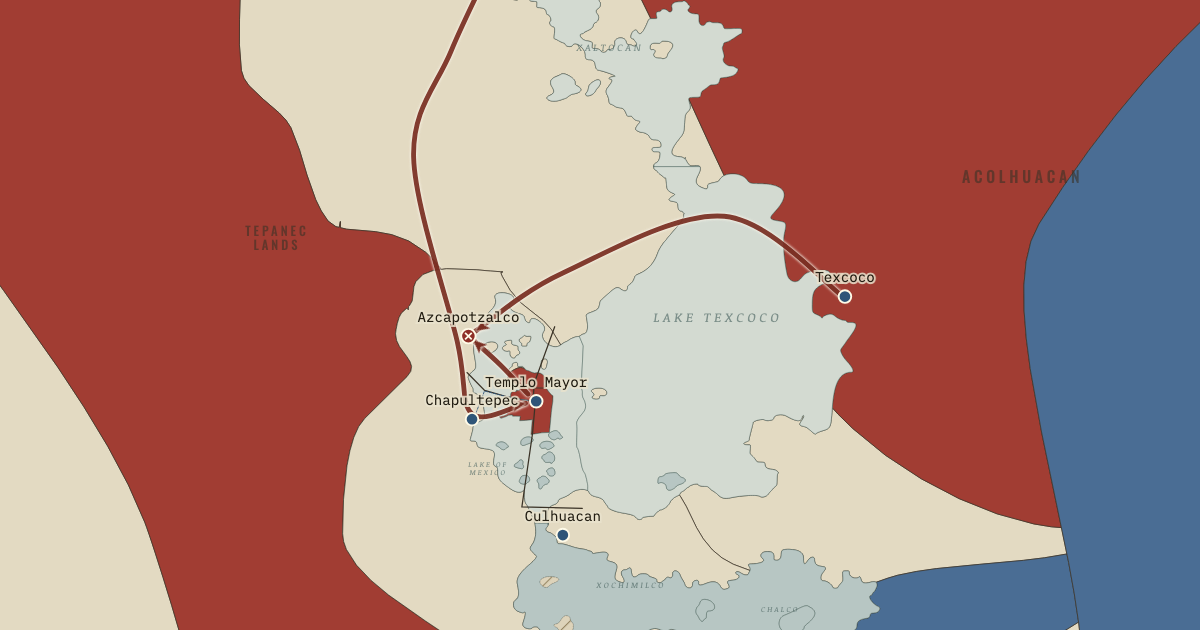
The Mexica arrived in a basin whose inhabitants already knew both the uses and the dangers of water. Depending on where its rim is drawn, the Basin of Mexico covers 7,500–9,600 square kilometres. Its lakes could join into one sheet in wet years and separate as they shrank in the dry season. Most rain fell from June to September; a late beginning or an early frost could ruin the maize harvest. Water draining into the lowest lake, Texcoco, left salt behind as it evaporated. Springs below the southern mountains supplied fresh water to Xochimilco and Chalco. People there had made chinampas, raised fields built from material piled up from the shallow lake bed. The newcomers inherited this knowledge as well as the basin’s uncertain rainfall.
The short answer
- A closed basin made salt and floods inevitable. Water draining from the mountains had no river outlet from the basin. Evaporation removed water and left salts, especially in low-lying Texcoco; in wet years the level of the connected lakes rose. Settlers could use the lakes, but they also had to contend with salt and floods. These conditions would shape Mexica engineering for a century.
- Latecomers took the marginal land. Established cities such as Azcapotzalco, Culhuacan and Texcoco already held the best farmland on the shores when the Mexica arrived in the thirteenth century. After expulsion from Chapultepec and Culhuacan, the newcomers found refuge on islands in the western marshes that others had not claimed. Their later power grew out of this weakness, helping explain the value they placed on military service and organised labour.
- Service to Azcapotzalco taught war and politics. Azcapotzalco’s authority imposed tribute and military service on the Mexica for about a century. Campaigns across the basin gave them experience, while marriages connected them to powerful families. They also saw how a dominant city drew tribute from others. When Tezozomoc died in 1426 and his Tepanec kingdom split, that experience could be turned against their overlords.
- An alliance of the threatened. Maxtla’s enemies had reasons to set rivalry aside. He threatened the Mexica and Nezahualcoyotl, whose father the Tepanecs had killed in 1418; some Tepanec towns, including Tlacopan, also opposed him. A common danger brought them together. Like later alliances formed against a shared enemy, their coalition would become an instrument of expansion.
THE TURNING POINT
The fall of Azcapotzalco, 1428. Azcapotzalco’s sack in 1428 ended the Mexica’s position as vassals. With Texcoco and Tlacopan, they gained the Tepanec kingdom’s lands and tribute and authority to organise labour around the basin. This mattered for more than conquest. The dikes, aqueducts and chinampas of the following decades needed thousands of workers from many towns. Power over the shores made such work possible.
What it changed
A Triple Alliance to share tribute. The partners campaigned together and, according to later chronicles, divided tribute in shares: two-fifths each for Tenochtitlan and Texcoco, one-fifth for Tlacopan. Within a few years they subdued Xochimilco, Cuitlahuac and other southern lake towns. The alliance gained both the basin’s best chinampa land and the labour of those who farmed it.
Engineering the lake becomes possible. Rulers who could call workers from towns around the lake could attempt larger defences and water supplies. Chapter 8 follows two such works: the masonry aqueduct from Chapultepec and Nezahualcoyotl’s great dike of about 1449. Their labour depended on the political power gained in 1428.
Expansion beyond the basin. Azcapotzalco’s defeat gave the alliance access to tribute networks beyond the basin. Itzcoatl and his successor Moctezuma I then sent campaigns south into Morelos and north into Otomí lands. The growing empire would bring maize, beans and cloth to Tenochtitlan from hundreds of kilometres away, while creating enemies as well.
The full answer, argued
For the small and vulnerable community of the first century, the lake was mostly an advantage. It offered protection, food and canoe transport, allowing numbers to grow despite scarce farmland and the absence of draught animals. The islands had no springs, however, and the closed basin brought salt and flooding. Those burdens remained manageable while the city was small and under Tepanec rule, with no large labour force at its command. After 1428, power over the shores let the Mexica enlarge the city and engineer the water. More people could benefit from the lake, but more also depended on its uncertain level.
An interesting fact
The Codex Mendoza reached Oxford by a circuitous route. Samuel Purchas reported that French privateers captured it on its way to Spain. It came into the hands of André Thevet, cosmographer to the French king, who signed it in 1553. The English geographer Richard Hakluyt bought it in Paris, and Purchas published woodcuts of its pages in 1625. Later it belonged to John Selden, whose books entered Oxford’s Bodleian Library in the 1650s. It remains there as MS. Arch. Selden. A. 1.
This is the study layer of Founding of Tenochtitlan, chapter 7 of Climate and Innovation: The Norse and the Aztecs, c. 790–1521; the full index of the atlas is here.
Related questions
THE FREE PRINTABLE STUDY GUIDE
Get the printable study guide for Climate and Innovation free. I’ll send you a few short letters, then one when a new atlas opens. That’s all. — Paul
NO TRACKING · YOUR ADDRESS IS USED FOR THE DISPATCH AND NOTHING ELSE · UNSUBSCRIBE ANYTIME