Norse and Aztecs · 1250
Can climate cause a society’s success or failure?
The seminar question: “Can climate ever be the cause of a society’s success or failure, or only its context?”
Between about 950 and 1250 much of the North Atlantic enjoyed a warm spell scientists call the Medieval Climate Anomaly; from about 1275–1300 it slid into the colder Little Ice Age. Proxies such as Greenland ice cores and lake-mud records show the change was uneven, warming one coast while a neighbour cooled.
WW2 is free in full, and chapter 1 of every atlas is free. A free account opens 3 more chapters a day. Starter, at $9 a month, opens all 21 with no daily limit — see the plans.
Free printable Norse and Aztecs study guide, sent by email ↓
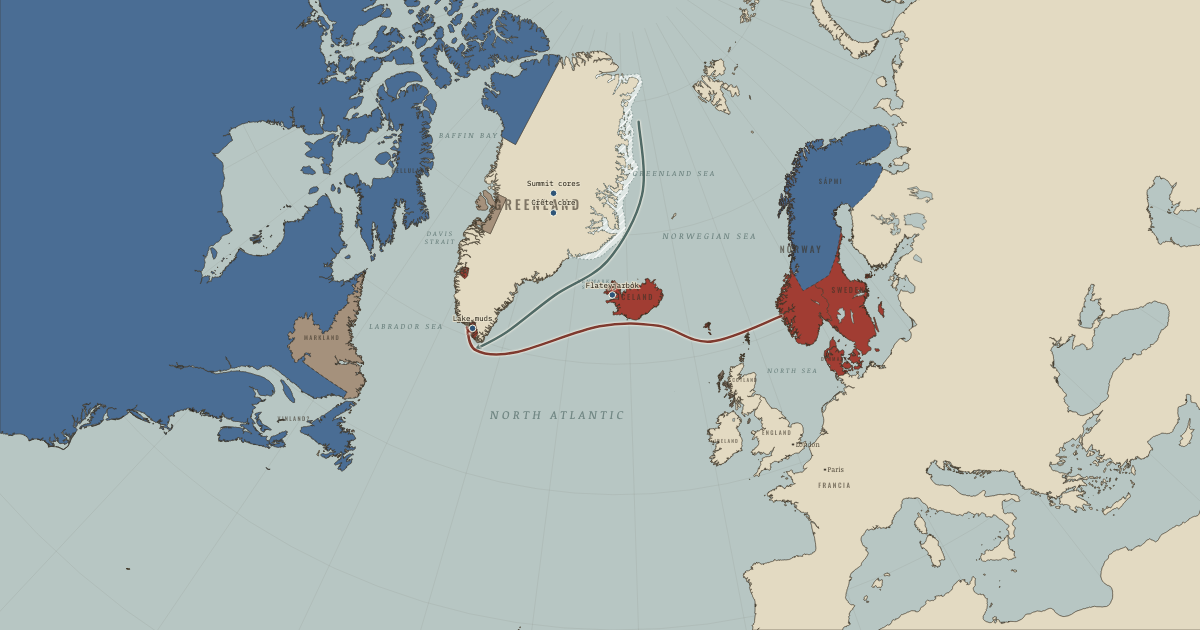
A warm period in one place need not be warm everywhere. Michael Mann and colleagues compared hundreds of records in 2009 and found that, between 950 and 1250, the North Atlantic was relatively warm while parts of the tropical Pacific were cool. The name Medieval Climate Anomaly describes such a regional departure from the usual pattern, rather as an unusually hot decade might stand out in a city's records.
The short answer
- Living at the margin magnifies small changes. Hay linked Greenland's short summer to the survival of cattle through eight winter months. Too little warmth or moisture could leave the animals without enough feed. Mexica maize faced a different limit at about 2,240 metres: an early autumn frost could kill the crop before it ripened. Near such limits a shift of a degree or two could turn an ordinary harvest into a desperate year.
- Ocean currents and sea ice shape the routes. Ships connected Greenland to Norway, but the sea also carried an obstacle. The cold East Greenland Current, shown by the grey arrow, moves Arctic ice down the east coast and around Cape Farewell. As cooling made drift ice more extensive and longer-lasting in summer, harbors could be blocked and voyages stretched out. The connection became slower and riskier just as the settlements depended on it.
- Volcanoes can tip a climate into a new state. Sulphur from a large eruption can reach high into the atmosphere, reflect sunlight and cool the world for several years. Gifford Miller's team argued in 2012 that four large eruptions over roughly fifty years helped initiate the Little Ice Age in 1275–1300; the sequence included the 1257–58 eruption later traced to Samalas in Indonesia. Expanding sea ice could then reflect more sunlight, keeping summers cold after the volcanic haze had cleared.
- Societies build their own vulnerabilities. A settlement of perhaps 2,000–2,500 people in Norse Greenland had a small margin against repeated bad years. Tenochtitlan, perhaps 200,000 strong, could draw on an empire for food, but placed a large population on one lake. Population, food diversity and trade determined what resources each society had when cold or drought struck. A shock that one community survived could be fatal to another.
THE TURNING POINT
Summit, Greenland, 1 July 1993. On 1 July 1993 the GISP2 drill reached bedrock 3,053 metres beneath the Greenland ice sheet's summit. Its core offered an almost year-by-year climate record independent of the sagas and annals. That independence mattered: if historians inferred climate from the same documents whose history they wanted climate to explain, the argument risked becoming circular. Ice and documents could now be compared, although conditions high at Summit still needed to be related carefully to those on coastal farms.
What it changed
The warm centuries open the sea road. Norse voyages to Iceland, Greenland and North America coincided with the relatively warm centuries of roughly 950–1250. Climate helped set the conditions for open-ocean crossings; ships and the farming society that supported them made the voyages possible. Chapter 2 takes up that combination.
The cold tests the farms. Greenland's outlying farms depended on hay and cattle, while walrus ivory supported trade. Cooling after about 1275–1300 placed those arrangements under pressure. Chapter 5 weighs that pressure with markets, isolation and choice in asking why the Norse left while newly arrived Inuit stayed and prospered.
A second laboratory in Mexico. The Basin of Mexico faced floods in 1449 and 1499 and frost and drought in the 1450s. Chapter 8 examines dikes, aqueducts and granaries as Mexica responses. By supporting a larger population on the lake, those measures also meant that a later failure could harm more people.
The full answer, argued
Climate can cause a change without explaining the outcome by itself. Warmer centuries widened the opportunity for farming in Norse Greenland; cooling after 1275–1300 narrowed it. Yet Iceland endured the colder period, and Thule Inuit expanded into Greenland while the Norse withdrew. Different food and tools made survival possible under cold conditions. Even the evidence of physical change differs by location: Lake 578 records drying near a farm, while the summit cores record conditions high above the settlements. Historians study vulnerability by asking how population, trade, technology and choices exposed people to a pressure or helped them withstand it. The same shock could be an inconvenience to one society and a catastrophe to another.
An interesting fact
A beer bottle helped give scientists a way to read ancient temperatures in ice. On a rainy Saturday at the end of June 1952, Danish physicist Willi Dansgaard set an empty bottle and funnel in his garden at Herlev, near Copenhagen, and collected successive showers. The proportion of heavy oxygen in the rain varied with the temperature of the cloud from which it fell. Dansgaard reasoned that, if snow retained the same signature, Greenland's ice sheet could preserve a temperature record. Two decades later he read that record alongside the history of the Greenland Norse.
This is the study layer of Medieval Warm Period and Little Ice Age, chapter 1 of Climate and Innovation: The Norse and the Aztecs, c. 790–1521; the full index of the atlas is here.
Related questions
THE FREE PRINTABLE STUDY GUIDE
Get the printable study guide for Climate and Innovation free. I’ll send you a few short letters, then one when a new atlas opens. That’s all. — Paul
NO TRACKING · YOUR ADDRESS IS USED FOR THE DISPATCH AND NOTHING ELSE · UNSUBSCRIBE ANYTIME