Norse and Aztecs · 1450
Which Norse innovation mattered most in the long run?
The seminar question: “Which Norse innovation was most significant in the long run: the ship, the stockfish trade or the Althing?”
The most durable Norse innovations were the flexible ones. Clinker-built boats outlived the Viking raids by centuries; stockfish, cod dried on racks in Arctic Norway, became the backbone of Norway’s economy, shipped through Bergen; and Iceland’s law and assembly endured after it accepted the Norwegian king in 1262–64.
Chapter 6 is included with every paid plan. WW2 is free in full, and chapter 1 of every atlas is free. A free account opens 3 more chapters a day. Starter, at $9 a month, opens all 21 with no daily limit — see the plans.
Free printable Norse and Aztecs study guide, sent by email ↓
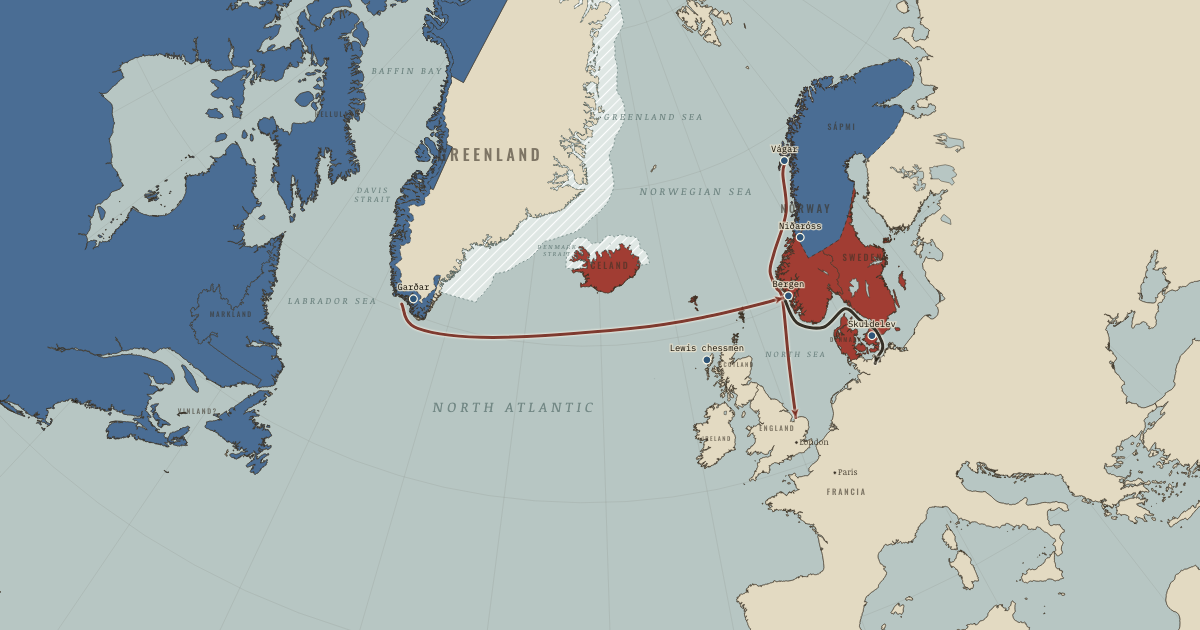
A shipbuilding skill could outlive the purpose for which a particular ship was made. The clinker method joined overlapping planks and served builders of warships as well as cargo vessels. Skuldelev 1, for example, was a 16-meter ocean-going pine ship built in western Norway around 1030. Later, broad trading vessels carried fish and grain. Builders could alter the size and use of a boat while retaining the craft itself.
The short answer
- Versatile technology survives changing purposes. Clinker construction could be adapted to vessels from rowing boats to ships 30 meters long. Warships, cargo ships and fishing boats used the method, much as a modern truck can serve several trades. When raiding declined, fish, timber and grain still needed transport. The skills and investments in timber and wool retained value because builders could answer new demands.
- Cod suited a colder sea. Cod thrive in cold water and gather to spawn off Lofoten each winter. The same northern conditions that troubled farms near the edge of their range helped fishers preserve their catch: cold, dry wind dried the fish without expensive salt. Stockfish could then travel to distant markets, making the climate an asset to the trade.
- Iceland’s size and variety gave it resilience. Around 1100 Iceland may have had 40,000–60,000 people supported by livestock, fishing and trade. Its size and range of activities helped it endure disasters, though at great cost. The plague of 1402–04 did not end the society; older estimates put the death toll at half or more, while recent studies suggest about a quarter to 45 percent. Greenland, with roughly a twentieth of Iceland’s population, had fewer farms and trades across which to absorb losses.
- Greenland depended on one export and one link. A few ships from Bergen brought Greenland iron, timber and grain, paid for almost entirely with walrus ivory. When European buyers turned again to elephant ivory, the principal export became less reliable. The royal ship then sank in 1369 and was not replaced. The colony faced trouble both earning imports and bringing them across the sea.
THE TURNING POINT
Bergen, c. 1360. The Hanseatic League established a permanent office at Bergen around 1360. German merchants could carry northern Norway’s dried cod to large markets around the North Sea and Baltic, making a staple food the basis of bulk trade. Greenland’s luxury export traveled a longer, icy route and did not occupy the same place in that system. The decades in which Bergen grew as a fish market also saw the last royal ship sail for Greenland.
What it changed
Norway becomes a fish economy. Northern Norwegian stockfish shipped through Bergen remained one of Norway’s largest exports for the next five centuries. German merchants connected it to their networks for centuries, and Bryggen’s wooden merchant houses survive as a UNESCO World Heritage site. Fishers had found profit in northern conditions that made Greenland’s farming harder.
Iceland endures as a fishing and farming society. Under Norwegian and later Danish rule, Iceland grew poorer during the colder centuries, yet its language, law codes and saga literature survived. Manuscripts including the sagas of the Vinland voyages became major sources for later Europeans studying the Norse Atlantic. Their survival was also a legacy of the Althing’s culture.
A second experiment begins far to the south. As Greenland’s last Norse farms emptied, the Mexica of central Mexico were completing an empire organized around a dense, engineered landscape and tribute from a wide region. Chapter 7 takes up this different arrangement. It asks what concentration and engineering could accomplish in a demanding environment, after the Norse case has explored mobility and dispersal.
The full answer, argued
The answer depends on the kind of significance we have in mind. Ships made settlement and exchange possible, carrying people to Iceland and Greenland and later carrying fish and grain. Their building tradition lasted into the twentieth century. Stockfish had the greatest economic weight after about 1100, linking a cold sea to lasting markets in England and the Hanseatic towns. The Althing has a different claim: Iceland’s tradition of law and assembly outlived independence and helped shape its modern parliament. One defensible choice is the ship, because it enabled settlement and trade, while stockfish sustained northern societies through the colder centuries. The ship’s long life also shows how a useful technique can find work beyond its original purpose.
An interesting fact
In 1831 a hoard came to light near Uig on the Isle of Lewis in the Outer Hebrides. Its 93 pieces included 78 chessmen, 14 round playing pieces and a belt buckle. Carved around 1150–1200, probably in Trondheim, they were made mostly from walrus ivory, with some whale teeth. Among the kings, queens and bishops are warders biting the tops of their shields. Eighty-two pieces are in the British Museum and eleven in National Museums Scotland; much of the ivory may have come from Greenland’s Norðrseta hunting grounds.
This is the study layer of Norse stockfish trade and legacy, chapter 6 of Climate and Innovation: The Norse and the Aztecs, c. 790–1521; the full index of the atlas is here.
Related questions
THE FREE PRINTABLE STUDY GUIDE
Get the printable study guide for Climate and Innovation free. I’ll send you a few short letters, then one when a new atlas opens. That’s all. — Paul
NO TRACKING · YOUR ADDRESS IS USED FOR THE DISPATCH AND NOTHING ELSE · UNSUBSCRIBE ANYTIME