Norse and Aztecs · 930
Was the Althing a success if Iceland lost independence?
The seminar question: “Was the Althing a successful innovation if Iceland still fell into civil war and lost its independence in 1262–64?”
Norse settlers reached Iceland from the 870s, and within about sixty years the landnám had claimed every usable valley; many came from Ireland and Scotland, often enslaved. The Althing assembly met at Þingvellir from 930, while woodcutting and grazing stripped birch woodland that once covered a quarter to two-fifths of the land.
Chapter 3 is included with every paid plan. WW2 is free in full, and chapter 1 of every atlas is free. A free account opens 3 more chapters a day. Starter, at $9 a month, opens all 21 with no daily limit — see the plans.
Free printable Norse and Aztecs study guide, sent by email ↓
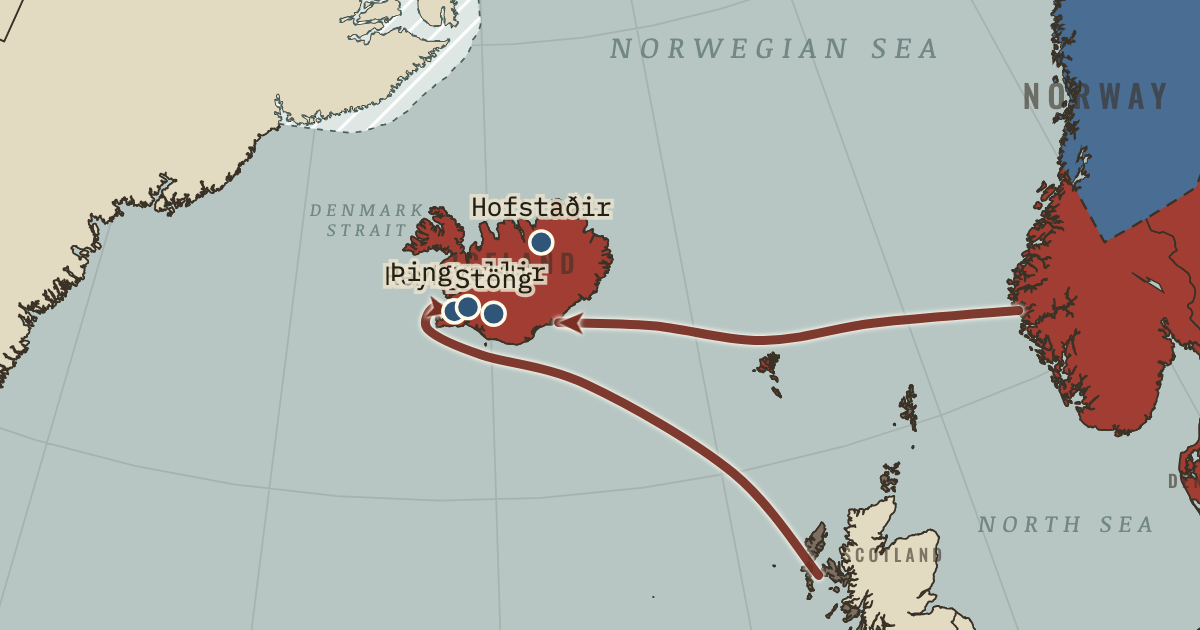
The names in Landnámabók, the Book of Settlements, give the migration a scale: nearly 400 leading settlers and about 1,400 places. Population geneticists estimate that 8,000–16,000 people came altogether. Yet the named leaders tell only part of the story. DNA from early settlers’ skeletons led Sunna Ebenesersdóttir’s team in 2018 to estimate their average ancestry at about 57 percent Norse, with most of the rest Gaelic; earlier work found that more than 60 percent of founding female lineages came from Ireland and Scotland. Many Gaelic women and men had been captured in raids and brought as slaves. Their labor helped establish farms in a society whose literary history gives Norwegian leaders greater prominence.
The short answer
- An empty island within reach of the ships. The crossing was within reach of the ships described in Chapter 2: Iceland is about 970 kilometers west of Norway and about 450 from the already-settled Faroe Islands. Irish hermits may have visited before the Norse, but there was no settled population to conquer. Newcomers could claim land and build a colony from the ground up.
- Land hunger and politics in Norway. Later Icelandic writers explained the migration as flight from Harald Fairhair’s tyranny after he united much of Norway in the late ninth century. Historians approach that flattering account of the settlers’ ancestors cautiously. Scarce farmland and growing royal power nevertheless seem to have encouraged ambitious families to leave. In Iceland a chieftain could hold land without a king above him; early claimants took large estates and divided them among kin and followers.
- Captives from the Gaelic west. Raids in Ireland and Scotland supplied captives whom settlers took to Iceland as slaves. They cleared land, herded animals and wove cloth. Genetic evidence shows the size of the Gaelic contribution to the founding population. Without forced labor, clearing the island’s usable land in about sixty years would have been much slower. Violence in the Gaelic west helped make the new farms possible.
- The need for law without a king. Freedom from royal power left settlers with disputes over land, livestock and killings, and feuds could destroy families. Norwegian regional assemblies, called things, offered a means of resolving such quarrels. Icelanders adapted the tradition to an island-wide assembly, giving people a common procedure without placing one chieftain in command of the others.
THE TURNING POINT
Þingvellir, 930 — and the decision of 999/1000. The Althing founded at Þingvellir in 930 gave scattered farmers a place and a procedure for settling disputes. Its importance became clear in 999 or 1000, when divisions between Christians and pagans threatened civil war. Both parties agreed to accept the lawspeaker Þorgeir’s decision. After a day and a night beneath his cloak, he ruled that Icelanders should be baptized, while allowing some pagan practices in private. Agreement on how to decide enabled a society without a king to make a momentous change peacefully.
What it changed
A springboard further west. Iceland became a base for the next westward voyages. Erik the Red had been outlawed for killings first in Norway and then in Iceland. He sailed west in the early 980s and returned with plans for a colony; in 985 or 986 a fleet left Iceland for Greenland, as Chapter 4 follows. People who had lost their place in an earlier settlement helped carry the frontier farther west.
A durable legal culture. Iceland lost independence when its chieftains accepted the Norwegian crown in 1262–64, but its legal tradition endured. Law first recited and later written in the Grágás codes remained part of Icelandic identity. The Althing met almost every summer until 1798 and was revived in the nineteenth century; Icelanders count it among the world’s oldest parliaments.
An environment slowly degraded. Fewer trees meant less timber for houses and ships, so Icelanders turned to driftwood and imports. Erosion reduced grazing land as cooling after 1300 brought further pressure. Iceland survived, unlike Norse Greenland, but grew poorer and more dependent on trade with Norway. Chapter 5 follows the colder centuries.
The full answer, argued
For more than 300 years the Althing helped armed chieftains make law and settle disputes without a king, army or taxes. The peaceful adoption of Christianity in 999 or 1000 shows how much an agreed procedure could accomplish. Yet a judgment depended on the winner’s followers for enforcement. When wealth and power accumulated in a few great families in the thirteenth century, that dependence became dangerous: rivals fought the civil wars of the Sturlung Age and accepted the Norwegian king. The institution had worked under a rough balance of power and struggled when that balance changed, a problem no medieval assembly had fully solved. It nevertheless survived as a symbol and later as a parliament.
An interesting fact
The Arctic fox was Iceland’s only native land mammal when the settlers arrived, probably having crossed sea ice at the end of the last Ice Age. Norse ships brought sheep, cattle, horses, goats, pigs, dogs and cats; mice came as stowaways. Icelandic plants had not previously been grazed by anything larger than a goose. The arrival of livestock helps explain the pressure on birch woodland and thin volcanic soils.
This is the study layer of Settlement of Iceland, chapter 3 of Climate and Innovation: The Norse and the Aztecs, c. 790–1521; the full index of the atlas is here.
Related questions
THE FREE PRINTABLE STUDY GUIDE
Get the printable study guide for Climate and Innovation free. I’ll send you a few short letters, then one when a new atlas opens. That’s all. — Paul
NO TRACKING · YOUR ADDRESS IS USED FOR THE DISPATCH AND NOTHING ELSE · UNSUBSCRIBE ANYTIME