Refugee crises · 1945
Were the Allies responsible for the expulsion of Germans?
The seminar question: “How should responsibility for expelling Germans be divided between the Allied powers and the governments that carried out the removals?”
Between 12 and 14 million Germans fled or were driven out of the lands east of the Oder and Neisse and from Czechoslovakia, Hungary and other states after 1945. At Potsdam in August 1945 the Allies accepted this ‘transfer’, asking that it be orderly and humane, but the expulsions had begun before any agreement and were neither.
WW2 is free in full, and chapter 1 of every atlas is free. A free account opens 3 more chapters a day. Starter, at $9 a month, opens all 21 with no daily limit — see the plans.
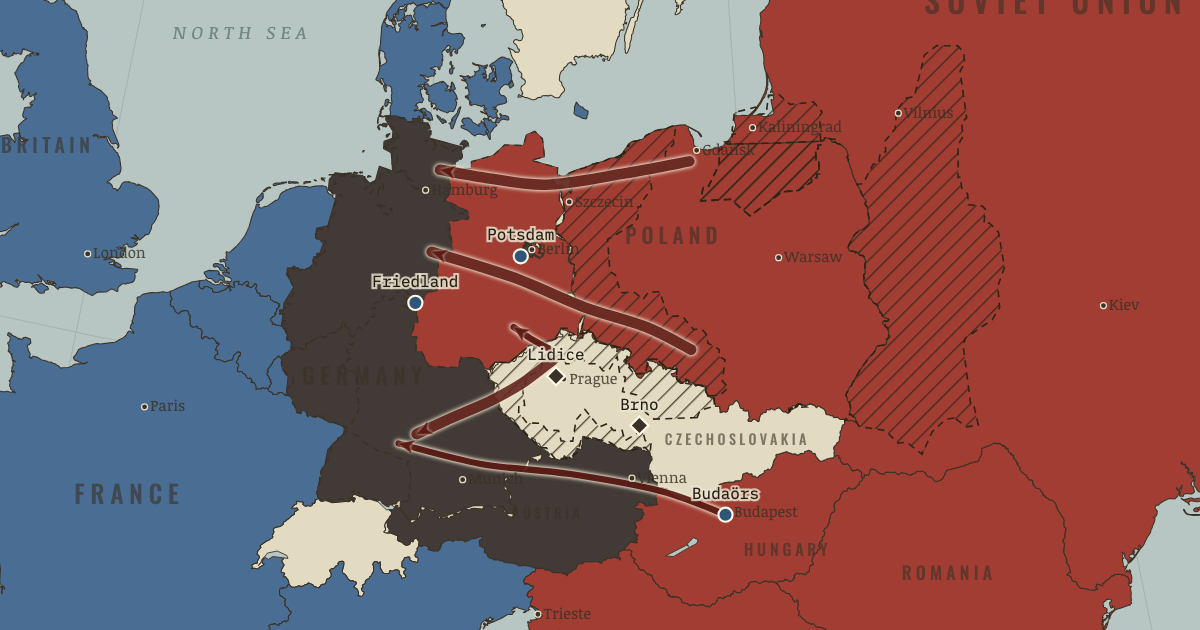
The leaders who advocated transfer believed they had learned something from the road to war. Hitler had used the grievances of Sudeten Germans to dismember Czechoslovakia in 1938, then invoked Poland’s German minority before invading in 1939. If a minority could be used as a pretext for aggression, removing it might prevent a future aggressor from doing the same. From 1942 Czech and Polish exiles argued that removal would make their states safe. Churchill told the House of Commons in December 1944 that expulsion was the most “satisfactory and lasting” method and that “a clean sweep will be made”. Planners could point to the 1923 Treaty of Lausanne, under which about 1.2 million Orthodox Christians left Turkey and about 400,000 Muslims left Greece. This compulsory exchange of minorities seemed a precedent for peace. Its sponsors assumed that transfer could also be humane.
The short answer
- The lesson drawn from Munich. Hitler invoked the grievances of three million Sudeten Germans when he dismembered Czechoslovakia in 1938, and Poland’s German minority when he justified invasion in 1939. Czech and Polish leaders, followed by British supporters of transfer, drew a lesson from those precedents: a mixed borderland could supply a pretext for another war. Removing the minority appeared both a response to occupation and a lasting security measure.
- Six years of occupation. Occupation gave many Poles and Czechs reasons to associate their German neighbors with Nazi rule. About six million Polish citizens were killed, half of them Jews; villages including Lidice were destroyed in reprisal, and Nazi plans envisaged deporting or eliminating Slavic populations. Many local Germans served the occupation, and in 1935 about two-thirds of Sudeten German voters had backed Konrad Henlein’s pro-Nazi party. These facts helped make collective blame plausible, though individual Germans had made very different choices.
- Poland moved west. Poland lost its eastern provinces to the Soviet Union under the settlement accepted at Yalta, with compensation to come in the west. Potsdam placed the Oder–Neisse lands under Polish administration “pending the final determination” of the border. Warsaw sought permanence by settling Poles there and removing Germans. The uprooting of Poles in the east and the expulsion of Germans in the west were connected.
- Allied consent and the Lausanne precedent. The 1923 Greek–Turkish exchange, which moved about 1.6 million people, offered Allied planners a precedent they thought had brought peace. Churchill called expulsion the most “satisfactory and lasting” method in December 1944. Belief that transfer could prevent conflict and be managed humanely helped secure great-power support for Polish and Czechoslovak plans.
THE TURNING POINT
Potsdam, Section XIII, 2 August 1945. By 2 August 1945 removals were already under way. At Potsdam the three powers declared that transfers from Poland, Czechoslovakia and Hungary “will have to be undertaken” and should be “orderly and humane”. They accepted transfer in principle while requesting a suspension until the Control Council could plan the flow. The occupying powers controlled the receiving zones and could organize arrivals; their appeal for humane treatment had little means of enforcement.
What it changed
A sixth of West Germany. West Germany’s September 1950 census counted 7.9 million expellees, 16.5 percent of its population. Many were first housed in rural Bavaria, Lower Saxony and Schleswig-Holstein. Housing programs, the Equalisation of Burdens law of 1952 and the postwar boom helped integrate them, a founding achievement of the Federal Republic explored in chapter 6. Expellees also organized a party and associations that kept claims to the lost east in politics for a generation.
Room for Poles from the east. The departure of Germans opened homes in Silesia and Pomerania to Poles from central Poland and provinces annexed by the Soviet Union. Breslau became Wrocław within three years. Some settlers found German furniture still in their houses; many expected for years to be moved again. Chapter 3 follows these linked journeys, in which one removal made room for another.
Outside the refugee regime. German expellees arriving in Germany were generally treated by international agencies as Germany’s responsibility. The 1951 Refugee Convention excludes people recognized by their country of residence as having the rights and obligations attached to nationality there. Chapter 5 examines a protection system in which access depended in part on whether a person had a state’s protection.
A memory still contested. Expellee associations became influential in West German politics. Remembering German suffering alongside responsibility for Nazi occupation remained a question in relations with Poland and the Czech Republic for decades. The 1990 border treaty and the Berlin documentation center opened in 2021 mark later stages of the argument, discussed in the epilogue.
The full answer, argued
The Allied powers accepted responsibility when they agreed at Potsdam that transfer “will have to be undertaken”. Churchill had already endorsed a “clean sweep”, and the Control Council planned for 6.65 million people to enter zones the powers controlled. Poland and Czechoslovakia could hardly have sent millions there without that consent. National authorities, however, had begun expulsions before Potsdam and made decisions of their own, including the Czechoslovak citizenship decree. The Allies asked for a pause, though removals continued. Following R. M. Douglas, we can describe an international policy carried out by national governments: the powers accepted and organized transfers, while national authorities initiated and executed removals. Both helped produce the outcome in different ways. Chapter 10 tests the significance of international consent against the Geneva bargains.
An interesting fact
The Sudeten German community found a particular place in Bavaria, which received more of its members than any other part of Germany. In 1954 the Bavarian government formally became its patron. Politicians call Sudeten Germans the state’s “fourth tribe”, alongside Old Bavarians, Franconians and Swabians; Sudeten German Day at Whitsun remains a fixture of Bavarian politics. Expellees from Gablonz (Jablonec nad Nisou) founded Neugablonz near Kaufbeuren on the site of a wartime explosives works, rebuilding their glass and costume-jewelry trade there.
This is the study layer of Expulsion of Germans after WW2, chapter 2 of Uprooted: Refugees in Europe 1945–1960 and Indochina 1975–1990; the full index of the atlas is here.
Related questions
THE FREE PRINTABLE STUDY GUIDE
Get the printable study guide for Uprooted free. I’ll send you a few short letters, then one when a new atlas opens. That’s all. — Paul
NO TRACKING · YOUR ADDRESS IS USED FOR THE DISPATCH AND NOTHING ELSE · UNSUBSCRIBE ANYTIME