Refugee crises · 1975
Why did displacement differ in Vietnam, Cambodia and Laos?
The seminar question: “Why did the communist victories of 1975 produce such different kinds of displacement in Vietnam, Cambodia and Laos?”
Between April and December 1975 communists took power in Vietnam, Cambodia and Laos. On 29–30 April US helicopters carried about 7,000 people out of Saigon, and over 110,000 evacuees passed through tent cities on Guam. In Cambodia the Khmer Rouge entered Phnom Penh on 17 April and emptied it of two million or more people.
Chapter 7 is included with every paid plan. WW2 is free in full, and chapter 1 of every atlas is free. A free account opens 3 more chapters a day. Starter, at $9 a month, opens all 21 with no daily limit — see the plans.
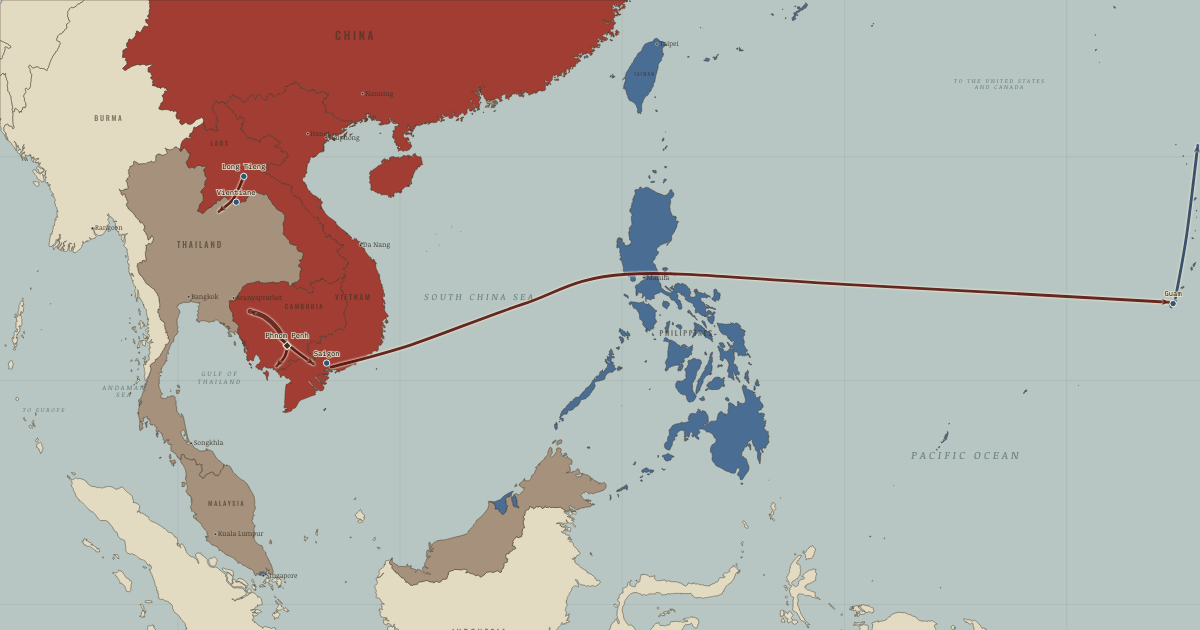
The evacuation from Vietnam began with a problem of time. The Republic of Vietnam, the American-backed South, collapsed within eight weeks of the North's March 1975 offensive. Officials, officers and employees associated with the Americans had reason to fear the victors, but preparations for their departure had to be improvised as the government fell.
The short answer
- Thirty years of war. The victors inherited countries already uprooted by almost continuous war since 1945. Fighting against French rule gave way to a conflict between the communist North and the American-backed South that spread into Laos and Cambodia. Bombing and ground fighting drove millions from the countryside into cities such as Saigon and Phnom Penh. The populations gathered there were impoverished and divided by loyalties the new rulers would punish.
- American withdrawal. American troops left under the Paris agreements of January 1973, and Congress cut aid to Saigon and Phnom Penh in 1974–75. The southern army then collapsed faster than planners expected after the North attacked in March 1975; Cambodia's government fell on 17 April. People at risk needed a way out just as the institutions meant to organize one were falling apart. Evacuation was improvised, and many were left behind.
- Revolutionary programmes. The victorious parties wanted to change the societies they now governed. Hanoi sought reunification and socialist transformation of the South; the Khmer Rouge aimed at a classless peasant nation built from Year Zero; the Pathet Lao established a socialist state aligned with Vietnam. Their plans differed, but each could identify whole classes or groups as enemies. Political victory thus became a cause of displacement, as it had in Europe in 1945.
- Alliances with the losing side. Soldiers, officials, interpreters and Hmong fighters were among hundreds of thousands who had served the old regimes or worked with Americans. Those ties could make them suspects after defeat and gave many reason to flee. The same service also gave them a claim on the foreign power they had assisted, helping explain the American evacuation and resettlement.
THE TURNING POINT
Saigon, 29–30 April 1975. On 29 and 30 April helicopters took about 7,000 people from Saigon to the fleet. About 130,000 left in the wider evacuation that spring. These departures ended the American war for those who escaped and began an obligation to receive them: over the next twenty years the United States became the principal country of resettlement for Indochinese refugees. Images of allies escaping defeat shaped American views and later helped boat people gain admission. Millions connected to the old regime remained in Vietnam; their circumstances would contribute to a larger flight.
What it changed
Those left behind. Defeat did not end the danger for people who stayed. Hundreds of thousands of former officers and officials entered re-education camps, and city dwellers were pushed toward New Economic Zones in the countryside. Chapter 8 follows these policies and the 1978 attack on private trade into mass departures. Some unable to leave in 1975 became boat people in 1978 and 1979.
Year Zero. The evacuation of the cities began Democratic Kampuchea's attempt to remake life without money, markets, religion or families as people had known them. Forced labor, starvation and execution killed an estimated 1.5 to 2.2 million people over the next four years. Chapter 8 records the catastrophe with memorial markers and ranges of figures. Survivors reached the Thai border in 1979 after the regime fell.
Thailand on the front line. Thailand received Lao and Hmong refugees from 1975 and later Cambodians across its long land borders. Its leaders also feared Vietnamese power and communist insurgency at home. These pressures help explain a policy that was open in some years and harsh in others, and the changing colors in chapters 9 to 11. Like Austria in 1956, Thailand was a relatively small state receiving people displaced by a larger conflict.
A resettlement commitment. The first arrivals formed Vietnamese American communities and established a precedent for federal responsibility. Both helped press Washington to act when boat departures grew in 1978–79. Chapter 10 follows the Refugee Act of 1980. Earlier arrivals also sponsored relatives, giving later arrivals help in settling.
The full answer, argued
Each victory placed different people in danger. Hanoi sought to absorb the South, and about 130,000 people, many exposed by their American connections, left Vietnam in an evacuation organized and funded by the United States. The Khmer Rouge treated cities as enemies in a radical transformation, forcing a vast population to move inside Cambodia while few escaped abroad. In Laos, Hmong identity and service in the CIA-backed army together made reprisals a fear and encouraged flight toward Thailand. Political loyalty mattered throughout, but the groups singled out and the routes available to them differed. For this Paper 1 study, the comparison shows how a victor's intentions toward the defeated help shape displacement.
An interesting fact
A chance encounter at sea brought some of the crisis's first boat people to Hong Kong. In early May 1975 the Danish container ship Clara Maersk was sailing there when it found a crowded freighter in the South China Sea. It took about 3,700 people aboard, far beyond its intended capacity. The crew fed them from the ship's stores and landed them on 4 May. Merchant ships continued to rescue people at sea; UNHCR later counted about 67,000 rescues between 1975 and 1990.
This is the study layer of Fall of Saigon and the 1975 exodus, chapter 7 of Uprooted: Refugees in Europe 1945–1960 and Indochina 1975–1990; the full index of the atlas is here.
Related questions
THE FREE PRINTABLE STUDY GUIDE
Get the printable study guide for Uprooted free. I’ll send you a few short letters, then one when a new atlas opens. That’s all. — Paul
NO TRACKING · YOUR ADDRESS IS USED FOR THE DISPATCH AND NOTHING ELSE · UNSUBSCRIBE ANYTIME