Refugee crises · 1947
Did the 1944–47 population transfers end ethnic conflict?
The seminar question: “Did the population transfers of 1944–1947 end ethnic conflict in east-central Europe, or did they complete it by other means?”
After the war Poland was moved about 200 kilometres west: the Soviet Union kept its eastern borderlands and Poland received German land. Under the Lublin agreements of September 1944, about 1.2 to 1.5 million Poles and Polish Jews left the Soviet republics, while about 482,000 Ukrainians were sent to Soviet Ukraine.
Chapter 3 is included with every paid plan. WW2 is free in full, and chapter 1 of every atlas is free. A free account opens 3 more chapters a day. Starter, at $9 a month, opens all 21 with no daily limit — see the plans.
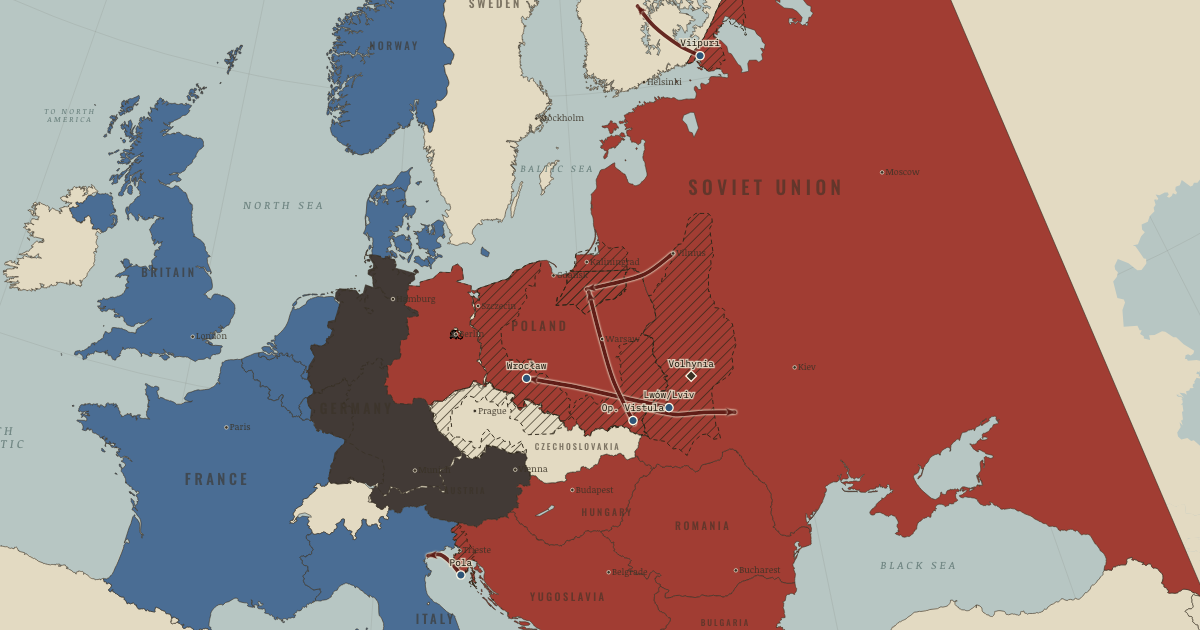
Poland’s eastern losses and western gains created two connected problems: people were leaving one region while another needed settlers. The arrows from Lwów and Wilno toward Wrocław and Gdańsk trace that connection. Under the September 1944 Lublin agreements, Poles in three Soviet republics could register for ‘evacuation’. Remaining was difficult. Soviet pressure, fear of Ukrainian insurgents and collectivisation—the merging of private farms into state-run collectives—made departure the safer or more practicable choice for many. About 780,000 came from Soviet Ukraine alone, along with surviving Polish Jews whose communities the Holocaust had destroyed.
The short answer
- Poland’s border moved to the Curzon Line. Stalin insisted on retaining the eastern Polish lands seized by the Soviet Union in 1939. At Yalta, Roosevelt and Churchill accepted a border close to the Curzon Line, with western land as compensation. Nearly half of prewar Poland, including Lwów and Wilno, changed hands. The line left people under a different state; the governments chose to move them across it.
- The war of 1943 in Volhynia. The massacres of 1943–44 made coexistence difficult to imagine. Ukrainian nationalist insurgents killed tens of thousands of Polish civilians in Volhynia and eastern Galicia, while Polish units killed thousands of Ukrainians in reprisal. Against the prospect of more massacres, population exchange could appear to authorities and many victims as a path to safety, even when removal was forced.
- Communist nation-building. Poland’s new communist government needed support it could not assume it possessed. Nationalism offered one claim to legitimacy: it could present itself as building a Poland for Poles. Homogeneity also suited Stalin’s preference for clear borders and loyal populations, and vacated western land could be distributed to settlers. Removing Germans and Ukrainians served the project of bringing nation and territory together.
- Treaties that ceded land. Finland lost Karelia under the 1944 Moscow Armistice and the 1947 Paris treaty. Italy’s treaty that February ceded Istria, Fiume and Zara to Yugoslavia. Neither required inhabitants to depart, but staying meant living under a new state. Most left, suggesting how few believed they could remain safely as minorities under a victorious neighbor.
THE TURNING POINT
Operation Vistula, 28 April 1947. On 28 April 1947 Poland began deporting its own citizens. No border had moved, and no treaty required the operation. About 140,000 people were affected. General Świerczewski’s killing supplied a pretext, but the deliberate dispersal of Ukrainians so their communities could not re-form went beyond fighting an insurgency. The pursuit of security through homogeneity had become a reason to move people even without a new external demand.
What it changed
A Poland of Poles. Before the war roughly a third of Poland’s citizens were not Poles. War and forced movements left it among Europe’s most ethnically uniform states. Germans, Ukrainians, Lemkos and Polish easterners lost homes, while the multi-ethnic life of Lwów and Wilno was destroyed. The 1990 border treaty made the settlement permanent and ended uprooted people’s hopes of reclaiming their former homes.
Integration at home as a model. Finland’s 410,000 Karelians were resettled within a few years, with landowners and taxpayers contributing the resources. Even a poor state could absorb a large displaced population when it recognized them as citizens with claims. West Germany’s 1952 Equalisation of Burdens law applied similar thinking on a much larger scale, as chapter 6 explains. Stateless displaced persons had no home state from which to claim the same provision.
Exiles in Trieste and beyond. For many Istrian exiles, departure led first to years in camps near Trieste or in Italian cities, then to settlement in Italy or emigration to Australia, the Americas and elsewhere. The Free Territory of Trieste remained divided between Allied and Yugoslav administrations until 1954. Italy then took the city and Yugoslavia the hinterland, prompting a final departure from the Yugoslav zone. At Magazzino 18 in Trieste’s old port, furniture some exiles never reclaimed still remains.
Displaced persons who would not go east. Many Ukrainians, Poles and Balts in German DP camps in 1945 had homes in regions now annexed by the Soviet Union. Returning meant becoming Soviet citizens, and most refused. That decision shaped camp life and Cold War asylum politics; chapter 4 follows the right to refuse return as it became central to refugee protection.
The full answer, argued
The transfers can be seen as ending conflict: the borders drawn in 1945 held, and Poles and Ukrainians, Finns and Russians, and Italians and Yugoslavs did not fight again over these lands. Finland also showed that a state could resettle displaced citizens humanely. Yet separation achieved the aim pursued in the 1943 Volhynia massacres, and Operation Vistula dispersed civilians without a war or new treaty requiring it. Snyder’s account brings these observations together: peace came through separation. That conclusion requires us to count the lives, property and communities destroyed, as well as Soviet power’s role in sustaining peace. A border drawn to resolve displacement could create another displaced population.
An interesting fact
The Racławice Panorama left Lwów for Wrocław in 1946. This circular painting, about 15 metres high and 114 metres long, was completed in 1894 for the centenary of Tadeusz Kościuszko’s 1794 victory over Russian troops. Communist authorities were wary of its patriotic image of Poles defeating Russians and kept it rolled up for almost four decades. In 1985 it went on display in a purpose-built Wrocław rotunda; it remains among the city’s most visited sights.
This is the study layer of Polish population transfers, chapter 3 of Uprooted: Refugees in Europe 1945–1960 and Indochina 1975–1990; the full index of the atlas is here.
Related questions
THE FREE PRINTABLE STUDY GUIDE
Get the printable study guide for Uprooted free. I’ll send you a few short letters, then one when a new atlas opens. That’s all. — Paul
NO TRACKING · YOUR ADDRESS IS USED FOR THE DISPATCH AND NOTHING ELSE · UNSUBSCRIBE ANYTIME