Refugee crises · 1956
Was West Germany’s expellee integration deliberate policy?
The seminar question: “How far was the integration of West Germany’s expellees the result of deliberate government policy?”
West Germany, home to 7.9 million expellees, treated them as citizens, and its 1952 Equalisation of Burdens law made owners of surviving property pay half its value into a fund for those who had lost everything. Refugees from communist states, among them East Germans leaving steadily for the West, became symbols of the Cold War.
Chapter 6 is included with every paid plan. WW2 is free in full, and chapter 1 of every atlas is free. A free account opens 3 more chapters a day. Starter, at $9 a month, opens all 21 with no daily limit — see the plans.
In 1950 one West German resident in six was an expellee. Many were crowded into barracks and farm attics in Schleswig-Holstein, Lower Saxony and Bavaria. Industrial jobs lay elsewhere, and local people sometimes met the newcomers with open hostility. Citizenship gave the expellees a claim on the state, but it did not by itself give them a house or a livelihood.
The short answer
- Citizens with a vote. Expellees in West Germany had a political resource stateless DPs lacked: citizenship. They could vote, organize and stand for office. About one voter in six was an expellee, and their party joined the government in 1953. Their pressure helped bring measures such as the Equalisation of Burdens law during the new state's difficult early years.
- The economic miracle. Recovery gave integration room to work. West German output grew rapidly in the 1950s, with Marshall Plan aid, the 1948 currency reform and booming exports among its elements. Employers needed workers; expellees filled jobs and helped create growth. That growth in turn made housing and compensation easier to finance.
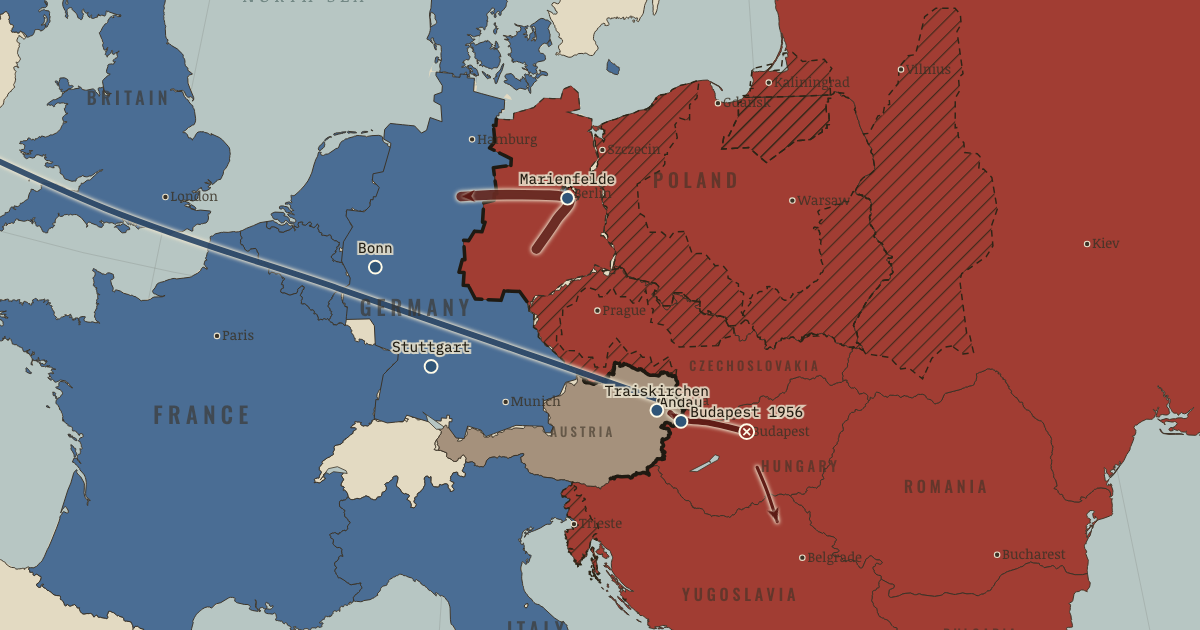
- Repression in the Soviet bloc. People had reasons to leave the Soviet bloc, among them collectivisation, purges and the suppression of the East German uprising in June 1953 and the Hungarian revolution in 1956. The routes depended on geography and border controls. Berlin remained an opening from East Germany until 1961; in 1956 Hungarians crossed into Austria and Yugoslavia.
- Western interest in the East’s refugees. Western governments saw escape from communism as evidence against their rivals. Help for those arriving could serve a humanitarian purpose and make a Cold War argument at the same time. West Germany granted East Germans citizenship on arrival, and resettlement places for Hungarians appeared quickly in 1956.
THE TURNING POINT
The bridge at Andau, November 1956. The small bridge over the canal at Andau carried people fleeing Hungary until Soviet engineers destroyed it on 21 November 1956. Their journey illustrates a response made up of several decisions. Austria offered first asylum, UNHCR found a legal route through the Convention's date limit, and 37 countries offered places elsewhere. An open border brought immediate safety; offers of homes abroad helped Austria receive the arrivals. In 1979 states sought a similar combination for Indochinese boat people under different conditions.
What it changed
A template for burden-sharing. Austria's reception of Hungarians and other countries' offers of permanent homes formed a model for sharing responsibility. The July 1979 Geneva meeting used a comparable bargain in Southeast Asia, linking asylum in Malaysia, Thailand and Indonesia to Western resettlement places. Chapter 10 examines the different scale and sympathy surrounding the boat people, who were more numerous and less familiar to Western voters.
The Wall closes Europe’s door. After August 1961 the Berlin Wall sharply reduced mass departures from East Germany, closing the main escape route for 28 years. Smaller numbers continued to flee communist states, including after Prague in 1968. Borders opened again in 1989, followed by German reunification. The GDR had stopped the exodus by preventing would-be refugees from leaving.
UNHCR goes global. Hungary helped establish UNHCR's role in emergencies beyond its expected closing date. In the 1960s it expanded its work to refugees from conflicts and wars of independence in Africa and Asia; the 1967 Protocol changed the Convention's original time and geographic limits. By 1975 the agency was working in Southeast Asia, where many states had not joined the treaty and cooperation, money and diplomacy mattered.
The expellees in politics. Economic integration did not end disputes over the lost homes. Expellee organizations opposed Willy Brandt's recognition of the Oder–Neisse line in 1970 and influenced debates about memory into the twenty-first century. The epilogue follows those debates to the 1990 border treaty and the Berlin documentation center opened in 2021.
The full answer, argued
Government policy gave expellees means to rebuild: the Equalisation of Burdens law paid more than 130 billion marks over decades, the Federal Expellee Law established legal status, and housing and relocation programs moved hundreds of thousands closer to industrial jobs. But these measures depended on a wider recovery. The boom supplied jobs and resources, while expellees' own work, organization and votes pressed politicians to act. Andreas Kossert's account of local hostility also shows that economic progress did not immediately bring social acceptance. Policy was necessary but not sufficient; growth and political pressure were its partners. Vietnamese refugees resettled abroad later depended initially on decisions in foreign countries where they had no vote.
An interesting fact
World Refugee Year began with a proposal in Crossbow. In 1958 four young British Conservatives, Christopher Chataway, Colin Jones, Trevor Philpott and Timothy Raison, made their case in the journal; the UN General Assembly adopted the idea that December. Chataway was already known as an athlete. With Chris Brasher, he had paced Roger Bannister's first sub-four-minute mile at Oxford on 6 May 1954. UNHCR reports that the year raised about 90 million dollars from 97 countries and territories, including some £9 million in Britain. The four founders received the Nansen Medal in 1960.
This is the study layer of Expellee integration in West Germany, chapter 6 of Uprooted: Refugees in Europe 1945–1960 and Indochina 1975–1990; the full index of the atlas is here.
Related questions
THE FREE PRINTABLE STUDY GUIDE
Get the printable study guide for Uprooted free. I’ll send you a few short letters, then one when a new atlas opens. That’s all. — Paul
NO TRACKING · YOUR ADDRESS IS USED FOR THE DISPATCH AND NOTHING ELSE · UNSUBSCRIBE ANYTIME