Refugee crises · 1951
Was the Refugee Convention humane or a Cold War tool?
The seminar question: “To what extent was the 1951 Refugee Convention a humanitarian achievement rather than an instrument of the Cold War?”
Between 1947 and 1951 Europe’s response to displacement moved from relief to resettlement and legal status. The International Refugee Organization, boycotted by the Soviet bloc, resettled about 1,039,000 people overseas by the end of 1951, and in Geneva on 28 July 1951 the Refugee Convention was adopted.
Chapter 5 is included with every paid plan. WW2 is free in full, and chapter 1 of every atlas is free. A free account opens 3 more chapters a day. Starter, at $9 a month, opens all 21 with no daily limit — see the plans.
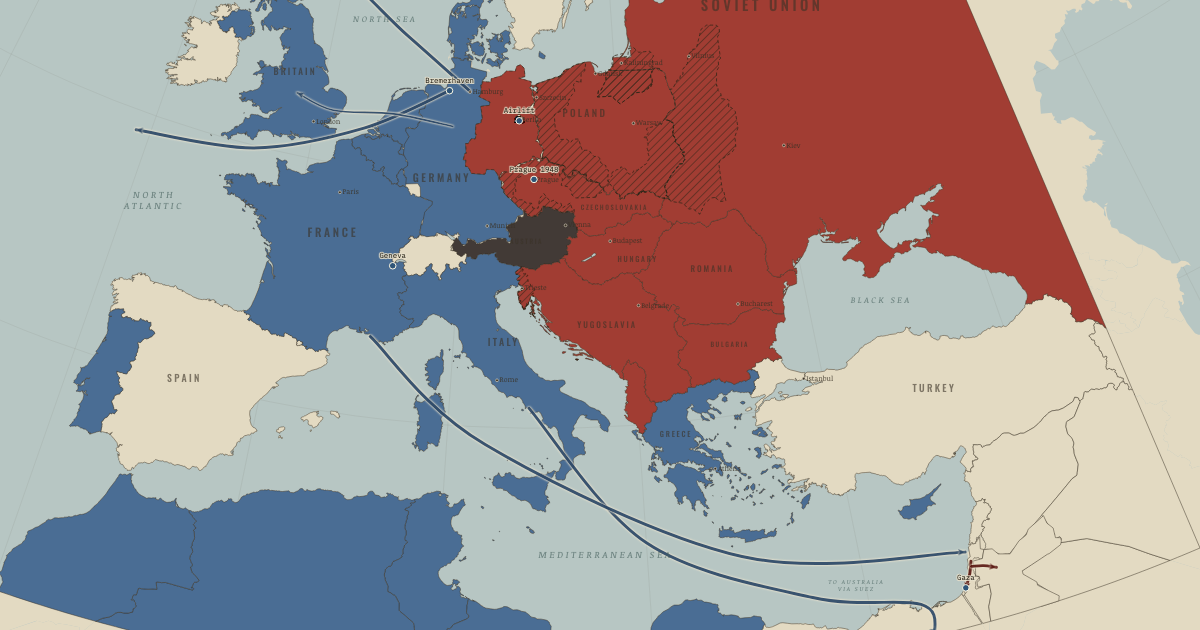
What was to happen to people who remained in Europe's camps after the war? By 1947 most of the roughly million still there refused to return east, and Western governments had stopped forcing them. The IRO succeeded the wartime relief agency UNRRA that year and sought homes in third countries. Resettlement meant more than moving people out of camps: another government had to agree to admit them.
The short answer
- The last million would not go home. The people remaining in camps in 1947 needed more than relief. Many refused return to communist states, and Western governments had stopped forcing them. The IRO succeeded UNRRA with the task of finding homes in other countries, while repatriation remained among its activities.
- Labour shortages overseas. Australia's “populate or perish” campaign and labor shortages in Canada, Britain and Latin America brought recruiters to the camps. Mines, farms, forests, railways and textile mills needed workers. DPs were available, often young and anti-communist, and could be hired under contracts. Employers' needs opened places, while favoring the fit and skilled.
- The Cold War. The February 1948 communist takeover in Czechoslovakia, the Berlin blockade and the creation of two German states in 1949 made flight from the East politically significant in the West. The Soviet bloc boycotted the IRO and called its clients traitors. A persecution-based definition could protect people fleeing communist rule alongside victims of other persecution.
- Displacement was not ending. Crises in Palestine, India, Korea and China showed by 1950 that displacement extended beyond Europe's wartime camps. UNHCR and the Convention offered an agency and a framework of rights. Their founders nevertheless expected an end to the problem: UNHCR received a three-year mandate and the treaty a date limit.
THE TURNING POINT
Geneva, 28 July 1951. At Geneva on 28 July 1951, states adopted a treaty defining refugee status and accepting duties toward those who qualified. Access to courts, work and papers mattered; so did Article 33's restriction on return to threatened life or freedom. Yet the same bargain limited protection by date and, optionally, geography. Both features mattered later in Indochina, where the rule against return was invoked although many first-asylum states had not signed.
What it changed
A definition that travelled. The Convention's five grounds of persecution traveled beyond its European beginnings after the 1967 Protocol removed the date limit and extended geographic scope, subject to existing declarations. During the Indochinese crisis the United States incorporated the definition in its Refugee Act of 1980. After 1988, screening of boat people used refugee criteria to decide who qualified for protection.
The first-asylum gap. A treaty binds the states that join it. Most Southeast Asian first-asylum states had joined neither the Convention nor the Protocol; the Philippines joined in 1981. When boats reached Malaysia, Thailand and Indonesia, diplomacy, aid and resettlement promises consequently mattered greatly. In June 1979 those governments confronted the limits of their willingness to receive more arrivals.
Germans integrated at home. The two German states took responsibility for German expellees. West Germany used housing, employment measures and the Equalisation of Burdens law of 1952; East Germany used land reform and the official term “resettlers”. Chapter 6 compares their experiences. Their citizenship gave them a different position from stateless DPs who needed another country to admit them.
UNHCR’s first emergency. About 200,000 Hungarians fled after the 1956 revolution. UNHCR coordinated assistance and resettlement, treating their flight as connected to events before the Convention's 1951 cut-off. An agency expected to close in 1953 had found both a new emergency and a way to respond.
The full answer, argued
The Convention was a humanitarian achievement: states accepted legal duties toward refugees, including restrictions on return to persecution. The memory of Nazi persecution and forced returns in 1945–47 made those duties compelling. But the shape of the agreement also suited Western interests. Its persecution-based definition covered people escaping communist states; the Soviet bloc stayed outside, and date and optional geographic limits bounded commitments. Palestinians, people displaced by partition and Chinese refugees in Hong Kong came under different arrangements. Humanitarian purpose and Cold War politics worked together in a treaty that protected people Western states wanted to help on terms those states would accept. The later Indochinese crisis showed how much protection depended on which governments had joined it.
An interesting fact
The travel document provided for by the Convention had an ancestor. In 1922 Fridtjof Nansen, the Norwegian explorer and the League of Nations' first High Commissioner for Refugees, introduced an identity certificate for Russians left stateless by revolution and civil war. More than fifty governments recognized these “Nansen passports”. Composer Igor Stravinsky, painter Marc Chagall and ballerina Anna Pavlova were among their holders. Nansen received the Nobel Peace Prize in 1922; UNHCR's annual Nansen Refugee Award has carried his name since 1954.
This is the study layer of 1951 Refugee Convention, chapter 5 of Uprooted: Refugees in Europe 1945–1960 and Indochina 1975–1990; the full index of the atlas is here.
Related questions
THE FREE PRINTABLE STUDY GUIDE
Get the printable study guide for Uprooted free. I’ll send you a few short letters, then one when a new atlas opens. That’s all. — Paul
NO TRACKING · YOUR ADDRESS IS USED FOR THE DISPATCH AND NOTHING ELSE · UNSUBSCRIBE ANYTIME