Haiti and Kenya independence · 1966
How did Kenya’s road to independence shape its challenges?
The seminar question: “How far did the manner of Kenya’s independence shape its challenges between 1963 and 1978?”
Independent Kenya inherited the colony’s borders, land map and divisions. Somali-speaking northerners fought the Shifta War of 1963–67; the government bought settler farms and resettled about 35,000 families, while many of the best farms passed whole to a new African elite; and KADU merged into KANU in 1964 as politics narrowed.
Chapter 11 is included with every paid plan. WW2 is free in full, and chapter 1 of every atlas is free. A free account opens 3 more chapters a day. Starter, at $9 a month, opens all 21 with no daily limit — see the plans.
Free printable Haiti and Kenya independence study guide, sent by email ↓
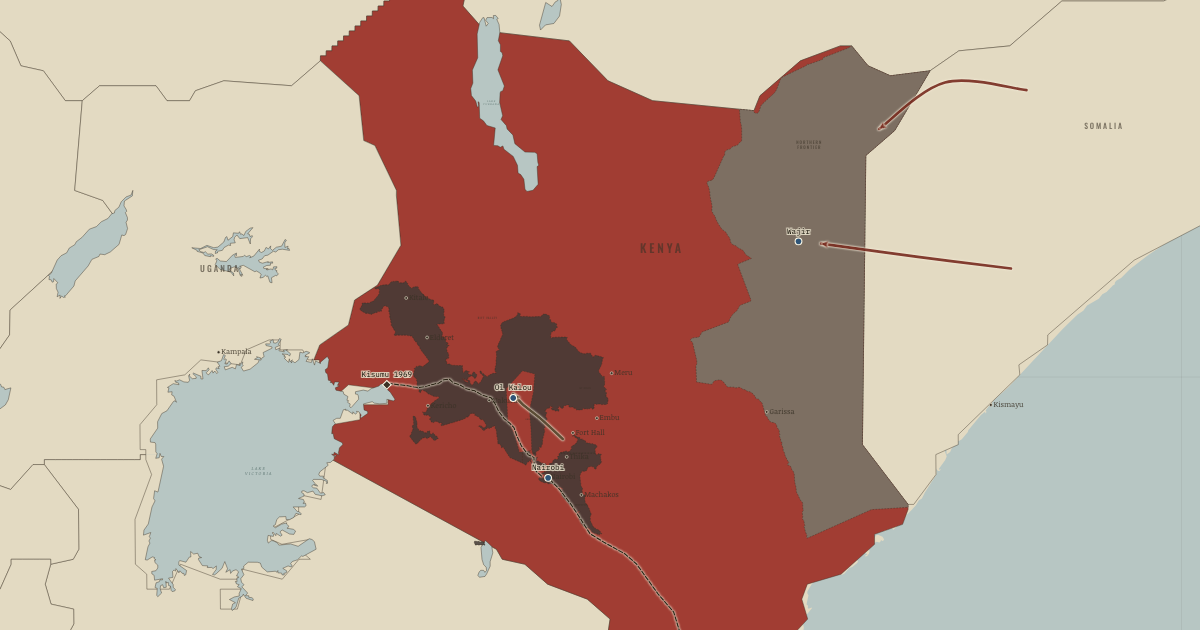
The people of Kenya’s north-east had reason to question the border the new government was determined to defend. A British commission found in 1962 that most Somali-speaking people in the Northern Frontier District wanted to join the new Somali Republic. Britain nevertheless placed their districts in a Kenyan region. Independence had changed who governed the territory, while leaving the colonial boundary in place.
The short answer
- Borders drawn by the colony. Britain’s boundary placed a Somali-speaking majority in the north-east within Kenya. The 1962 commission found that many wanted to join Somalia, but its findings were set aside so the new Kenyan state would begin intact. People whose preference had been established were placed in a country they had rejected. London’s decision, confirmed in Nairobi, was followed within weeks of independence by war.
- Land settled by purchase. The independence bargain protected property and made purchase the means of transferring land. British loans financed much of the scheme, but individual buyers still needed savings or credit. People with money or office could acquire the best farms; poorer families obtained small plots on credit or nothing. Former detainees and forest fighters who had lost land during the Emergency often had least to bring to the market. A settlement that helped keep the transition peaceful also built inequality into it.
- A state built for control. The independent government inherited provincial administrators, detention powers, a strong police force and a habit of governing by decree. These had served a colonial state concerned with keeping order over a reluctant population, and the Emergency sharpened them. KANU dismantled the regions while retaining the other instruments. The machinery once used against Mau Mau was available against the KPU.
- Rival visions inside the ruling party. KANU’s leaders agreed on independence without agreeing on what should follow. Odinga and Bildad Kaggia wanted free land for the poor and closer ties with socialist states. Mboya and Kenyatta favored private property, foreign investment and Western aid. Money and support from abroad sharpened the disagreement during the Cold War. Odinga’s departure in 1966 turned it into a contest between parties, which the state chose to win by force.
THE TURNING POINT
Government Road, Nairobi, 5 July 1969. Tom Mboya’s assassination removed a leading possible successor to Kenyatta and intensified the ethnic divisions around political power. A Luo trade unionist, Mboya had built KANU’s organization and its links with the United States; he was its strongest non-Kikuyu candidate for the succession. He was shot outside a Nairobi chemist’s shop on 5 July 1969. A Kikuyu gunman was hanged, though many Kenyans believed others had ordered the killing. Luo anger exploded at Kisumu in October. Gunfire, the KPU ban and Odinga’s detention followed, leaving Kenya a one-party state in practice. The pattern of ethnic succession politics established in 1969 has shaped every Kenyan election since.
What it changed
A peaceful succession, a narrower state. The constitution provided for succession when Kenyatta died in August 1978, and it worked: Vice-President Moi, a former KADU leader, took office without violence, a rare event in Africa at the time. He first promised continuity, then tightened control and made Kenya a one-party state in law in 1982. The epilogue considers how far this outcome followed from the manner of independence.
Ethnic arithmetic in politics. After 1969, political bargains increasingly joined ethnic blocs: leaders delivered their communities’ votes in exchange for jobs, roads and land. The colonial habit of governing by tribe had acquired a new role in the independent state. Presidential succession became a test of whether communities could share power, and the crises of 1992 and 2007–08 grew from this logic.
The landless remember. For people who remained landless, and for neglected Mau Mau veterans, the Emergency was part of a history that the official account of peaceful handover left out. Ngũgĩ wa Thiong’o and other novelists made the betrayed fighter a central figure in Kenyan literature. Veterans’ groups pressed for recognition and compensation; their campaign succeeded only in the twenty-first century, as the epilogue shows.
The full answer, argued
The settlement explains much of the new state’s predicament. Negotiated independence preserved colonial borders, a market in land and a centralized state. The north-east fought a secession war, many remained landless, and the machinery of the Emergency was available against political opponents. But Kenyan leaders also made choices: they abolished the regions, harassed the KPU, retained detention without trial and allowed elite families to accumulate great estates. Somalia’s claims and Cold War funding for rival factions mattered too. The settlement narrowed the options without deciding how every inherited power would be used. The epilogue compares Haiti, where outright victory in war left a different but equally heavy inheritance.
An interesting fact
A colonial detention power reached into Kenya’s literary life in December 1977, when the novelist Ngũgĩ wa Thiong’o was held without trial at Kamiti prison. Months earlier, villagers at Kamiriithu had staged Ngaahika Ndeenda, a Gikuyu (Kikuyu) language play he wrote with Ngũgĩ wa Mĩriĩ, (“I Will Marry When I Want”), which mocked the new elite. In his cell he wrote Caitaani Mũtharaba-inĩ (“Devil on the Cross”) on prison toilet paper. Released in December 1978 after Kenyatta’s death, he went on writing fiction in Gikuyu, arguing that decolonising the mind had to begin with language. A law made to hold Mau Mau suspects had been used to silence the movement’s greatest novelist.
This is the study layer of Kenya after independence, chapter 11 of Two Roads to Independence: Haiti 1789–1838 and Kenya 1895–1978; the full index of the atlas is here.
Related questions
THE FREE PRINTABLE STUDY GUIDE
Get the printable study guide for Two Roads to Independence free. I’ll send you a few short letters, then one when a new atlas opens. That’s all. — Paul
NO TRACKING · YOUR ADDRESS IS USED FOR THE DISPATCH AND NOTHING ELSE · UNSUBSCRIBE ANYTIME