Refugee crises · 1979
Did the 1979 Geneva meeting solve the boat-people crisis?
The seminar question: “How far did the Geneva meeting of July 1979 solve the boat-people crisis?”
At the UN’s call, 65 governments met in Geneva on 20–21 July 1979 and raised resettlement pledges from about 125,000 to 260,000 places. Southeast Asian states agreed to let boats land, Vietnam promised to curb illegal departures, and the Orderly Departure Program flew about 620,000 approved emigrants out of Vietnam by 1997.
Chapter 10 is included with every paid plan. WW2 is free in full, and chapter 1 of every atlas is free. A free account opens 3 more chapters a day. Starter, at $9 a month, opens all 21 with no daily limit — see the plans.
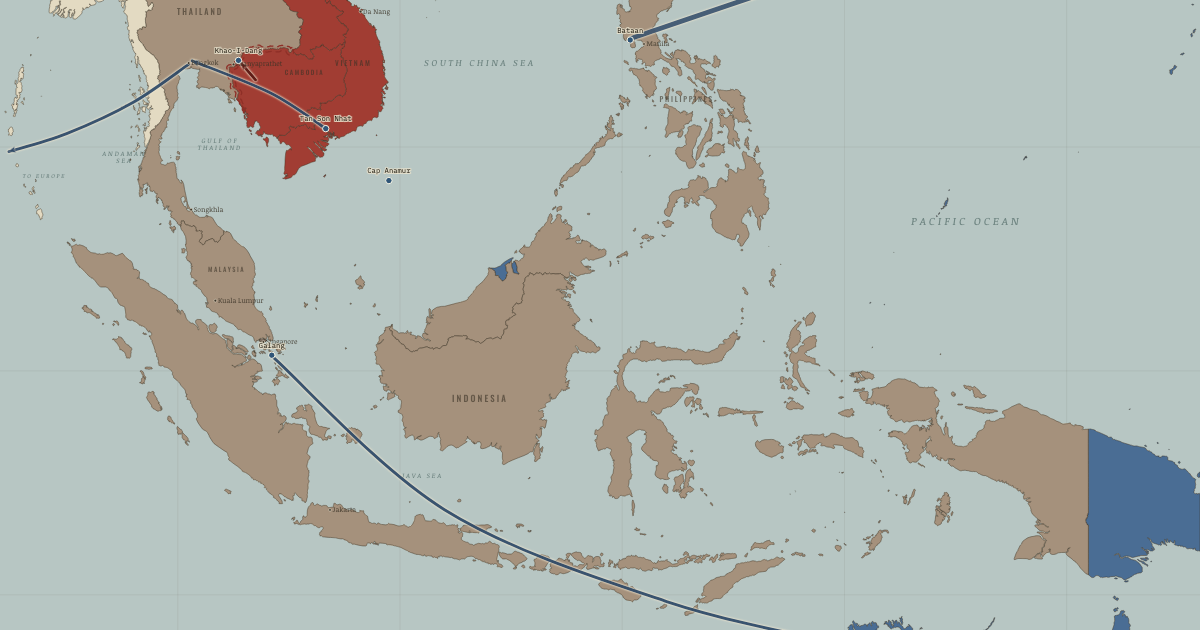
At Geneva the immediate problem was how to let people land without leaving their first hosts responsible for them indefinitely. Resettlement countries promised places, and monthly departures to permanent homes rose from about 9,000 before the meeting to about 25,000 afterward. Regional governments could reopen their shores; Western governments no longer faced the spectacle of boats being towed back to sea. Vietnam, for its part, gained relief from condemnation after promising to “make every effort to halt illegal departures”. Arrivals fell sharply as Vietnamese police stopped boats leaving.
The short answer
- The threat at the shoreline. In June 1979 ASEAN declared that no new arrivals would be accepted, and boats were pushed back. The prospect was plain: people whom Western governments had promised to help could die at sea. First-asylum states used their power to refuse as leverage. Within weeks the UN called the Geneva meeting, with mass death at sea the alternative to action.
- Debts of a lost war. Many refugees were former allies or employees of the United States, France or Australia, or their relatives. American leaders spoke of a moral obligation; the Vietnamese community formed after 1975 pressed for relatives to be admitted. Cold War interest reinforced that sense of duty, since flight from a communist state confirmed Western judgments of it.
- Public pressure in the West. Crowded boats appeared on television, and reports described piracy at sea. Public sympathy gave Western governments room to increase quotas, as it had for Hungarians in 1956. French intellectuals from left and right joined “A Boat for Vietnam”; a West German citizens’ committee chartered the Cap Anamur to rescue people.
- Hanoi’s interest in a deal. Vietnam’s invasion of Cambodia and war with China had left it isolated, while its economy depended on aid. Further condemnation threatened the support it retained. An agreement eased that pressure; orderly departure also allowed Hanoi to control who left and retain remittances from relatives abroad. Curbing departures cost Hanoi little and brought it into the international arrangement.
THE TURNING POINT
Geneva, 20–21 July 1979, and the camp at Galang. Galang shows what the Geneva agreement required on the ground. Before the meeting, refugees landing in Indonesia waited in makeshift camps without guaranteed onward movement. Afterward Indonesia offered an island south of Singapore as a processing center, where resettlement officers registered and interviewed people and prepared them for their new countries. The promise of Western places made temporary regional asylum possible, and shores reopened within weeks. The same arrangement made asylum dependent on continued resettlement, a condition tested when Western generosity ran out.
What it changed
Leaving by aeroplane. Orderly departure gave some families a route through regulated emigration instead of a sea crossing. Numbers grew from a trickle in 1980 to about 86,000 departures at the 1991 peak. Relatives of earlier refugees, former re-education prisoners and Amerasian children traveled under the program, often after years of paperwork, interviews and bribes. The 1989 plan repeated the lesson that some departures could be organized; chapter 11 follows it.
A refugee law for the United States. The Refugee Act of 1980 remains the basis of American refugee admissions. Its Convention definition linked the United States to the international regime it had refused to sign in 1951. Chapter 12 compares the legal legacies: Europe’s crisis produced the Convention, while Indochina’s brought its largest resettlement country under it.
Processing centres become a system. Schools, clinics and language courses turned Galang, Bataan and Phanat Nikhom into lasting institutions. For people accepted elsewhere they were transit centers; for those whose cases were refused, the wait could last years. A place built for passage could become a place of indefinite detention. Chapter 11 follows the screening intended to address the growing problem.
The border camps endure. Hundreds of thousands of Cambodians remained in Thai border camps, partly governed by resistance factions. From 1982 the United Nations Border Relief Operation supplied them. Their return in 1992–93 followed a decade of waiting; their fate depended on a Cambodian peace settlement that took twelve years to arrive. Chapter 11 follows that wait.
The full answer, argued
Geneva resolved the immediate danger at the closed shores. Resettlement rose to about 25,000 a month, arrivals fell from over 50,000 to under 10,000, and orderly departure began to offer a safer route. Yet much of the fall resulted from Vietnamese police stopping boats: fewer people faced death at sea, while others lost the freedom to flee. The agreement did nothing for Cambodians at the Thai border and depended on resettlement countries continuing to accept arrivals. That promise weakened during the 1980s as later arrivals were increasingly seen as economic migrants. Geneva managed an emergency and bought a decade of order, but made asylum conditional rather than settling the problem. Hungary in 1956 suggests why sharing responsibility can work when the burden seems finite and falter when it appears endless.
An interesting fact
Jean-Paul Sartre and Raymond Aron had been friends at the École normale supérieure in the 1920s, then bitter political opponents for three decades. The boat people brought them together again. On 20 June 1979 they appeared at a Paris press conference for “A Boat for Vietnam”, the campaign that chartered the hospital ship Île de Lumière; photographers captured their handshake. Six days later they went together to the Élysée Palace to ask President Valéry Giscard d’Estaing to admit more refugees. A dispute over the ship within Médecins Sans Frontières led Bernard Kouchner to leave and found Médecins du Monde in 1980.
This is the study layer of 1979 Geneva conference on refugees, chapter 10 of Uprooted: Refugees in Europe 1945–1960 and Indochina 1975–1990; the full index of the atlas is here.
Related questions
THE FREE PRINTABLE STUDY GUIDE
Get the printable study guide for Uprooted free. I’ll send you a few short letters, then one when a new atlas opens. That’s all. — Paul
NO TRACKING · YOUR ADDRESS IS USED FOR THE DISPATCH AND NOTHING ELSE · UNSUBSCRIBE ANYTIME