Norse and Aztecs · 1515
How far did chinampas make Tenochtitlan possible?
The seminar question: “How far did the chinampas, as opposed to tribute and trade, make Tenochtitlan possible?”
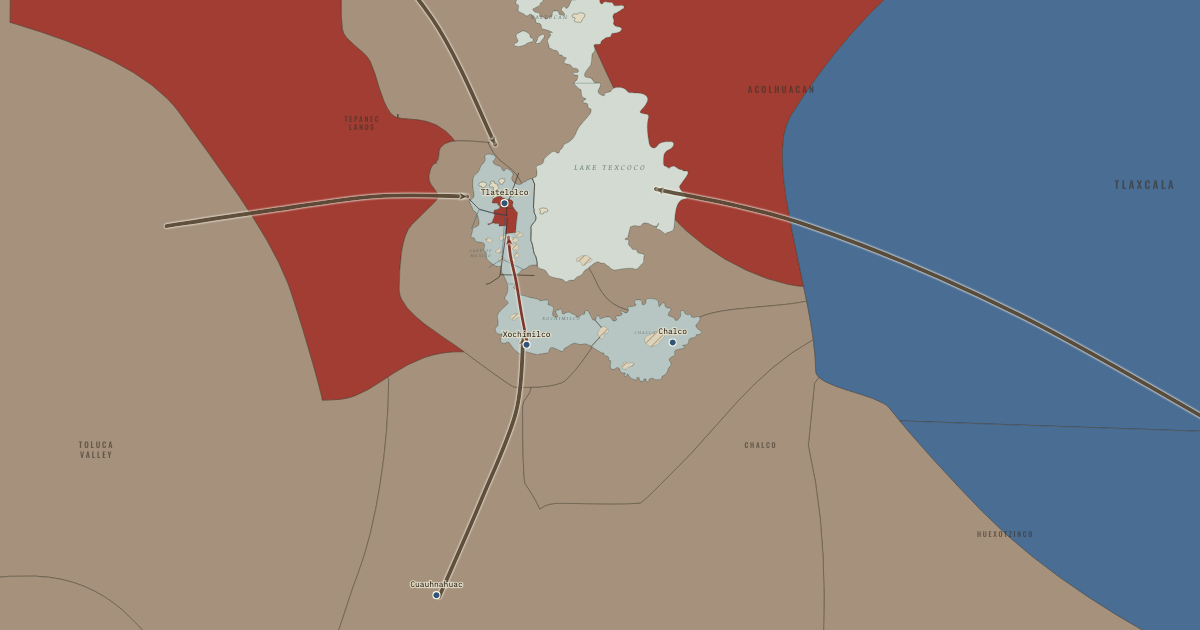
Chinampas were raised fields built in the shallow fresh lakes of Xochimilco and Chalco from mud and plants anchored by willows, where water softened frost. With a market and imperial tribute, they helped feed Tenochtitlan’s perhaps 200,000 people after the Triple Alliance took Xochimilco around 1430 and Chalco by about 1465.
Chapter 9 is included with every paid plan. WW2 is free in full, and chapter 1 of every atlas is free. A free account opens 3 more chapters a day. Starter, at $9 a month, opens all 21 with no daily limit — see the plans.
Free printable Norse and Aztecs study guide, sent by email ↓
Farmers had refined the chinampa long before the Mexica gained control of the southern lakes. They dug canals through shallow water and piled mud and plants into long rectangular beds. Stakes held the beds in place, as did ahuejote willows, whose roots bound their edges. Seedlings started in nurseries of mud cut into small blocks; once transplanted, they left room for further crops. This careful use of space and water paid off. Studies summarized by José Luis de Rojas and Juan José Batalla put maize yields at about 3,000 kilograms per hectare, compared with 1,000–1,400 on ordinary fields. The surrounding water also moderated temperatures, giving crops some protection from the frosts that threatened rain-fed maize.
The short answer
- Frost and unreliable rain threatened ordinary fields. The basin’s altitude exposed maize to two dangers. Above 2,200 metres, a September frost could arrive early, while summer rains could fail, as they did in 1452–54. Chinampa beds had moisture rising from below, and the water around them moderated the cold. Their location in the shallow lakes thus answered both problems, much as irrigation helps farmers through a dry season, although it could not prevent every crop failure.
- The dike freshened water for new fields. Fresh water was indispensable: salt kills crops. Chinampas therefore flourished in the spring-fed southern lakes. Around 1449 Nezahualcoyotl’s dike helped separate the western lagoon from salty Lake Texcoco, making more water around Tenochtitlan suitable for cultivation. By 1469 the map shows fields south of the city. A work built for flood control also helped create conditions for the later fifteenth-century expansion of farming.
- Conquest gave the state control of the best water. The freshwater farming zones belonged to communities the alliance first had to defeat. It took Xochimilco and neighboring lake towns around 1430 and the Chalco confederation by about 1465, after decades of war. The victories gave the capital access to both fields and the labor of their communities. Arco and Abrams estimate 25 million person-days over forty years for the southern fields; local communities could have supplied that work, perhaps under state direction. How far the state directed it remains debated.
- A growing city needed food on a scale no island could supply. A few thousand people lived in Tenochtitlan in the 1300s. By 1519 the number may have reached 150,000–200,000 or more on an island of about 13.5 square kilometres. Growing food intensively in the lake helped, but the city still needed supplies from elsewhere. Canoes carried nearby produce, markets gathered goods from many communities, and tribute reached beyond the basin. The search for supplies accompanied expansion toward the warm, wet Gulf coast.
THE TURNING POINT
The conquest of Xochimilco, c. 1430. Xochimilco’s conquest soon after 1428 joined an old agricultural skill to a new center of power. Local communities had built chinampas for generations; the alliance now controlled some of the basin’s most productive farmland and could draw on its labor and tribute. Historians think state organization may also have helped enlarge the fields. For a capital with a growing need for food, that control mattered.
What it changed
One of the world’s largest cities. The scale of the city astonished Spaniards who arrived in November 1519. Tenochtitlan and Tlatelolco together probably housed 150,000–200,000 people or more, exceeding any city in Spain. Food made such a concentration possible. Chapter 10 considers the other demands of island life: organizing water, streets, canals and waste for its inhabitants.
A food supply tied to empire. Food from distant communities helped sustain the capital, but those connections could also be broken. Provinces might rebel against tribute, and enemies could cut routes. In 1521 former subjects joined the Spaniards and blockaded the lake, turning the city’s dependence into a vulnerability during the siege described in Chapter 11.
A technique that outlived the empire. Chinampa farming survived the conquest of the empire. Fields at Xochimilco still supply vegetables and flowers in parts of southern Mexico City and form part of a UNESCO World Heritage site. Chapter 12 follows this longer history: the technique continued after the state that expanded it had fallen.
The full answer, argued
The chinampas gave the city a substantial supply close enough for fresh produce to travel by canoe. Their moisture and frost protection made harvests more reliable, and estimated maize yields were perhaps three times those of rain-fed fields. The southern zone expanded after Xochimilco and Chalco were conquered. Parsons estimated that chinampas could feed perhaps 100,000 people or more, but many estimates put the city’s population at 150,000–200,000 or higher. The difference had to be made up through exchange and tribute, including grain, beans and cotton from distant provinces. We cannot calculate exact shares while the cultivated area, population and tribute volumes remain uncertain. The city depended on several connected sources, and disruption to those connections threatened its food supply.
An interesting fact
Cacao beans were small change in basin markets, and they attracted counterfeiters. The sixteenth-century Florentine Codex, compiled under the friar Bernardino de Sahagún, describes sellers who emptied beans and filled the shells with earth or other material so they would pass as good cacao. The deception worked on the same principle as a counterfeit coin: the appearance of something valuable concealed a substitute.
This is the study layer of Aztec chinampas, chapter 9 of Climate and Innovation: The Norse and the Aztecs, c. 790–1521; the full index of the atlas is here.
Related questions
THE FREE PRINTABLE STUDY GUIDE
Get the printable study guide for Climate and Innovation free. I’ll send you a few short letters, then one when a new atlas opens. That’s all. — Paul
NO TRACKING · YOUR ADDRESS IS USED FOR THE DISPATCH AND NOTHING ELSE · UNSUBSCRIBE ANYTIME