Feminism and the Tunisian Revolution · 2015
Did terrorism or the response threaten Tunisia more?
The seminar question: “Did the terrorist attacks of 2012–2015 threaten Tunisia’s democracy more than the government’s response to them?”
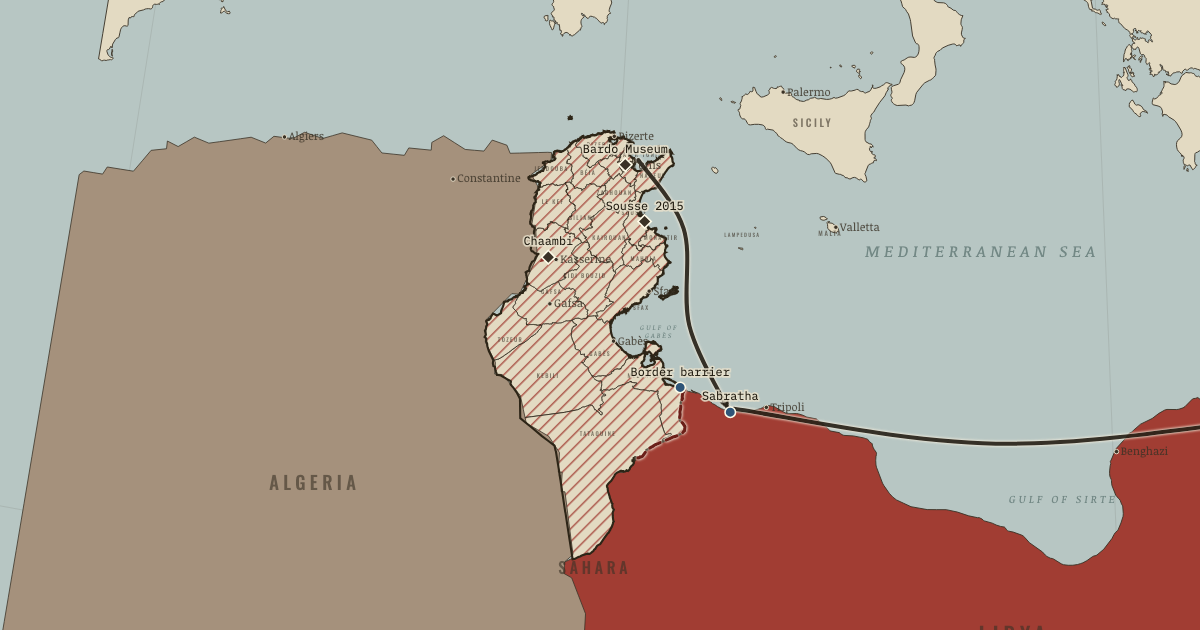
After 2011 the jihadist group Ansar al-Sharia recruited in poor suburbs and interior towns; its supporters attacked the US embassy in September 2012 and members were linked to the 2013 murders of two left-wing politicians. Libya’s collapse supplied weapons and camps, and attacks in 2015 brought back emergency rule.
Chapter 11 is included with every paid plan. WW2 is free in full, and chapter 1 of every atlas is free. A free account opens 3 more chapters a day. Starter, at $9 a month, opens all 21 with no daily limit — see the plans.
Free printable Feminism and the Tunisian Revolution study guide, sent by email ↓
The fall of Ben Ali’s police state gave Tunisians freedoms that had long been denied. It also changed the conditions in which religious movements could organize. These movements did not all seek the same thing. Ennahda, the Islamist party that led the 2011 government, sought to shape law through elections; Salafists called for a return to the practices of the earliest Muslims; jihadists, a small minority, sought to impose their version of Islamic rule through violence.
The short answer
- Freedom for preachers and recruiters. Ennahda’s members had themselves suffered decades of repression, and the new government hesitated to repress religious activists. With mosque surveillance ended and political prisoners, including jihadist veterans, released, Salafists could preach and organize among young men with few prospects. Some preachers banned under Ben Ali returned to their pulpits; Salafist groups seized other mosques by force.
- A security state in transition. Tunisia’s security institutions had been built for a different political order. The police, a backbone of Ben Ali’s rule, were distrusted and partly purged; the small army had little counter-insurgency experience. Intelligence networks that watched dissidents were ill suited to tracking armed groups. Officers who feared prosecution for conduct under Ben Ali were often reluctant to take risks. Effective democratic policing had yet to fill the gap left by the removal of repressive practices.
- Libya’s collapse next door. A recruit could reach camps near Sabratha in hours and return almost as easily. That possibility grew from Libya’s collapse after Gaddafi fell in 2011 and its slide into civil war by 2014. Ungoverned space lay within a day’s drive of Tunisian towns, weapons were plentiful, and the Islamic State held territory around Sirte. Smuggling routes, long tolerated because border towns depended on them, carried fighters as well as fuel.
- Grievances the revolution had not met. The revolution had raised economic hopes that remained unmet. Unemployment in 2015 was higher than in 2010, especially among young graduates and in the interior. Recruiters could offer unemployed young men pay, belonging and purpose. Many came from towns and suburbs that had protested in 2010–11: grievances shared by protesters could also help draw a minority toward violence.
THE TURNING POINT
Port El Kantaoui, 26 June 2015. Three months after Bardo, the attack near Sousse persuaded foreign governments to advise against travel and tour operators to cancel programs. Tourism, which employed hundreds of thousands, collapsed for the next two years. The government declared an emergency and passed a counter-terrorism law, bringing back powers lifted only sixteen months earlier. The transition now had to reconcile security with liberty, a choice it never fully resolved.
What it changed
Emergency rule returns. The emergency declared on 4 July 2015 was lifted on 2 October, reimposed on 24 November and renewed continuously for years. Powers over movement, strikes and gatherings were available against political opponents as well as armed groups. Adopted to protect democracy, they later became tools for undermining it.
An economy without visitors. When visitors stayed away, coastal resorts emptied; some towns lost most visitors for two years. Tourism receipts fell about 35 per cent in 2015, growth nearly stopped and unemployment remained around 15 per cent. The interior, already short of the revolution’s economic benefits, received even fewer. Economic disappointment later became the most common reason Tunisians gave for losing faith in democratic politics.
A prize for compromise. On 9 October 2015, between the two emergency declarations, the Nobel Peace Prize recognized the National Dialogue Quartet’s compromise. The award brought attention and aid while Tunisia was under attack. It also reinforced the country’s image as the Arab Spring’s one success story, an image that helped and burdened subsequent governments.
The full answer, argued
The attacks killed soldiers, police, politicians and tourists, sought to provoke conflict between secular and religious Tunisians, and damaged the economy supporting the transition. Tourism receipts fell about a third in 2015. The government had reason to defend the public, and in the short term its response helped democracy survive: elections continued and the Nobel Prize recognized the 2013 compromise. But the emergency and the 2015 counter-terrorism law also restored powers over gatherings, movement and detention resembling those of the old regime. Human-rights groups documented abuses. Renewed for years, emergency rule normalized exceptional powers that a later president would use to dismantle democratic institutions after 2021. Terrorism weakened the economy and public trust; the response eroded habits of liberty, and that danger proved more lasting. How a democracy defends itself can matter as much as the attack it faces.
An interesting fact
The National Dialogue Quartet brought leaders of very different institutions together: Houcine Abassi of the UGTT trade-union federation, Wided Bouchamaoui of the employers’ union UTICA, Abdessattar Ben Moussa of the Tunisian Human Rights League and Mohamed Fadhel Mahfoudh of the Order of Lawyers. Bouchamaoui had become the first woman to lead Tunisia’s employers’ federation when elected in 2011. Thus a business leader sat alongside the trade-union leader in the group awarded the 2015 Nobel Peace Prize, the first Nobel Prize ever awarded to Tunisians.
This is the study layer of Terrorism in Tunisia, chapter 11 of Protest and Change: Second-Wave Feminism and Tunisia, 1945–2015; the full index of the atlas is here.
Related questions
THE FREE PRINTABLE STUDY GUIDE
Get the printable study guide for Protest and Change free. I’ll send you a few short letters, then one when a new atlas opens. That’s all. — Paul
NO TRACKING · YOUR ADDRESS IS USED FOR THE DISPATCH AND NOTHING ELSE · UNSUBSCRIBE ANYTIME