Feminism and the Tunisian Revolution · 2015
How did feminism and Tunisia’s revolution create change?
The seminar question: “Compare and contrast how second-wave feminism and the Tunisian revolution created change.”
Second-wave feminism and the Tunisian revolution both grew from a gap between what a society promised and what it delivered, and both were organised through existing networks, from state commissions to trade unions. Feminism worked for four decades through law and culture, while Tunisia’s revolution changed the state far faster.
Chapter 12 is included with every paid plan. WW2 is free in full, and chapter 1 of every atlas is free. A free account opens 3 more chapters a day. Starter, at $9 a month, opens all 21 with no daily limit — see the plans.
Free printable Feminism and the Tunisian Revolution study guide, sent by email ↓
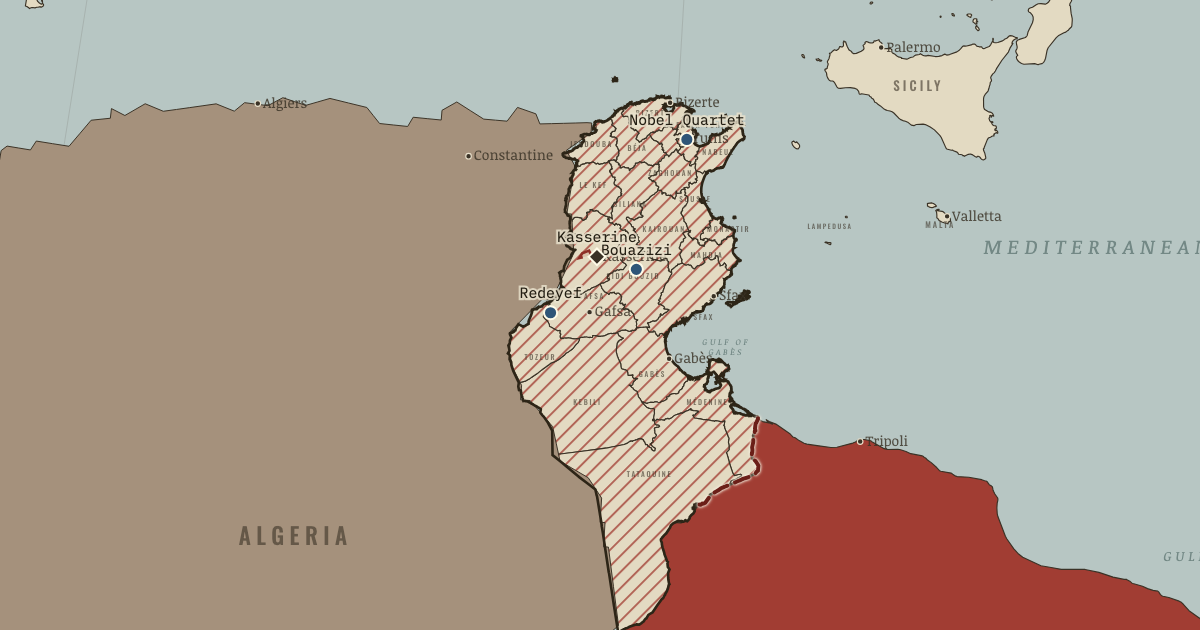
The two movements began with expectations that ordinary experience frustrated. Educated women in the 1950s and 1960s had been raised to expect careers and equal citizenship. Yet pay scales, jury rules and job advertisements treated them as dependants. In Tunisia in the 2000s, education had been presented as a route to work, but educated young people found that jobs went to the well connected. In each society, people could see a distance between what they had been promised and the opportunities available to them.
The short answer
- A promise that reality broke. Education and the vote had expanded women’s expectations; schooling and economic growth had raised Tunisians’ hopes. In both cases people could compare those promises with their actual opportunities, and the gap fueled anger. Those whose expectations had risen fastest were the most likely protesters: being led to expect more can make a shortfall a cause of revolt.
- A moment of naming. Neither The Feminine Mystique nor Bouazizi’s self-immolation caused a movement alone. Each gave scattered experiences a public story and a recognizable name and face. People could see that others shared their grievance, helping them coordinate. Both catalysts were later mythologized, which makes close historical examination necessary.
- Networks before the movement. When opportunities arose, protesters did not have to build every network from nothing. Feminists drew on state commissions, unions, civil-rights groups and universities. Tunisian union branches, lawyers, teachers and online activists, many veterans of the Gafsa campaign, could also be redirected toward protest. Without those existing connections, the catalysts would have produced only a day’s headlines.
- Openings from above. Divisions and hesitation among insiders gave outsiders room to act. Kennedy’s Commission and a civil-rights bill amended by an opponent provided American openings; Tunisia’s army would not defend Ben Ali, and the union leadership changed sides. Protest most often succeeds when such openings appear. Without them it is usually contained or crushed, as the Gafsa revolt was in 2008.
THE TURNING POINT
The Nobel Peace Prize, 9 October 2015. The Nobel Peace Prize honored the National Dialogue Quartet on 9 October 2015 for bringing adversaries to the table. Its achievement invites comparison with feminism’s work through NOW, courts and CEDAW: in both stories mobilization had to become institutions if gains were to last. Yet Tunisia was under emergency rule when the prize was awarded, and its interior still awaited the revolution’s economic promises. Compromise-built institutions depended on delivering results to those who began the protest.
What it changed
Change through law. Legal change can carry a victory beyond the moment of protest. Equal-pay and anti-discrimination statutes, court rulings and CEDAW recorded feminist gains; Tunisia’s 2014 constitution included equality and parity articles. Yet neither case makes law permanent by itself: provisions can be ignored, reinterpreted or overturned.
Counter-movements as part of the story. Those who resisted change organized too. STOP ERA and the anti-abortion movement opposed feminist gains, while Tunisia’s old elite and jihadist groups reacted against its transition. The anti-ERA campaign helped elect Ronald Reagan; the Tunisian elite returned through elections in 2014. Their actions help explain which gains endured and which were lost.
The excluded keep organising. The claims left outside mainstream victories continued to organize people. Black women founded reproductive-justice groups in the 1990s, and poor women and women of color continued organizing in the United States. After 2011 unemployed graduates held sit-ins in Kasserine and Gafsa. Control over their own bodies and regional development remained unfinished demands.
Unfinished business. A movement’s history continues after its apparent victory. The ERA’s ratification remains legally disputed and the United States never joined CEDAW. From July 2021 Tunisia’s democracy was dismantled as President Kaïs Saïed suspended parliament and later replaced the constitution. Over decades, the cases keep raising questions of equality, dignity and who belongs.
The full answer, argued
Both movements made public claims out of frustrated expectations. Naming a shared grievance helped people recognize one another, while existing networks of activists, unions and professionals gave them a means to act. Both sought durable change in law, faced counter-movements and left some of the people whose grievances gave them force with unmet demands. Their targets and methods differed. Second-wave feminists sought changes to laws and cultural norms within political systems they accepted. Over four decades in stable democracies, they used legislatures, courts, media and the UN. Their gains accumulated in many places and were hard to reverse wholesale. Tunisian protesters challenged the system itself: a dictatorship fell in four weeks, and negotiation built a democracy in three years. Its rapid gains depended on new institutions and an economy that faltered. Both movements achieved real but partial change. In these cases, feminist gains accumulated slowly and proved harder to reverse wholesale, while Tunisia’s rapid institutional transformation proved fragile. How a movement creates change helps shape its durability.
An interesting fact
Independent Tunisian women’s associations had campaigned for years under police surveillance before 2011. Two years after the atlas ends, their movement won two changes that would have been unthinkable under Ben Ali. In July 2017 parliament passed a comprehensive law against violence against women, abolishing a provision that allowed a man who had sex with a minor to escape prosecution by marrying her. That September the government withdrew a 1973 administrative circular barring Tunisian Muslim women from marrying non-Muslim men.
This is the study layer of How protest movements create change, chapter 12 of Protest and Change: Second-Wave Feminism and Tunisia, 1945–2015; the full index of the atlas is here.
Related questions
THE FREE PRINTABLE STUDY GUIDE
Get the printable study guide for Protest and Change free. I’ll send you a few short letters, then one when a new atlas opens. That’s all. — Paul
NO TRACKING · YOUR ADDRESS IS USED FOR THE DISPATCH AND NOTHING ELSE · UNSUBSCRIBE ANYTIME