Haiti and Kenya independence · 1975
Haiti or Kenya: whose independence left a heavier burden?
The seminar question: “Compare and contrast how Haiti and Kenya won independence, and judge which path left the heavier burden.”
Haiti won independence in 1804 by defeating the French army in the only successful revolution of enslaved people, and made all its citizens Black by law. Kenya won it in 1963 through rebellion and negotiation, after Mau Mau lost on the battlefield, and defined its citizens by a territory and flag many communities had not chosen.
Chapter 12 is included with every paid plan. WW2 is free in full, and chapter 1 of every atlas is free. A free account opens 3 more chapters a day. Starter, at $9 a month, opens all 21 with no daily limit — see the plans.
Free printable Haiti and Kenya independence study guide, sent by email ↓
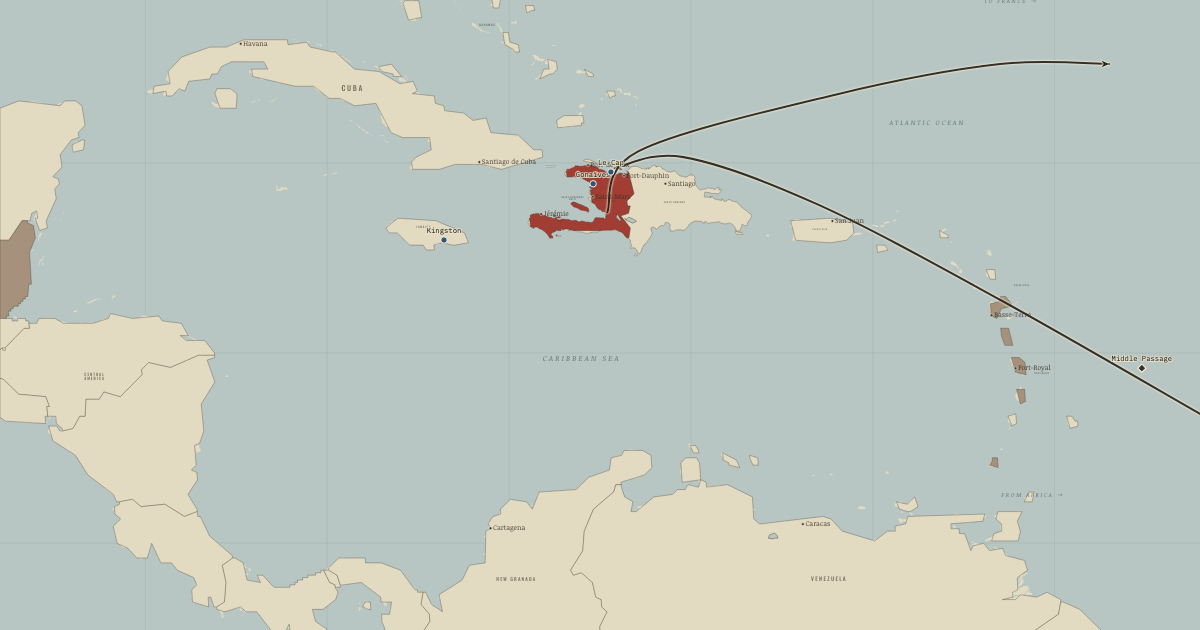
Haiti’s founders defined their nation against slavery and the color hierarchy that had justified it. The constitution of 1805 made all citizens Black; that of 1816 offered citizenship to any African or Indigenous American who arrived. Haiti could thus be imagined as a refuge from slavery. Its founding sites, from Gonaïves to the Citadelle, Christophe’s mountain fortress, became symbols of Black sovereignty across the Atlantic.
The short answer
- Different empires at different moments. The international settings made the same demand for freedom meet different responses. Haiti confronted revolutionary and Napoleonic France at the height of the Atlantic slave system, when no great power would accept a state of formerly enslaved people. Kenya faced a Britain weakened by the Second World War, embarrassed by its camps and surrounded by newly independent states. In 1802 the demand met reconquest; in 1960 it reached a negotiating table.
- Victory against negotiation. Haiti’s army destroyed French power, leaving its leaders few working colonial institutions and a state to build largely from the ground up. Kenya’s insurgents lost militarily, after which politicians negotiated independence. The colonial state, laws and administrators passed intact to the new government. Haiti gained sovereignty without recognition; Kenya gained recognition along with the machinery of the old regime.
- Who held the land at independence. French planters in Haiti were driven out, killed in the killings of 1804 recorded in chapter 5, or barred from owning land. The subsequent struggle placed cultivators and the state on opposing sides over how the land would be worked. Kenyan settlers could stay or sell at market prices. Buyers with money acquired land, while landless people had to buy their way in. These settlements shaped inequality for generations.
- Recognition and the price of entry. Recognition came at different prices. France demanded 150 million francs from Haiti, later reducing the indemnity to 90 million, and Haiti also had to repay the loans taken to meet it. Kenya entered the United Nations and Commonwealth at once and received loans and aid with conditions of their own. Between the two cases the international order had changed from a club of empires to a community of states claiming to include everyone.
THE TURNING POINT
Two founding days: Gonaïves 1804 and Nairobi 1963. At Gonaïves on 1 January 1804, the generals of an army of former slaves swore to renounce France forever. They named their country after its first inhabitants; no foreign dignitaries were present, and no state was ready to recognize Haiti. At Uhuru Gardens on 12 December 1963, the Union flag came down in the presence of the Duke of Edinburgh. Kenya was welcomed into the United Nations within days. One independence was seized against the world, the other handed over within it. The contrast helps explain why Haiti had to buy what Kenya was given, and why Kenya inherited what Haiti had destroyed.
What it changed
Haiti’s long nineteenth century. Through the age of empire Haiti remained an independent republic of smallholders: isolated, indebted and politically unstable, but free while slavery flourished in Cuba, Brazil and the United States. Its example reached abolitionists and Black thinkers across the Atlantic, while its debts shaped its poverty. Haitians and historians still weigh both legacies. The republic’s survival showed that a state of formerly enslaved people could endure.
Kenya’s land and its politics. The 1960s land settlement and Kikuyu migration into the Rift Valley left disputes that remained alive. So did fear of central domination, which had helped produce majimbo, the regional self-government of the 1963 constitution. Violence erupted around the elections of 1992 and 2007. The constitution of 2010 responded by devolving power to 47 counties, returning in a new form to the regional idea of 1963. Land remained a measure of what independence had delivered.
The reckoning with empire. The question of colonial reparations brings both cases into the present. Haitian governments have asked France to return the indemnity; Kenyan veterans won compensation from Britain in court. Both former powers have offered regret and limited funds. How an empire should account for what it took remains an open question in the twenty-first century.
The full answer, argued
Both struggles arose from colonial systems that took land for a privileged class and relied on coerced labor. Both involved violence and divisions within the colonized society. Their outcomes differed: Haiti’s army defeated Napoleonic France outright, while Kenya’s insurgents lost and politicians negotiated independence in London. Haiti was shunned and charged an indemnity; Kenya was recognized at once and received loans. The burdens that followed were different too. Haiti faced debt and diplomatic isolation, with coffee farmers bearing the financial cost for a century. Kenya inherited an authoritarian state and a land settlement that left many fighters landless. One strong judgment is that Haiti’s burden was heavier because it was imposed from outside for so long, while acknowledging how deeply Kenya’s inherited institutions shaped its politics. The manner of independence shaped the burdens each nation carried; its leaders decided how they were shared.
An interesting fact
Every 1 January, Haitians at home and abroad eat soup joumou. By tradition this squash soup was reserved for enslavers in colonial Saint-Domingue; formerly enslaved people first ate it to celebrate independence in 1804. In December 2021 UNESCO added it to the Representative List of the Intangible Cultural Heritage of Humanity, the first Haitian element listed. A dish once associated with the division between masters and slaves now marks the anniversary of its end.
This is the study layer of Independence in Haiti and Kenya, chapter 12 of Two Roads to Independence: Haiti 1789–1838 and Kenya 1895–1978; the full index of the atlas is here.
Related questions
THE FREE PRINTABLE STUDY GUIDE
Get the printable study guide for Two Roads to Independence free. I’ll send you a few short letters, then one when a new atlas opens. That’s all. — Paul
NO TRACKING · YOUR ADDRESS IS USED FOR THE DISPATCH AND NOTHING ELSE · UNSUBSCRIBE ANYTIME