15 ATLASES
History of Ukraine in maps
Ukraine as it appears in 15 interactive history atlases, from 264 BC to 2015: Scythia & Sarmatia, Kievan Rus, Ukraine, the Ukrainian SSR, Soviet Ukraine, Soviet Union. Each era below lists who ruled the land and when control changed, linked to the dated map that shows it.
WW2 is free in full, and chapter 1 of every atlas is free. A free account opens 3 more chapters a day. Starter, at $9 a month, opens all 21 with no daily limit — see the plans.
Free printable Stalin’s Soviet Union study guide, sent by email ↓
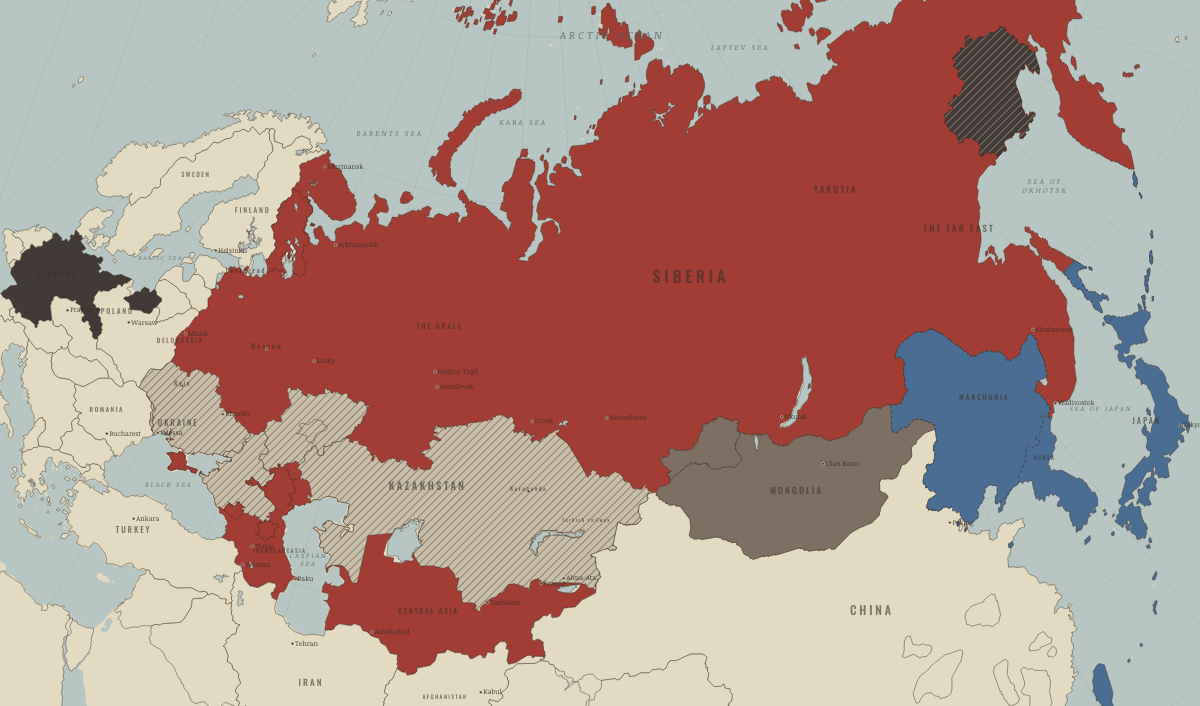
What was Ukraine before it was Ukraine? The sections below follow this land through every era covered by the Maps of History atlases: who ruled it, what it was called, and when control changed. Each line links to the dated map. Modern borders serve as an approximation, as each atlas says on the map itself.
Scythia & Sarmatia (mod. Ukraine) · Ancient Rome
Scythia and Sarmatia were steppe lands beyond Rome’s ordinary provincial system. Greek ports including Olbia and Chersonesus connected the grain trade to the Black Sea, and Rome supported and garrisoned points along the coast. Sarmatians, Goths and Huns moved through the wider corridor. Movements associated with the Huns in the 370s set pressures in motion that would reshape the empire (Ch. 10).
| 264 BC | Tribal peoples & confederations — the opening position |
ANCIENT ROME: EVERY CHAPTER AND MAP →
Ukraine · Norse and Aztecs
| Other peoples and states — the opening position |
NORSE AND AZTECS: EVERY CHAPTER AND MAP →
The Rus’ & Cuman lands (mod. Ukraine) · Crusades
The Orthodox principalities of the Rus’ and the Cuman nomads of the steppe lay outside the crusaders’ Mediterranean world, but they faced the same age of Mongol expansion. Two decades after Cumans fled west with news of an enemy no one could stop, the Mongols took Kyiv, the great city of the Rus’, in December 1240. Their conquests thus overran Orthodox Europe before destroying Baghdad’s caliphate in 1258. Crusading touched this region at its edges: popes preached against the pagan Cumans, and the Baltic crusades pressed on the Rus’ from the north-west. Here, however, the horsemen of the steppe shaped the thirteenth century.
CRUSADES: EVERY CHAPTER AND MAP →
Kievan Rus (mod. Ukraine) · Mongol Empire
Here the southern heart of Kievan Rus met the steppe later ruled by the Golden Horde. Kiev, the mother of Rus cities, refused to surrender and was stormed in December 1240. Six years later a papal envoy counted just two hundred houses standing. The Pontic steppe stayed under direct Horde rule for generations, and along the hatched belt on this map the region’s history split from Europe’s.
| Other settled powers (Jin China, Christendom, Delhi) — the opening position | |
| The Mongol Empire |
MONGOL EMPIRE: EVERY CHAPTER AND MAP →
Ukraine (Russian and Habsburg empires) · Industrial Revolution
| Industrialising — the opening position | |
| Industrialising | |
| Industrialising |
INDUSTRIAL REVOLUTION: EVERY CHAPTER AND MAP →
Ukraine · Age of Revolutions
| The conservative monarchies — the opening position |
AGE OF REVOLUTIONS: EVERY CHAPTER AND MAP →
Ukraine · Meiji Japan and post-Soviet Russia
Ukraine was the second most populous Soviet republic and the home of Chernobyl. Its parliament declared independence on 24 August 1991. On 1 December more than 90% of voters confirmed the decision, with a majority in every region; the result convinced Yeltsin that a Union without Ukraine was impossible. The new state inherited Crimea, transferred to Ukraine in 1954, and a large Soviet nuclear arsenal, which it gave up by 1996. It also faced a deep economic depression.
| The USSR, then Russia — the opening position | |
| Independent neighbours |
MEIJI JAPAN AND POST-SOVIET RUSSIA: EVERY CHAPTER AND MAP →
Ukraine · Russian Revolution
Ukraine’s grain and open plain made it a central battleground of the revolution. The Rada, Germans, Hetman, Directory, Whites, Poles, Makhno’s anarchists and Reds all fought over it; Kiev changed hands more than a dozen times. The human cost was terrible. In the era’s worst pogroms, perhaps 100,000 Jews were murdered. Unlike Finland or Poland, Ukraine was reconquered, becoming a founding Soviet republic in 1922.
| The Tsarist empire — the opening position | |
| Provisional Government, then the Whites | |
| Breakaway national states | |
| Soviet power |
RUSSIAN REVOLUTION: EVERY CHAPTER AND MAP →
Ukraine (Russian Empire) · WWI
As the empire collapsed, Ukraine declared independence and became an eastern prize of the war. Germany occupied it in 1918 as the granary of the “bread peace” (Ch. 11). Reds, Whites, Poles and Ukraine’s own republics contested it until 1921; between Brest-Litovsk and Soviet victory, Kyiv changed hands more than a dozen times.
| The Entente & Allies — the opening position | |
| The Entente & Allies | |
| Russia in revolution | |
| Under Central Powers occupation | |
| Russia in revolution | |
| Russia in revolution |
The Ukrainian SSR · Stalin’s Soviet Union
Ukraine was both the Union’s granary and its second industrial region. Under Stalin, few republics suffered more. Farms were collectivised despite fierce resistance, and the famine of 1932–33, the Holodomor, killed roughly 3.5 to 5 million people. Party members and intellectuals were purged as nationalists. Western lands annexed from Poland in 1939 became part of the republic; Germany occupied Ukraine in 1941–44, and an insurgency continued to fight Soviet rule in the west until the early 1950s.
| The Soviet Union — the opening position | |
| Famine regions (memorial) | |
| The Soviet Union | |
| Under German occupation | |
| The Soviet Union | |
| Famine regions (memorial) | |
| The Soviet Union |
STALIN’S SOVIET UNION: EVERY CHAPTER AND MAP →
Soviet Ukraine · Road to WW2
| Neutral & unaligned — the opening position | |
| Aggressor clients & partners | |
| Democracies & powers fighting them |
ROAD TO WW2: EVERY CHAPTER AND MAP →
Ukraine · WW2
Soviet Ukraine was a central killing ground of the war. German forces overran it in 1941, and armies fought across it twice. Babi Yar and the Holocaust by bullets were part of an occupation that left staggering losses. The experience of Ukraine between two totalitarian regimes remains important to understanding its history since.
| Soviet Union — the opening position |
Ukraine · Cold War
Ukraine, the second Soviet republic, contained a quarter of the union’s people and industry and served as its breadbasket. It was also the site of Chernobyl, where the lies surrounding the disaster helped kill the system (Ch. 11). On 1 December 1991, 90% voted for independence. Without Ukraine, the arithmetic of reviving the USSR no longer worked. The questions the map leaves open around Ukraine have run through every post-Cold-War European crisis.
| USSR & Warsaw Pact — the opening position | |
| Non-aligned & neutral | |
| Non-aligned & neutral |
COLD WAR: EVERY CHAPTER AND MAP →
Soviet Union (Ukraine) · Feminism and the Tunisian Revolution
| Right won in law — the opening position | |
| No reform yet / outside this story | |
| Right won in law |
FEMINISM AND THE TUNISIAN REVOLUTION: EVERY CHAPTER AND MAP →
Soviet Ukraine · Refugee crises
Soviet Ukraine absorbed the eastern half of prewar Poland, including Lwów, which became Lviv. Most Poles left for Poland in 1944–46, and about 482,000 Ukrainians arrived from Poland. A nationalist insurgency continued into the 1950s. In the West, Ukrainian DPs were among the most determined to refuse repatriation; many resettled in Canada, the United States and Australia.
| Soviet-occupied or communist — the opening position |
REFUGEE CRISES: EVERY CHAPTER AND MAP →
Related
THE FREE PRINTABLE STUDY GUIDE
Get a printable atlas study guide of your choice free. I’ll send you a few short letters, then one when a new atlas opens. That’s all. — Paul
NO TRACKING · YOUR ADDRESS IS USED FOR THE DISPATCH AND NOTHING ELSE · UNSUBSCRIBE ANYTIME