13 ATLASES
History of Greece in maps
Greece as it appears in 13 interactive history atlases, from 264 BC to 2015: Greece, Greece — Byzantine, then Frankish, Latin & Byzantine Greece. Each era below lists who ruled the land and when control changed, linked to the dated map that shows it.
WW2 is free — every chapter. No sign-up.
What was Greece before it was Greece? The sections below follow this land through every era covered by the Maps of History atlases: who ruled it, what it was called, and when control changed. Each line links to the dated map. Modern borders serve as an approximation, as each atlas says on the map itself.
Greece · Ancient Rome
At Cynoscephalae and Pydna, Roman legions defeated Macedonian armies. The destruction of Corinth in 146 BC showed what Roman “liberation” could mean. Conquest also brought Romans into closer contact with Greek language, philosophy, art and civic life. Greek became the language of the surviving eastern half of the empire, whose inhabitants called themselves Roman until 1453.
| 264 BC | Hellenistic kingdoms — the opening position |
| 146 BC | Roman territory |
ANCIENT ROME: EVERY CHAPTER AND MAP →
Greece — Byzantine, then Frankish · Crusades
Byzantium helped the First Crusade across its territory, ferrying and feeding its armies. The Franks then kept Antioch despite their oaths, and distrust hardened over the following century. In 1204 the Fourth Crusade sacked Constantinople itself and divided Greece into Frankish principalities. The Byzantine Empire was restored in 1261, but it never became whole again, and the Orthodox Church has never forgotten the attack on its core.
| Byzantium (and Latin Constantinople 1204–61) — the opening position | |
| Latin Christendom | |
| Byzantium (and Latin Constantinople 1204–61) |
CRUSADES: EVERY CHAPTER AND MAP →
Latin & Byzantine Greece · Mongol Empire
| Other settled powers (Jin China, Christendom, Delhi) — the opening position |
MONGOL EMPIRE: EVERY CHAPTER AND MAP →
Greece · Industrial Revolution
INDUSTRIAL REVOLUTION: EVERY CHAPTER AND MAP →
Greece · Age of Revolutions
The Greek rising against Ottoman rule in 1821 challenged the Restoration’s rule against revolt against a legitimate sovereign. European public opinion sustained the cause through Chios’s martyrs, Byron’s death and the cannon at Navarino. The powers helped establish an independent kingdom in 1830. It was the first new nation-state carved from an empire through a combination that would recur: local insurgency, great-power rivalry and publicity.
| Neutral / uncommitted — the opening position | |
| Republics & revolutionary states |
AGE OF REVOLUTIONS: EVERY CHAPTER AND MAP →
Greece · Meiji Japan and post-Soviet Russia
| Western powers and allies — the opening position |
MEIJI JAPAN AND POST-SOVIET RUSSIA: EVERY CHAPTER AND MAP →
Greece · WWI
During the National Schism, Greece had rival governments: the pro-Entente premier Venizelos opposed a pro-neutrality king, and Allied fleets appeared at Athens. Greece joined the Entente in June 1917 and fought well on the Salonika front. It then pursued promises in Anatolia, landing at Smyrna in 1919 (Ch. 14). The campaign ended in the disaster of 1922, and the population exchange ended three thousand years of Greek Asia Minor.
| The Entente & Allies — the opening position | |
| The Entente & Allies | |
| The Entente & Allies |
Greece · Stalin’s Soviet Union
| Nazi Germany & its allies — the opening position | |
| Nazi Germany & its allies | |
| Other states | |
| Rivals & the Western bloc |
STALIN’S SOVIET UNION: EVERY CHAPTER AND MAP →
Greece · Road to WW2
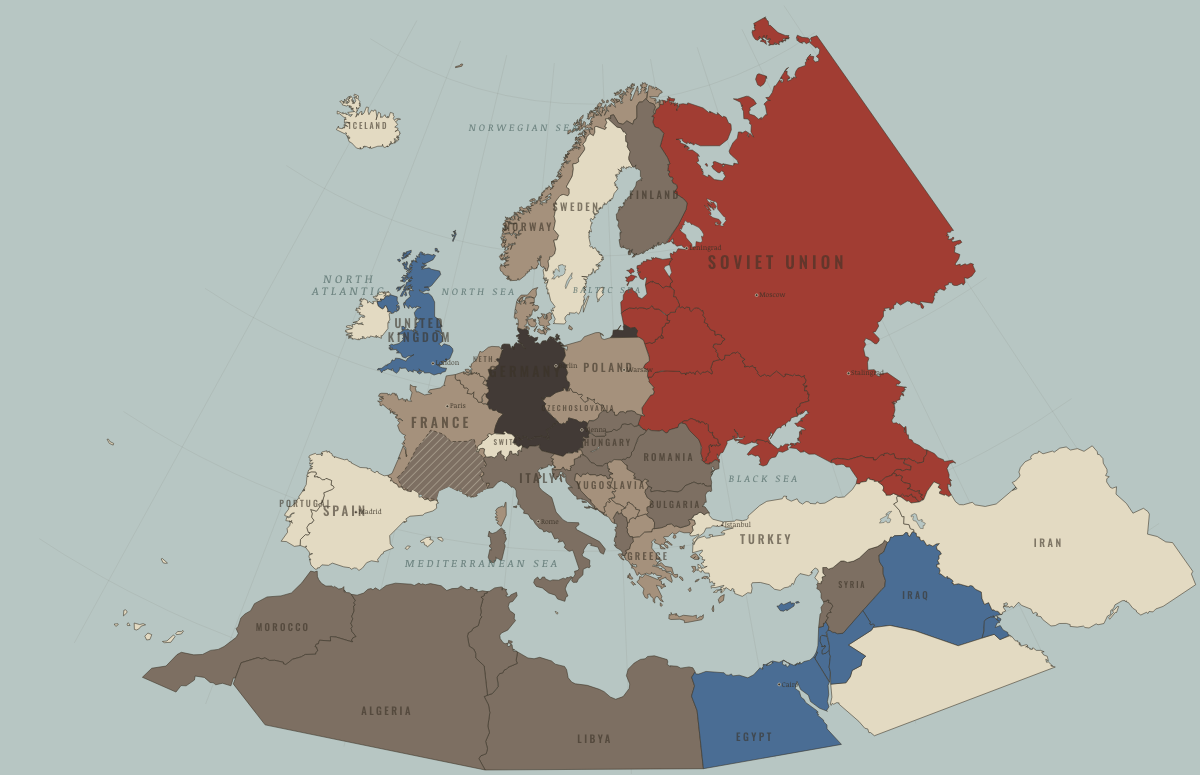
Mussolini expected Greece to be an easy victory. Instead, after the invasion from Albania in October 1940, Greek forces drove his troops back across the border and inflicted the Axis's first land defeat. Germany had to conquer Greece in April 1941. Some historians still count that Balkan detour against Barbarossa's timetable. Under occupation, Greece suffered one of the war's terrible famines in the winter of 1941–42.
| Neutral & unaligned — the opening position | |
| Occupied — held by force |
ROAD TO WW2: EVERY CHAPTER AND MAP →
Greece · WW2
Greece gave the Axis its first land defeat by throwing back Italy in 1940, before Germany defeated it (Ch. 5). Under occupation, famine killed tens of thousands during the winter, and fierce resistance met reprisals. The world war was followed by civil war in 1946–49, the Cold War’s first battlefield.
| Axis-occupied — the opening position | |
| Axis-occupied | |
| Western Allies |
Greece · Cold War
| US-aligned states — the opening position | |
| NATO & core Western allies |
COLD WAR: EVERY CHAPTER AND MAP →
Greece · Feminism and the Tunisian Revolution
| Refused: women excluded; ERA never ratified — the opening position | |
| Right won in law | |
| No reform yet / outside this story | |
| Right won in law |
FEMINISM AND THE TUNISIAN REVOLUTION: EVERY CHAPTER AND MAP →
Greece · Refugee crises
| Western bloc or democracy — the opening position |
REFUGEE CRISES: EVERY CHAPTER AND MAP →
Related
THE FREE PRINTABLE STUDY GUIDE
Get a printable atlas study guide of your choice free. I’ll send you a few short letters, then one when a new atlas opens. That’s all. — Paul
NO TRACKING · YOUR ADDRESS IS USED FOR THE DISPATCH AND NOTHING ELSE · UNSUBSCRIBE ANYTIME