ON THIS DAY ·
Battle of Sekigahara
21 Oct 1600 — Near this mountain pass, Tokugawa Ieyasu’s eastern army defeated the western coalition in a single day. The lords who had opposed him became the “outer” (tozama) lords, kept at the edges of the political order for the next 268 years.
WW2 is free in full, and chapter 1 of every atlas is free. A free account opens 3 more chapters a day. Starter, at $9 a month, opens all 21 with no daily limit — see the plans.
Free printable Meiji Japan and post-Soviet Russia study guide, sent by email ↓
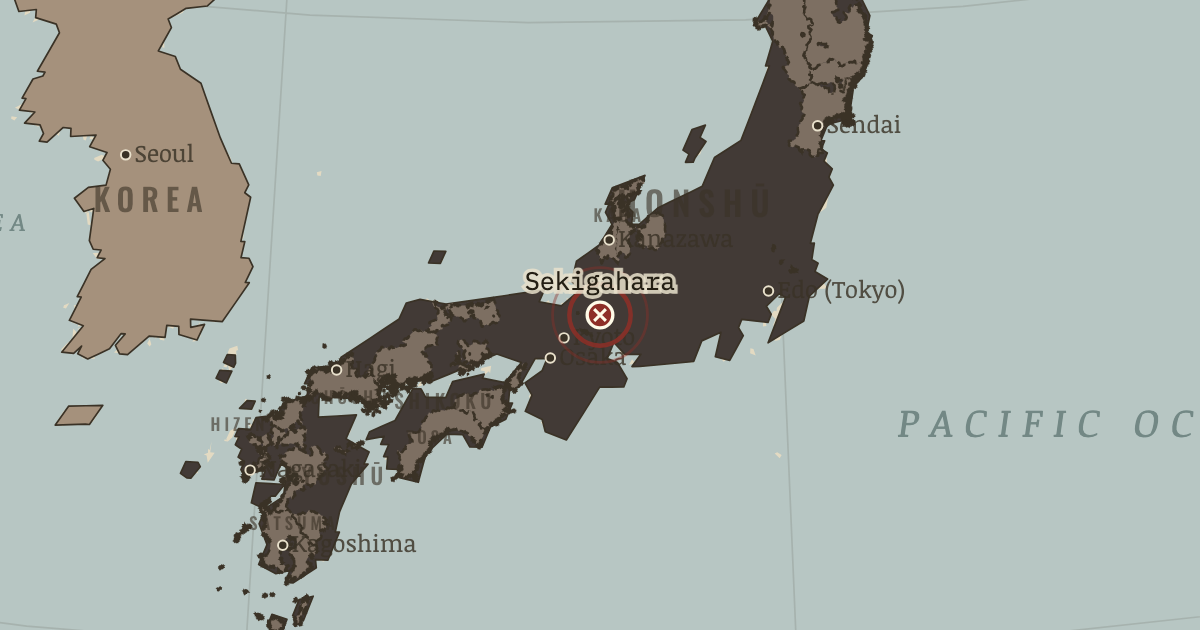
The moment in context
The Tokugawa settlement began with a problem of victory. Tokugawa Ieyasu had won at Sekigahara in 1600 and became shogun in 1603, ruling behind an emperor without power, like a military strongman behind a figurehead king. He still had to keep other lords from fighting him or one another. His own house and the fudai, families who had served him before 1600, received the strategic centre around Edo, Kyoto and Osaka, shown in charcoal. The tozama, or ‘outer’ lords, had fought him or joined late. The Shimazu of Satsuma and the Mōri of Chōshū retained large domains on the grey-tan edges of the map, but were excluded from national office.
From Tokugawa shogunate and sakoku, chapter 1 of Remaking the State: Meiji Japan 1600–1912 and Post-Soviet Russia 1964–2000 (1842).
The place: Battle of Sekigahara — map and full story →
Teach this in 5 minutes
- Why it happened — Sekigahara settled who ruled and left the losers in place. Victory at Sekigahara left Ieyasu with enemies he had not destroyed. The Mōri of Chōshū lost most of their eight provinces but kept two, while the…
- The turn — The Treaty of Nanking, 29 August 1842. On 29 August 1842 the Treaty of Nanking made the consequences of defeat visible to Japan’s rulers. China, the region’s greatest state, had lost to…
- What it changed — Caution replaced preparation. The government responded to the Chinese crisis chiefly by avoiding a confrontation. It offered foreign ships fuel and water after 1842, yet rejected…
Then ask the room: Was the Tokugawa order already collapsing before 1853, or did the outside world break a system that still worked? The argued answer is on the chapter page →
The atlas that shows it
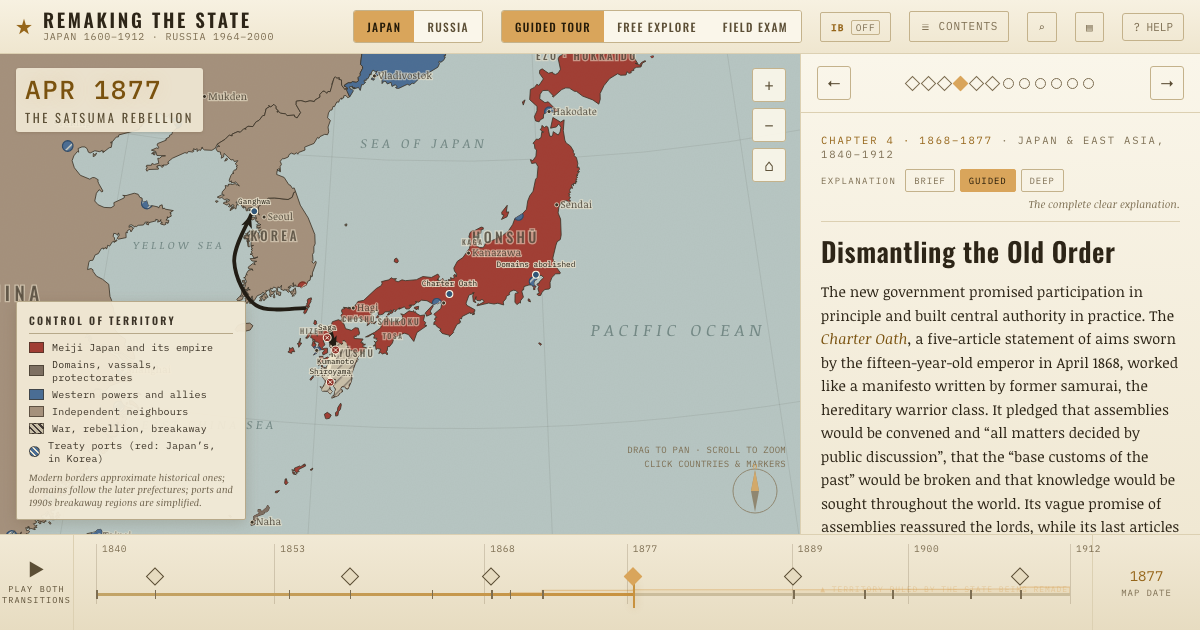
THE FREE PRINTABLE STUDY GUIDE
Get the printable study guide for Remaking the State free. I’ll send you a few short letters, then one when a new atlas opens. That’s all. — Paul
NO TRACKING · YOUR ADDRESS IS USED FOR THE DISPATCH AND NOTHING ELSE · UNSUBSCRIBE ANYTIME