Meiji Japan and post-Soviet Russia · 1996
Did Russia’s oligarchs cause or exploit a weak state?
The seminar question: “Were Russia’s oligarchs a product of weak state institutions, or the cause of their weakness?”
Russia in the mid-1990s was a state too weak to collect taxes, pay soldiers and teachers, or govern its regions. Tatarstan signed a treaty with Moscow in February 1994, Chechnya was invaded in December 1994, and the loans-for-shares auctions of late 1995 made the oligarchs a power in politics.
Chapter 11 is included with every paid plan. WW2 is free in full, and chapter 1 of every atlas is free. A free account opens 3 more chapters a day. Starter, at $9 a month, opens all 21 with no daily limit — see the plans.
Free printable Meiji Japan and post-Soviet Russia study guide, sent by email ↓
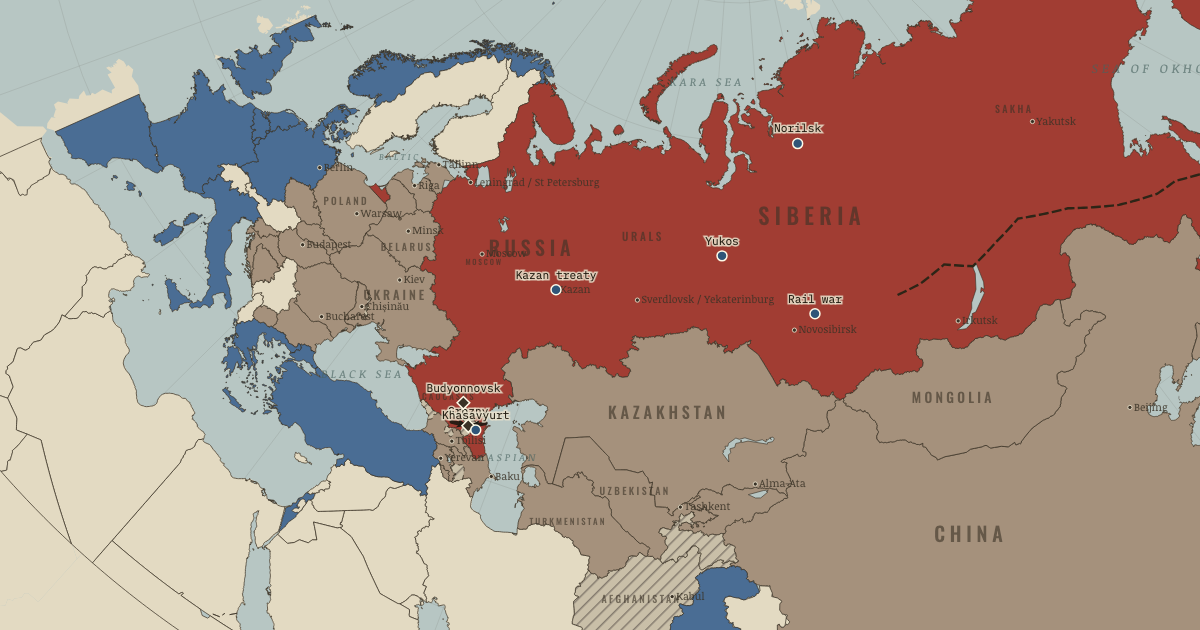
Before the Soviet Union fell, Yeltsin had a reason to encourage the republics inside Russia to resist Moscow. In his struggle with Gorbachev, he told them to “take as much sovereignty as you can swallow”. Tatarstan, Sakha and others declared sovereignty in 1990, claiming that their laws took precedence over Moscow’s. The dashed outlines on the maps of 1990–94 mark those claims. Regional leaders retained tax revenue, controlled local police and courts, and bargained with the center.
The short answer
- The state could not collect its own taxes. The government depended on revenue from large firms after privatization and inflation, but those firms often paid late, in goods or not at all. Regions retained much of what they collected, and the new rich moved money abroad. The shortage made it difficult to pay soldiers, officials and creditors; it ran through crises from the poor performance of conscripts in Grozny to the 1998 default.
- The regions had taken power as the Union fell. Yeltsin had encouraged the republics to claim sovereignty in 1990–91 to weaken Gorbachev. Once the Union fell, their leaders controlled resources, police and votes that Moscow needed. Bilateral treaties kept most regions in the federation, but the special terms produced a patchwork of authority, echoing the domains Japan’s leaders abolished in 1871.
- Chechnya’s history made compromise harder. Chechen resistance to Russian conquest in the nineteenth century was followed by Stalin’s deportation of the entire nation in 1944; survivors returned only in 1957. Dudayev’s demand for independence drew on that memory. After Russian authority withdrew, weapons and smuggling flourished. Moscow refused serious negotiations with the elected leader and expected a quick victory, turning a political problem into war.
- The government needed cash and a re-election. With an empty budget and the 1996 election approaching, Yeltsin’s government needed both money and allies. Banks lent against valuable state shares, then auctioned them when the loans went unpaid, usually to themselves. The arrangement resembled a pawnbroker selling an unredeemed pledge to his own relatives. Ownership gave the bankers a reason to support Yeltsin; the immediate struggle for survival helped shape one of modern history’s largest transfers of wealth.
THE TURNING POINT
Loans-for-shares, November–December 1995. The auctions of November–December 1995 joined the government’s need for money to Yeltsin’s need for political support. Banks organized the sales and bid in them, keeping rivals out; a handful of bankers acquired oil, nickel and other assets for a fraction of their value. They then financed and broadcast Yeltsin’s campaign. The deal helped save him in 1996, but discredited privatization for a generation. Moscow could give away companies it had been unable to tax.
What it changed
Oligarchs became a power in politics. Ownership gave oligarchs tools with which to shape politics after 1996. Boris Berezovsky and Vladimir Gusinsky used banks and television channels to influence ministers and elections; Berezovsky briefly became deputy head of the Security Council. Their leverage depended on a weak Kremlin, and a stronger president would move first against the most politically active among them.
An unresolved war and a humiliated army. Khasavyurt left Chechnya effectively independent, but did not settle its future. The elected president Aslan Maskhadov struggled to control warlords and kidnapping gangs. Many Russian officers saw the accord as betrayal, and many Russians blamed Chechens for kidnappings and bombings. Raids from Chechnya into neighboring Dagestan in 1999 would provide the occasion for a second war.
The default cleared the ground for recovery. The cheaper ruble made imports expensive and Russian products more competitive, helping output grow in 1999. Oil prices rose afterward and state revenue recovered quickly. Yeltsin’s successor inherited a country emerging from its deepest crisis and a budget refilled by oil; he would take much of the credit for recovery.
The full answer, argued
Both directions matter. Weak courts, an ineffective tax service and a government desperate for money and votes created the opportunity: loans-for-shares exchanged assets for loans and political support. Once oligarchs controlled banks, natural resources and media, they could lobby for tax exemptions, capture regulators and shape elections through their television channels. The 1996 campaign shows how their resources could help determine who governed. David Hoffman and Daniel Treisman describe a cycle in which weak institutions enabled oligarchs and their influence deepened that weakness. A later president broke the cycle by restoring central power, while also curbing media and courts. The case suggests a wider danger: markets built before the rule of law can create owners with an interest in keeping it weak.
An interesting fact
The 1996 slogan “Vote or lose” was aimed at young voters. In June, the 65-year-old Yeltsin danced on stage at a Rostov-on-Don rock concert before the cameras. Just over two weeks later, between election rounds, he suffered a serious heart attack. Staff concealed it with old footage and statements in his name; voters learned the truth only after his run-off victory. In November Russian surgeon Renat Akchurin performed quintuple bypass surgery, advised by American heart surgeon Michael DeBakey.
This is the study layer of Oligarchs and the First Chechen War, chapter 11 of Remaking the State: Meiji Japan 1600–1912 and Post-Soviet Russia 1964–2000; the full index of the atlas is here.
Related questions
THE FREE PRINTABLE STUDY GUIDE
Get the printable study guide for Remaking the State free. I’ll send you a few short letters, then one when a new atlas opens. That’s all. — Paul
NO TRACKING · YOUR ADDRESS IS USED FOR THE DISPATCH AND NOTHING ELSE · UNSUBSCRIBE ANYTIME