Stalin’s Soviet Union · 1928
Did Stalin win power by skill or his rivals’ errors?
The seminar question: “Did Stalin win the succession mainly through his own skill, or because his rivals made it easy for him?”
When Lenin died in January 1924, Stalin was the rival others feared least, yet as General Secretary he controlled party appointments. Zinoviev and Kamenev shielded him from Lenin’s Testament because they needed him against Trotsky, who was exiled to Alma-Ata in January 1928; by 1929 Stalin led without rivals.
WW2 is free in full, and chapter 1 of every atlas is free. A free account opens 3 more chapters a day. Starter, at $9 a month, opens all 21 with no daily limit — see the plans.
Free printable Stalin’s Soviet Union study guide, sent by email ↓
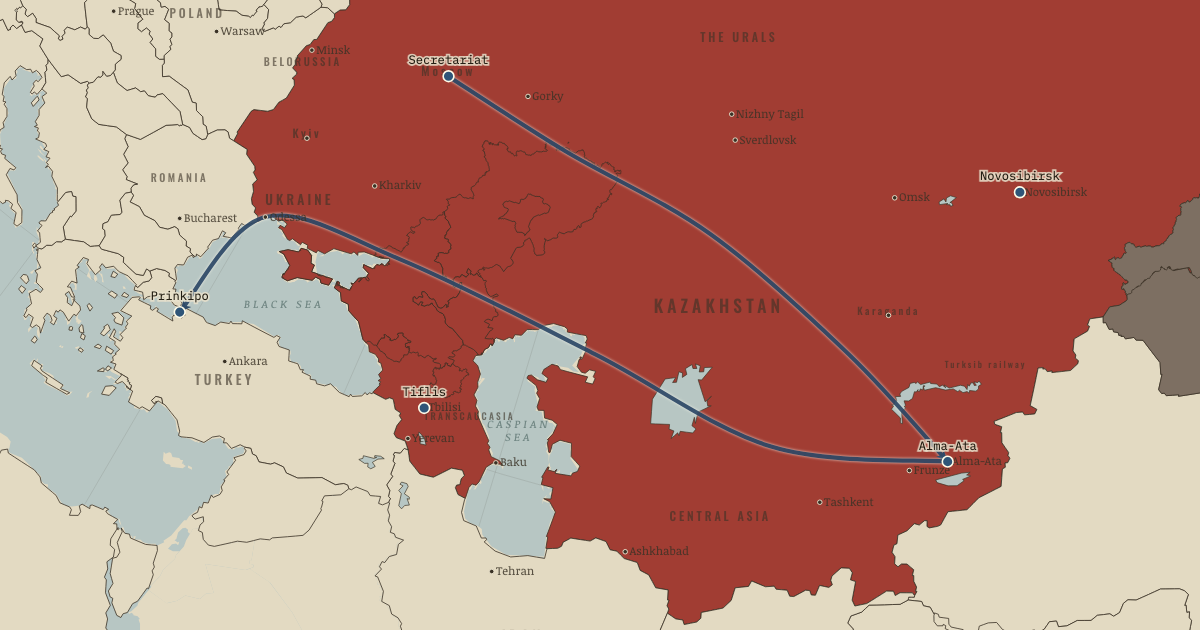
Lenin had tried to warn his colleagues about Stalin. After strokes left him partly paralyzed, he dictated notes in December 1922 and January 1923 that became known as his Testament. He said Stalin had accumulated “unlimited authority” and, in a postscript dated 4 January 1923, called him “too rude” and proposed removing him as General Secretary. The dispute behind this warning was the Georgian Affair, marked at Tiflis: Stalin and his ally Sergo Ordzhonikidze had bullied Georgian communists into a federation with Armenia and Azerbaijan.
The short answer
- The party had no rules for succession. Lenin’s personal authority held together a leadership with no office of party leader and no settled succession procedure. The Politburo made policy, while the Orgburo and Secretariat dealt with personnel. When illness removed Lenin from active leadership in 1922, his colleagues governed collectively and competed for influence. Control of committees could gradually convert that collective authority into personal power.
- The General Secretary controlled appointments. In April 1922 Stalin became General Secretary, a job his colleagues regarded as administrative. It gave him oversight of thousands of assignments and admissions, including the 1924 Lenin Enrolment. Provincial secretaries who owed him their positions selected congress delegates. Through these routine decisions he could gather a majority before his rivals recognized how formidable he had become.
- His rivals feared Trotsky more than Stalin. The Bolsheviks knew the French Revolution’s history: a general, Napoleon Bonaparte, had seized power after it. Trotsky, creator of the Red Army, seemed the obvious candidate for that role. Zinoviev, Kamenev and Bukharin each joined Stalin to block him. Their choice made sense in light of their fear, but it left the quiet organizer free to turn the apparatus against each of them.
- NEP’s grain problem made policy a weapon. Industrialization raised two connected questions: how fast should it proceed, and who should pay? The Left wanted resources taken from peasants for factories; the Right preferred the market and slower growth. The grain crisis of 1927–28 forced a choice. Having defended NEP against the Left, Stalin abandoned it and isolated the Right.
THE TURNING POINT
Alma-Ata, January 1928. On 17 January 1928 Trotsky was sent to Alma-Ata, 3,000 kilometres from Moscow, after expulsion from the party. The journey removed the last leader with an independent following and marks the settlement of the succession. Stalin traveled in the same month to Siberia, where he began taking grain by force. The defeated Left had urged a similar measure. With that opposition out of the way, Stalin could take up its program against the Right; the succession struggle was becoming a revolution against the peasants.
What it changed
A leader without rivals launched the Great Turn. Victory in 1927–29 left Stalin able to impose forced collectivization and rapid industrialization without an opposing faction to stop him. His choices for 1929–33 received the approval of a Politburo filled with allies, including Vyacheslav Molotov and Lazar Kaganovich. A leader who argued for slower change risked being called a “Rightist”. The succession had determined the pace of change as well as its author.
Defeated rivals became future defendants. The men defeated in the succession struggle later figured in the Great Terror. Zinoviev and Kamenev were shot in August 1936 after the first Moscow show trial; Bukharin and Rykov were shot in March 1938. Tomsky killed himself in 1936 before arrest, and an NKVD agent murdered Trotsky in Mexico in 1940. The trials accused former oppositionists of plotting with foreign powers since the 1920s.
Loyalty replaced debate inside the party. Public argument had already been weakened by the 1921 ban on factions. Once the remaining open factions were defeated, opposition brought expulsion and later arrest. Officials learned to anticipate Stalin’s wishes. Ian Kershaw used the phrase “working towards the Führer” for a comparable habit in Hitler’s Germany; under Stalin, anticipation also made the cult and the Terror easier to organize.
“Socialism in one country” justified the plans. The slogan “socialism in one country” gave the later plans a rationale as well as helping Stalin win. If socialism had to be built in a Soviet Union surrounded by enemies, industrialization could be presented as essential to survival. The Five-Year Plans put that idea into practice, with defense as their deepest purpose. Their sacrifices could be justified by the prospect of fighting a war alone.
The full answer, argued
Stalin made effective use of opportunities his rivals gave him. He recognized the value of Secretariat appointments in producing majorities, chose allies carefully, and offered “socialism in one country” to a party tired of waiting for revolution abroad. Zinoviev and Kamenev protected him from Lenin’s Testament in 1924; Trotsky declined to fight openly while he still had support in the army and among students; Bukharin underestimated Stalin until 1928. Historians assign different weights to these advantages. Deutscher and Daniels emphasize the machine, Kotkin Stalin’s intelligence and conviction, and Fitzpatrick support from below. The strongest judgment combines control of appointments with his rivals’ misjudgments: none of them matched his votes, timing and message. Where succession has no settled rules, routine administration can become a route to power.
An interesting fact
Alma-Ata was remote, but Trotsky continued to lead an opposition network from exile. His biographers Isaac Deutscher and Pierre Broué report that he and his son Lev Sedov sent about 800 political letters and 550 telegrams between April and October 1928. They received around 1,000 letters, many from oppositionists exiled across Siberia and Central Asia. The OGPU read much of this correspondence, helping convince Stalin that distance within the Soviet Union had not ended Trotsky’s influence. Deportation abroad in February 1929 removed him from the country but left him able to write. From 1929 his Bulletin of the Opposition, published abroad, continued attacking Stalin’s policies for the next decade.
This is the study layer of Stalin’s rise to power, chapter 1 of The Soviet Union under Stalin, 1924–1953; the full index of the atlas is here.
Related questions
THE FREE PRINTABLE STUDY GUIDE
Get the printable study guide for The Soviet Union under Stalin free. I’ll send you a few short letters, then one when a new atlas opens. That’s all. — Paul
NO TRACKING · YOUR ADDRESS IS USED FOR THE DISPATCH AND NOTHING ELSE · UNSUBSCRIBE ANYTIME