MAPS OF HISTORY · MONGOL EMPIRE · BATTLES AND EVENTS · Mongol invasions of KoreaMongol Empire · TURNING POINT · 1259
Mongol invasions of Korea (1259)
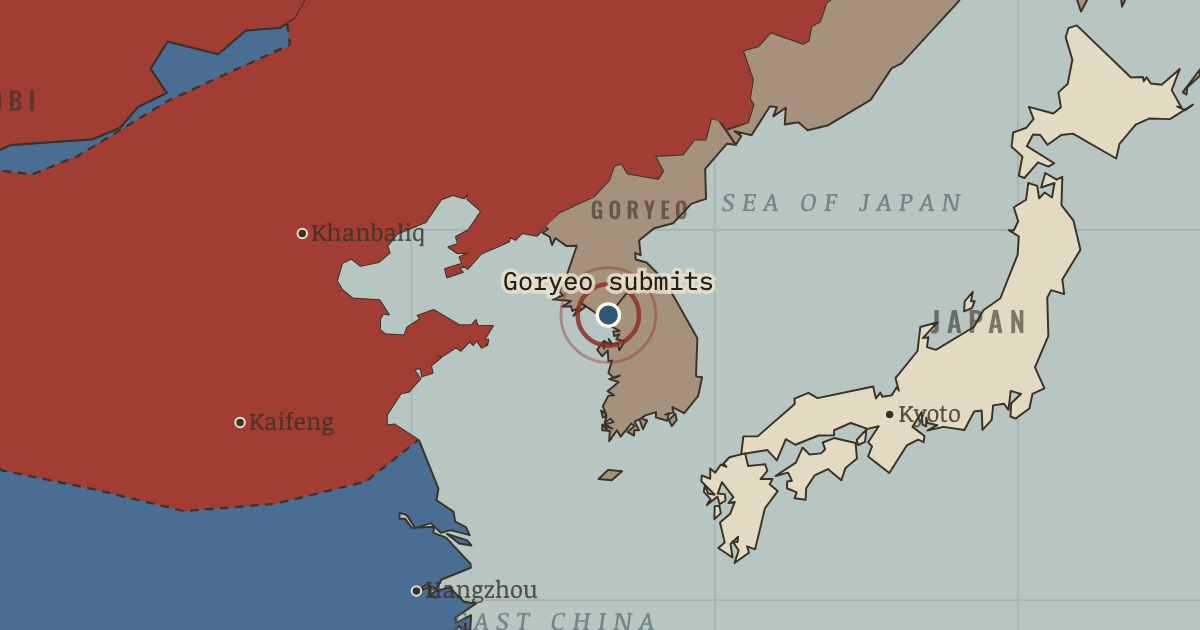
On the Mongol Empire map as “Goryeo comes to terms”
1259 — For thirty years and through six invasions, Goryeo’s court has taken refuge on Kanghwa island while the peninsula burns. Now the crown prince travels to the Mongol court. Goryeo retains its king but loses its independence, becoming a vassal and an in-law of the Mongols and soon an unwilling shipyard for their expeditions to Japan.
When 1259 Type Turning point Chapter How the Mongol Empire was governed (chapter 7 of Mongol Empire)Atlas The Mongol Empire, 1206–1294 TURNING POINT · THE MONGOL EMPIRE, 1206–1294 These maps are reconstructed from published sources · Cliopatria v0.2.1 — historical political boundaries · Asia for Educators — Expansion under Ögödei · Asia for Educators — Collapse of the Empire and Four Sectors · ISEAS Nalanda-Sriwijaya Centre Working Paper 25 — Mongol campaigns · Natural Earth — physical reference geography · Janet Martin — Medieval Russia 980–1584, chronology · Institute of History of Ukraine — Mongol invasion and its consequences
Source details Cliopatria contributors / Seshat Global History Databank. CC BY 4.0 · Selected dated polygons; documented unions, differences and shared edges for event-specific reconstructions; projected for display. Asia for Educators, Columbia University. Text consulted for historical facts; no map or prose copied Asia for Educators, Columbia University. Text consulted for historical facts; no map or prose copied ISEAS–Yusof Ishak Institute. Historical facts consulted; no map or prose copied Natural Earth. Public domain Janet Martin, Cambridge University Press. Historical facts consulted; no map or prose copied Encyclopedia of the History of Ukraine, 2019. Historical facts consulted; thematic geometry independently reconstructed Published polity extents are used at the date resolution available in their sources. Hatched affected regions and route arrows are educational reconstructions; the source details distinguish them from imported boundaries.
Chapter anchor 1254.5 uses the existing snapshot s1254 (1254). The lesson date remains separate from the source reference dates.
proxy: 1206 reference extent · reconstruction: 1188–1259 · reconstruction: 1236–1259 · reconstruction: 1237–1240 · reconstruction: 1250–1259 · reconstruction: 1250–1259 territory; post-1253 allegiance · reconstruction: 1250–1271 · reconstruction: 1250–1278 · reconstruction: 1250–1284 · reconstruction: 1254 · reconstruction: 1254; pre-conquest Tibetan reference 1139–1235 · reconstruction: 1254; regional outlines from pre-conquest 1206 principalities · vector: 1072–1325 · vector: 1072–1374 · vector: 1111–1278 · vector: 1139–1259 · vector: 1188–1259 · vector: 1188–1271 · vector: 1188–1284 · vector: 1188–1304 · vector: 1192–1325 · vector: 1192–1362 · vector: 1202–1259 · vector: 1202–1374 · vector: 1202–1743 · vector: 1210–1304 · vector: 1220–1313 · vector: 1227–1259 · vector: 1236–1259 · vector: 1236–1293 · vector: 1236–1452 · vector: 1241–1271 · vector: 1241–1278 · vector: 1241–1293 · vector: 1241–1313 · vector: 1241–1351 · vector: 1250–1259 · vector: 1250–1271 · vector: 1250–1278 · vector: 1250–1284 · vector: 1250–1293 · vector: 602–1501 · vector: 936–1271
Layer records and reconstruction methods
In the same chapter
Related
THE FREE PRINTABLE STUDY GUIDE
Get the printable study guide for The Mongol Empire free. I’ll send you a few short letters, then one when a new atlas opens. That’s all. — Paul
NO TRACKING · YOUR ADDRESS IS USED FOR THE DISPATCH AND NOTHING ELSE ·
UNSUBSCRIBE ANYTIME