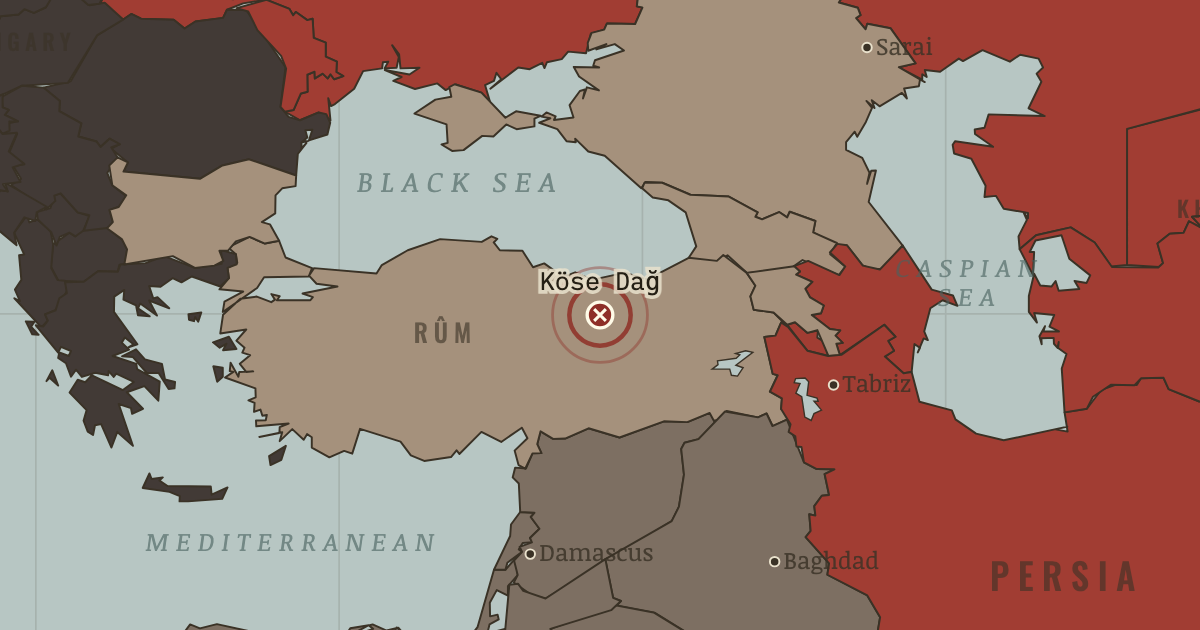
26 Jun 1243 — Baiju’s smaller army defeats the Seljuk sultanate of Rûm, the great power of Anatolia, in a single afternoon. The sultan remains in place as a tax-paying vassal. Mongol rule here takes the form of tribute, a census and obedience, without occupation.
WW2 is free in full, and chapter 1 of every atlas is free. A free account opens 3 more chapters a day. Starter, at $9 a month, opens all 21 with no daily limit — see the plans.
A Mongol army could conquer a city, but it could not station soldiers in every settlement across Eurasia. The empire needed another way to issue orders and collect resources. It kept control of important routes and used institutions already operating among the conquered. Censuses counted households, herds and labor obligations. A paiza, or tablet of authority, identified a bearer as someone acting for the khan.
Why it happened — Steppe practices on a larger scale. The Mongols adapted familiar steppe practices to an empire containing agricultural societies. Changing horses along a route became the yam; census…
The turn — The fountain at Karakorum. A silver fountain at Karakorum brought distant parts of the empire into one object. Guillaume Boucher, a Parisian artisan seized during the…
What it changed — Routes and exchange. Imperial authority over routes, backed by the census, yam and paiza, helped bring much of the Silk Road under one jurisdiction. Stations supplied…
Then ask the room: A million rulers, a hundred million ruled: how could such a small Mongol ruling group govern so many people? The argued answer is on the chapter page →