Age of Revolutions · CHAPTER 1 ·
Causes of the American Revolution
Chapter 1 of The Age of Revolutions, 1775–1848: “The World of 1775”
The Seven Years’ War ended in 1763 with Britain victorious but deep in debt, so London tried to tax its American colonies more directly. Stamp and tea duties became a dispute about consent: after protesters destroyed tea in Boston in 1773, Britain closed the port, and collective punishment helped the colonies cooperate.
WW2 is free in full, and chapter 1 of every atlas is free. A free account opens 3 more chapters a day. Starter, at $9 a month, opens all 21 with no daily limit — see the plans.
Free printable Age of Revolutions study guide, sent by email ↓
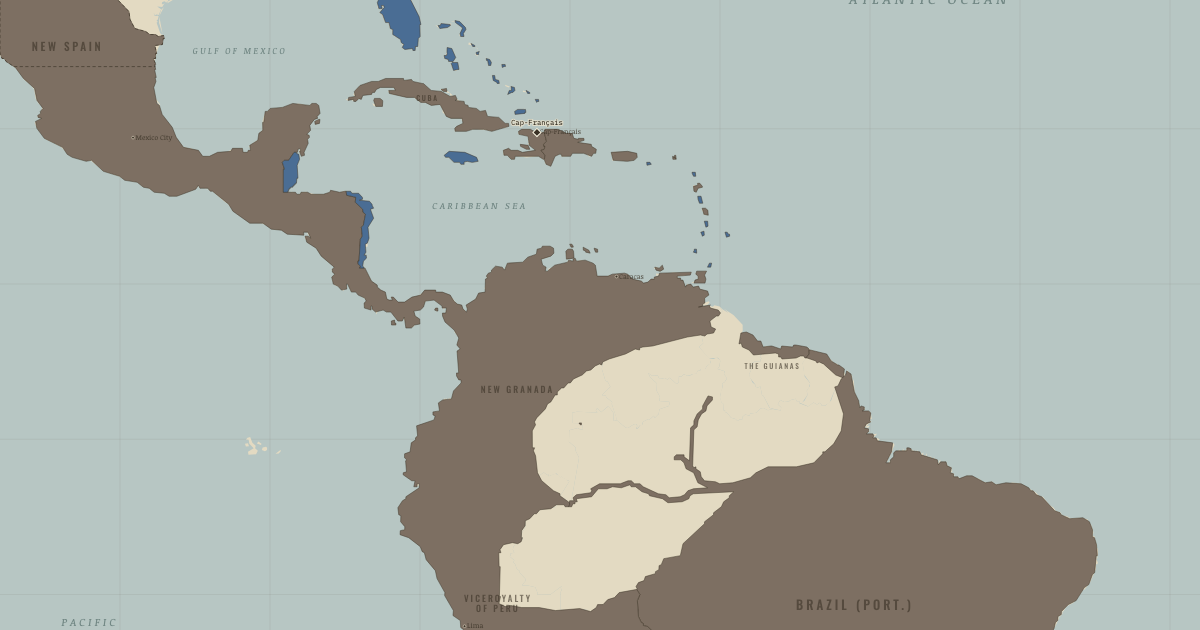
The map above is the world of The Atlantic world, April 1775 — The world of empires.
Every state on the map that year: The world in 1776 · Europe in 1776.
Part of IB History: The Age of Revolutions →
SHORT EXPLANATION
In 1775 European crowns claimed most of the Americas, but a color on the map could conceal a great deal. Indigenous nations still governed extensive territories, even where imperial treaties treated their land as available for seizure. Potosí’s silver and Saint-Domingue’s sugar enriched the empires; coerced Indigenous labor, enslaved workers and dispossession helped make that wealth possible.
Britain and France emerged from the Seven Years’ War heavily indebted. Britain’s search for colonial revenue brought Parliament into conflict with assemblies accustomed to voting their own taxes. As print carried arguments about consent and natural rights across the Atlantic, the question grew beyond the price of tea: could Parliament bind communities that elected no members to it?
The full story
The Atlantic world of 1775 joined places that worked in strikingly different ways. At Potosí, silver came from an older mining economy shaped by coerced Indigenous labor. At Cap-Français, sugar wealth depended on enslaved plantation workers. Boston was a settler community with assemblies and the means to organize against distant taxation. All belonged to an imperial system that drew wealth from ports, mines and plantations, while claiming inland territories where Indigenous nations often continued to govern.
Britain’s victory in the Seven Years’ War in 1763 enlarged its responsibilities as well as its empire. The government had a large debt and troops to maintain in North America, and ministers wanted colonists to contribute. Yet the people asked to pay were used to taxes voted by their own assemblies. Stamp and tea duties brought that custom into conflict with Parliament’s claim to authority; newspapers and pamphlets gave the dispute a language of rights.
The price of tea helps show why the dispute became so difficult. The Tea Act lowered it, but the duty remained. For colonial opponents, buying the cheaper tea meant accepting the authority that imposed the tax. Protesters destroyed the cargo in 1773, and Britain responded by closing Boston’s port and altering Massachusetts government. Other colonies could see their own position in the punishment of Massachusetts, and they had a reason to cooperate against it.
Ships carried people, revenue and political writing among Boston, Cap-Français and the wider Atlantic. The language of rights could travel along those routes, but it did not arrive in identical societies. Settlers arguing over taxation, enslaved people producing sugar and Indigenous communities facing claims to their land confronted different forms of power. The revolutions that followed would give their shared vocabulary different uses and consequences.
FULL EXPLANATION
How a bill became a question of authority
Britain had a practical reason to seek a colonial contribution: defending its new territory cost money, and colonists paid less tax than people in Britain. But a bill must be authorized as well as paid. Colonial assemblies had long voted local taxes, while Parliament claimed supremacy throughout the empire. These two practices now pointed to different answers about who could decide. For ministers, retreat threatened to weaken authority elsewhere in the empire. For colonial opponents, accepting Parliament’s claim threatened to leave no limit on later taxes. Each side could therefore regard a small immediate demand as a decision about future power. In France, war debt would likewise bring attempted fiscal reform and demands for representation; a less flexible political system would produce a larger rupture. In both cases, financial pressure worked through institutions and the choices made within them.
Liberty in an unequal Atlantic
Arguments about rights moved through a world of coerced labor and contested land. About one fifth of the people in the British mainland colonies were enslaved, and the proportion was much higher in Caribbean plantation colonies. British restrictions on western settlement meanwhile offered Native nations some protection against colonial expansion. These circumstances shaped what people could hope or fear from a break with Britain. Enslaved people sought freedom from whichever side offered it. Many Native nations supported Britain because an independent settler republic appeared more threatening to their lands. For settlers, self-government could mean freedom from imperial control; for others, the same change could extend slavery or dispossession. Their choices were part of the revolution, and they reveal why its promise of liberty could not have the same meaning for everyone.
Key places on the map
On this day
Why it happened
Paying for an empire. Britain’s victory in 1763 left it with the world’s biggest empire and biggest debt, as well as a new American frontier to garrison. Ministers could reasonably ask those protected by its troops to contribute to their cost. Colonial assemblies, however, had voted taxes for 150 years. The attempt to raise revenue therefore put the question of representation before the colonies: who had the authority to require payment? War debt and fiscal reform will bring France to another crisis in Chapter 3.
Readers and the language of rights. Locke, Montesquieu and Rousseau gave political arguments an influential body of theory. Print helped carry those arguments to readers: colonial literacy was among the highest in the world, and printers such as Franklin made political writing widely available. The “rights of Englishmen” and, later, the “rights of man” supplied terms in which people could make claims on their governments.
An empire sustained by slavery. About one in five people in British America was enslaved; in the sugar islands the proportion was about nine in ten. Plantation wealth supported an imperial world that maintained navies and circulated pamphlets. A declaration about “all men” would have to meet the fact that these societies depended on enslaved labor. In Chapter 5, enslaved people force that question upon the Atlantic world.
The people beyond the line. The Proclamation Line of 1763 sought to keep settlers off Native land and preserve peace at less cost. Colonial speculators, including Washington, resented the restriction. For the Six Nations, the Cherokee and many other nations, the same line offered some restraint on settlers. A movement to free the colonies from British authority could remove that restraint, with very different consequences for the people whose land settlers wanted.
THE TURNING POINT
Boston harbor, 16 December 1773. On 16 December 1773, protesters destroyed tea whose price the Tea Act had lowered. The bargain still carried a duty, and opponents saw acceptance of that duty as acceptance of Parliament’s taxing power. Parliament responded with the “Intolerable Acts”, punishing Massachusetts collectively. The response made a local confrontation a matter for the other colonies, which could now see a common interest in resisting it.
What it changed
A common deliberation. Twelve colonies with separate governments sent delegates to Philadelphia in 1774; they had never cooperated on anything before. Their Continental Congress gave them an institution through which to deliberate and speak for “America” before fighting began.
France sees an opportunity. Defeat in 1763 had humiliated France, and its ministers saw the American crisis as a chance for revenge against Britain. French money and gunpowder would support the rebels, while the resulting debt added to France’s own financial difficulties. Those financial ties connect Lexington to the Bastille.
Rights travel with cargo. Ships linking Nantes, Boston and Cap-Français carried printed arguments along with goods. Free people of color from Saint-Domingue would fight at Savannah in 1779 alongside men who spoke of rights. The ideas circulating through this trade could reach people excluded by those who first advanced them, and be put to new uses.
DISCUSSION QUESTION — Was the American crisis really about taxes, when the tea duty amounted to only a few pence?
The amount was small, but both sides understood the decision as a precedent. Parliament claimed power to legislate for the colonies in all cases; colonial opponents held that their own representatives had to consent to taxes. Ministers feared that giving way would weaken imperial authority, while colonists feared that accepting the duty would leave future taxation without a limit. War debt brought the demand for revenue; assemblies and print helped colonists organize resistance. The resulting crisis concerned who could rightfully govern, as well as who should pay.
An interesting fact
The people who destroyed the tea did not call the event the “Boston Tea Party”. They spoke of “the destruction of the tea”; the festive name appears in print in the 1820s, when surviving participants were old men giving interviews. The East India Company claimed that the 342 chests, about 46 tons of tea, were worth £9,659. Afterward the raiders swept the decks and replaced a padlock they had broken.
Related
THE FREE PRINTABLE STUDY GUIDE
Get the printable study guide for The Age of Revolutions free. I’ll send you a few short letters, then one when a new atlas opens. That’s all. — Paul
NO TRACKING · YOUR ADDRESS IS USED FOR THE DISPATCH AND NOTHING ELSE · UNSUBSCRIBE ANYTIME