WWI · AUG 1913
Which pre-1914 crisis did most to make WWI likely?
The seminar question: “Which of the three crises of 1908–1913 did most to make a general European war likely in 1914?”
Three crises between 1908 and 1913 were settled without a great-power war, yet each left Europe more dangerous. When Austria-Hungary annexed Bosnia-Herzegovina in 1908, Russia, pressed by Germany, backed down in 1909 and resolved never to retreat again. Germany’s gunboat at Agadir in 1911 hardened the western rivalry too.
WW2 is free in full, and chapter 1 of every atlas is free. A free account opens 3 more chapters a day. Starter, at $9 a month, opens all 21 with no daily limit — see the plans.
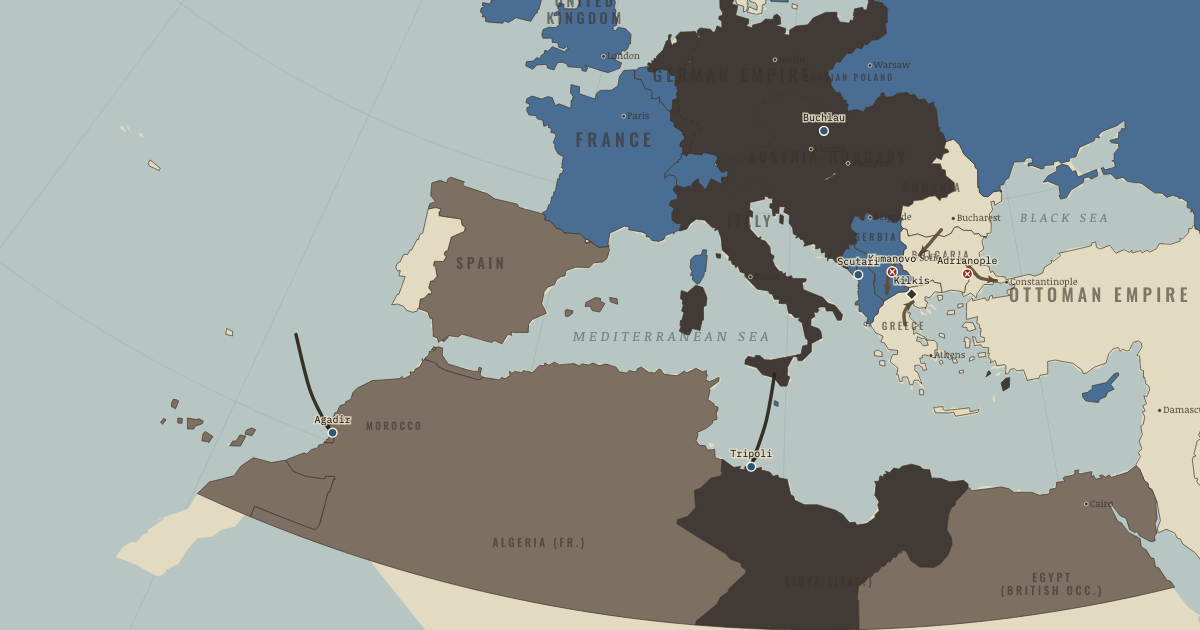
Austria-Hungary had administered Bosnia-Herzegovina since 1878, although the province remained formally Ottoman. In July 1908 the Young Turks, reforming officers, forced the Ottoman sultan to restore a constitution. Vienna feared that a revived Ottoman government might seek to reclaim Bosnia. Its foreign minister, Alois von Aehrenthal, met Russia’s Alexander Izvolsky at Buchlau castle in September. Izvolsky accepted annexation in return for Austrian support for opening the Straits between the Black Sea and Mediterranean to Russian warships. The bargain came apart when Vienna annexed Bosnia in October before Russia had secured passage through the Straits. In March 1909 Germany demanded that Russia recognize the annexation. Russia was unready for war and yielded. Bosnia turns from tan to charcoal on the map; in St Petersburg, an agreement made in private had ended in public humiliation.
The short answer
- The Ottoman retreat. The Ottoman Empire had lost Balkan territory since the Congress of Berlin. The Young Turk revolution of 1908 and Italy’s war against the empire in 1911–12 persuaded neighboring states that they might take what remained. Each retreat revived the Eastern Question: who would inherit Ottoman lands? Austria-Hungary and Russia had competing answers, and the final Balkan settlement brought them closer to collision (Chapter 1).
- Serbia’s turn toward Russia. Under the Obrenović kings, Serbia had been tied to Vienna by a secret treaty of 1881. That relationship changed in 1903, when army officers murdered King Alexander and Queen Draga and installed a dynasty looking to Russia and the union of South Slavs. Vienna tried economic pressure in the ‘Pig War’ of 1906–09, a trade boycott named for Serbia’s principal export. Serbia instead found French loans and Russian protection. The effort to restore Austrian influence helped drive its neighbor further away.
- A Habsburg empire afraid for its South Slavs. About seven million South Slavs lived under Habsburg rule, including Croats, Serbs, Slovenes, and Bosnian Muslims. Austrian leaders feared that a successful Serbia could attract them away, as Piedmont had drawn Italians from Habsburg rule during Italian unification in the 1860s. Annexation was intended to end Serbia’s claim to Bosnia. It also gave Serbian nationalists a grievance. Unification or Death, the secret society known as the Black Hand, was founded in 1911 and recruited young Bosnian Serbs.
- Russia’s need to recover face. Defeat by Japan in 1905 and the revolution that followed left Russia too weak to fight over Bosnia in 1909. Germany’s demand for acceptance of annexation became a remembered humiliation in St Petersburg. From 1910 Russia rebuilt its army with French money and returned its attention to the Balkans, sponsoring the Balkan League as a barrier to Austria-Hungary. It sought to recover influence in the region where its retreat had exposed its weakness.
THE TURNING POINT
The Bosnian crisis, September 1908 – March 1909. The bargain at Buchlau was meant to give each empire something: Austria-Hungary could annex Bosnia, and Russia could seek passage for warships through the Straits. Vienna acted before Russia secured that passage. Germany then insisted in March 1909 that Russia recognize the annexation, and Russia yielded. The result left Austria-Hungary acting with German support, Serbia aggrieved, and its Russian patron humiliated. These powers confronted one another again five years later, when Russia was much less willing to retreat.
What it changed
The July Crisis follows the script. Sarajevo, where the assassination of June 1914 occurred, was the capital of the province annexed in 1908. Young Bosnian Serbs armed through the Black Hand carried out the killing. Austria-Hungary turned again to the ultimatum that had worked against Serbia in October 1913, and Germany again promised support (Chapter 3). This time the confrontation escalated into general war.
Bulgaria’s revenge. The 1913 Treaty of Bucharest ended the Second Balkan War by taking most of Macedonia and southern Dobruja from Bulgaria. In October 1915 Bulgaria joined the Central Powers, Germany’s side, which offered it Macedonia. Its army helped crush Serbia within weeks (Chapter 6). The larger war offered a chance to pursue territory lost in the earlier one.
An arms race on land. Germany’s army laws of 1912 and 1913, France’s three-year service law, and Russia’s Great Programme produced some of Europe’s largest peacetime increases in army size. General staffs considered when the changing balance would favor them. German planners expected their advantage to disappear around 1916 or 1917. That expectation helps explain Berlin’s readiness to risk war while its leaders still believed victory possible, as armies moved in August 1914 (Chapter 4).
Nation-building by expulsion. New borders after the Balkan Wars displaced entire communities. Hundreds of thousands of Muslims fled toward Anatolia, the Turkish heartland in Asia; Bulgarians, Greeks, and Serbs were expelled from districts that changed hands. A Bulgarian–Ottoman agreement in 1913 arranged a voluntary exchange of villagers along the new border. The compulsory Greek–Turkish exchange of 1923 (Chapter 15) later gave the practice a place in international law.
The full answer, argued
Bosnia best explains several attitudes visible in July 1914: Russia remembered its retreat, while Germany had shown that it would back Austria-Hungary. Agadir helps explain the western response, convincing British leaders that Germany sought European dominance and tightening naval links with France, making British neutrality less likely. The Balkan Wars have the strongest claim to have changed the immediate situation. They largely removed the Ottoman buffer, nearly doubled Serbia’s size, and strengthened Vienna’s conviction that only war could solve its South Slav problem. Christopher Clark is among the historians who give those wars particular weight. Bosnia shaped expectations; the Balkan Wars created the conditions in which leaders would apply them. All three crises nevertheless ended without a general war, and none made the decisions of 1914 inevitable.
An interesting fact
Leon Trotsky reported the Balkan Wars while living in exile in Vienna. Writing as Antid Oto for the Kiev newspaper Kievskaya Mysl, he covered the fighting of 1912–13 and reported matters the belligerents’ own newspapers kept quiet. Five years later he led the Bolshevik delegation at Brest-Litovsk. Soon afterward, as commissar for war, he built the Red Army that marched on Warsaw in 1920. Journalists, soldiers, and politicians carried experience from the smaller wars into the much larger catastrophe that followed.
This is the study layer of Bosnian crisis and the Balkan Wars, chapter 2 of The Great War, 1871–1923; the full index of the atlas is here.
Related questions
THE FREE PRINTABLE STUDY GUIDE
Get the printable study guide for WWI free. I’ll send you a few short letters, then one when a new atlas opens. That’s all. — Paul
NO TRACKING · YOUR ADDRESS IS USED FOR THE DISPATCH AND NOTHING ELSE · UNSUBSCRIBE ANYTIME