Ancient Rome · CHAPTER 10 ·
Adrianople and the sack of Rome
Chapter 10 of The Rise and Fall of Rome, 264 BC – AD 476: “The Storm from the North”
In 376 Rome admitted Gothic refugees fleeing the Huns across the Danube, but corrupt officials starved and exploited them until they rebelled. At Adrianople on 9 August 378 the Goths destroyed an eastern army and killed Emperor Valens; Rome then settled them inside the empire as foederati, and in 410 the Goths sacked Rome.
Chapter 10 is included with every paid plan. WW2 is free in full, and chapter 1 of every atlas is free. A free account opens 3 more chapters a day. Starter, at $9 a month, opens all 21 with no daily limit — see the plans.
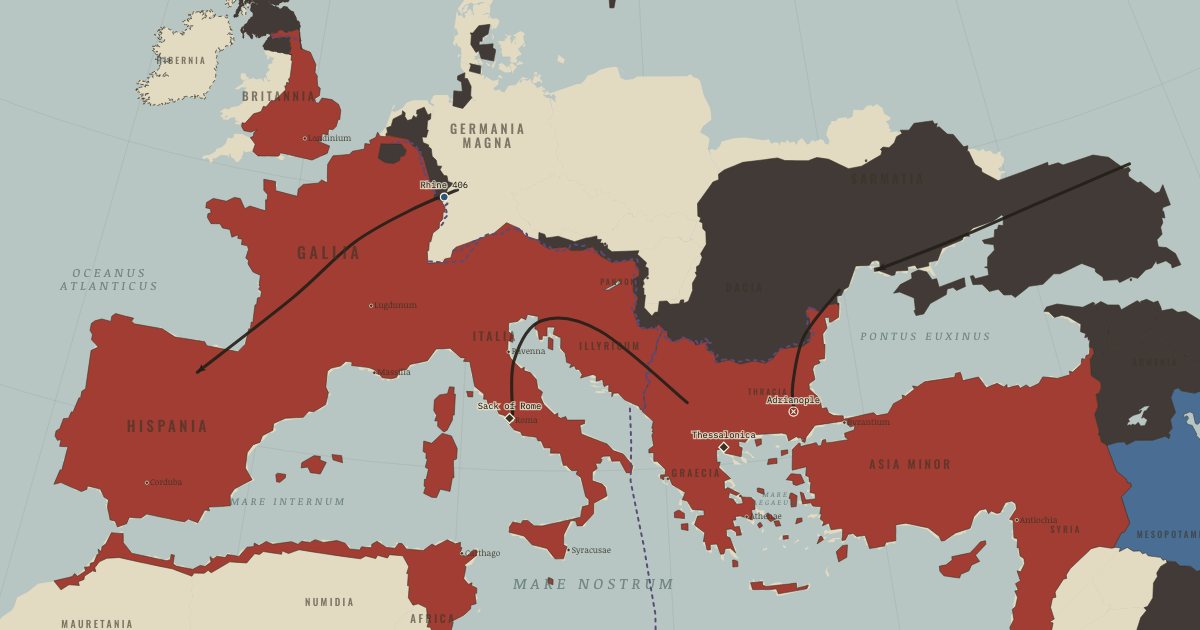
The map above is the world of The Roman Empire, AD 395 — East and West.
Every state on the map that year: The world in 400 · Europe in 400.
SHORT EXPLANATION
In 376 Goths fleeing the westward advance of the Huns reached the Danube and asked to enter the Roman Empire. Valens admitted them as potential settlers and soldiers. Officials then exploited the hungry newcomers, who revolted. At Adrianople in 378 they destroyed much of the eastern field army and killed Valens. A crisis that began with people seeking refuge had become a military disaster.
After the defeat Rome needed soldiers. The settlement of 382 allowed Gothic foederati to serve as armed allies under their own leaders, making their service a matter of agreement. Civil wars meanwhile drew troops from the frontiers. After the division of 395, Alaric sought land, pay and office from the western court. Conflict and failed negotiations ended in his sack of Rome in 410.
The full story
The Huns, mounted nomads advancing west from the steppe, shattered the Gothic world north of the Danube. In 376 perhaps a hundred thousand Goths came to the river seeking admission to the empire. Valens saw an opportunity: settlers could become taxpayers and soldiers. Feeding and settling such a large group was difficult, but Roman officials made the task worse. They diverted provisions and exploited the people left hungry. The Goths revolted.
Valens faced them at Adrianople on 9 August 378 without waiting for the western army. The Goths destroyed roughly two-thirds of his field force and killed him. A contemporary compared the defeat to Cannae. There was a difference: the Republic after Cannae had Italian allies from whom it could draw replacements, while the late empire lacked a comparable reservoir. The loss of trained troops therefore shaped the terms on which the war could end.
In 382 Theodosius settled Goths within the empire as foederati, allied soldiers serving under their own leaders. The arrangement supplied men the state urgently needed. Earlier settlers had often been dispersed and absorbed into provincial administration; now service depended on maintaining an agreement with an armed community. A change of ruler or a failure to meet obligations could bring the bargain into question again. Another kind of authority appeared at Thessalonica in 390. After Theodosius ordered the massacre of thousands following a riot, Bishop Ambrose required the emperor to perform public penance. The church had visibly brought an emperor to account.
The need to defend frontiers competed with another danger. An emperor who ignored a Roman rival might lose his throne, so civil wars repeatedly drew troops away from the borders. Peoples crossed the weakened Rhine at the end of 406. Meanwhile Alaric sought grain, land and pay for his followers and a recognized command for himself. The western court negotiated and resisted. In 408 it executed Stilicho, an experienced intermediary, and attacked federate families; more soldiers joined Alaric. His forces sacked Rome for three days in 410. The physical damage was smaller than later memory suggested, but the shock was immense. The road to the city had passed through decisions about settlement, military resources and imperial power.
FULL EXPLANATION
How Refugees Became an Armed Polity
The Goths of 376 had asked for admission to an empire that had settled outsiders before. This time a large population crossed quickly, remained together and was not fully disarmed. It depended on provisions that officials diverted for profit. Admission itself did not make revolt inevitable; misgovernment turned the refugees’ vulnerability into a war. After Adrianople, Rome had fewer soldiers and fewer choices. The 382 agreement brought Gothic forces into service under their own leaders as foederati. It met an immediate need, but the arrangement required renewed negotiation if rulers changed or obligations went unpaid. Feeding, dispersing and integrating settlers would also have required resources already claimed by other demands, including civil wars. The immediate settlement left a difficult relationship to be managed later.
The Sack as Failed Bargaining
For years Alaric asked for grain, land, payment and a recognized command. His demands could alarm the western court while also expressing a desire for a place within imperial government. The court negotiated and delayed, and removed men who dealt with him. Its residence at Ravenna mattered: the emperor was protected by strong defenses even while Italy suffered, so the court could resist pressure that fell on others. Stilicho’s execution removed an experienced broker; violence against federate families sent more soldiers to Alaric. By 410 he used an attack on Rome to force the issue. Its inhabitants suffered real violence. Yet his goal was not simply to abolish Rome, and his successors continued to seek authority in Roman forms.
Key places on the map
On this day
Why it happened
The Huns and Roman choices. Peter Heather gives the Huns a central place in the explanation. Their advance compressed peoples against Roman frontiers within a generation, linking the pressures behind the crossings of 376 and 406 with Attila’s campaigns in Chapter 11. Other historians emphasize the empire’s internal condition: earlier governments had dealt with Cimbri, Marcomanni and Goths. These questions belong together. Rome did not create the pressure from the steppe, but its institutions and decisions helped determine the outcome when people reached its borders.
The cost of Adrianople. The force lost at Adrianople had served as the eastern empire’s strategic reserve. The Republic could replace losses after Cannae from a citizen-militia base and its Italian allies; the late empire needed money and recruits to rebuild its army. The 382 treaty supplied Gothic soldiers in response to that shortage. Later losses of taxable land could make replacement still harder: less revenue meant fewer resources for troops, and concessions to armed groups could in turn reduce the revenue available. Chapter 11 follows this fiscal argument. The treaty answered a real need, even though later outcomes were not inevitable.
Civil wars and frontiers. Theodosius marched the eastern army west against Roman usurpers in 388 and 394, drawing resources away from the Rhine and Danube. A rival could take an emperor’s throne, so the danger was immediate. The provinces bore part of the cost when frontier forces were weakened. Peoples crossed the Rhine in 406 after withdrawals; Stilicho’s defense of Italy also drew troops from Britain and Gaul, where Constantine III emerged as a usurper. Protecting a ruler against Roman competitors could leave the empire less able to defend its borders.
The problem of integration. Rome had brought Gauls, Spaniards and Illyrians into its political and military life over centuries. Could it have accommodated the Goths in a comparable way? Alaric’s long pursuit of office suggests an opportunity, although any agreement would have needed both parties to sustain it. Hostile factions at court and religious differences—the Goths were Arian Christians—made accommodation harder. Attacks on federate families in 408 pushed soldiers toward Alaric, making the problem more urgent.
THE TURNING POINT
Adrianople, 9 August 378. Rome had recovered from lost armies before. At Adrianople the destruction of Valens’s force nevertheless narrowed the choices available to his successors. The settlement of 382 recognized Gothic forces inside the frontier under their own leaders and relied on a treaty to secure their service. Later Roman governments faced demands from Vandals, Sueves and Burgundians; the Gothic agreement offered a precedent, though it did not determine the terms of every later bargain. Ancient writers saw Adrianople as the beginning of the end. Modern historians differ, but the defeat changed the conditions of Rome’s relationship with the Goths.
What it changed
The exposed West. The division of 395 left the east with Constantinople’s fortified approaches and a larger share of imperial revenues—roughly two-thirds by one estimate. The west had the long Rhine and upper Danube frontiers, Britain, and the vital grain and taxes of Africa. Losses in 406, 410 and 439 therefore fell on the government with less capacity to replace them. The loss of Africa in 439 made the disparity especially consequential. Chapter 11 follows the western balance sheet.
The meaning of 410. The court was safe in Ravenna when Rome was sacked. Alaric died within months and his Goths later moved toward Gaul, but the event’s meaning outlasted its immediate damage. Pagans blamed the abandonment of the old gods. Augustine answered that no earthly city was the City of God: the fate of a political order was distinct from Christians’ ultimate hopes. That distinction helped shape Latin Christian thinking about politics for centuries.
Britain after imperial rule. Around 410 imperial government withdrew from Britain without an immediately succeeding single conquering government. Towns, villas, coinage and literacy contracted especially severely as the institutions supporting them disappeared. Bryan Ward-Perkins draws on pottery and coin distribution to examine the material consequences. Britain gives Chapter 12 a case in which to ask what the words “fall” and “transformation” explain.
DISCUSSION QUESTION — How did Goths seeking admission in 376 come to sack Rome in 410? Which decisions offered opportunities to change that course?
The crossing offered Rome prospective settlers and soldiers. It was the diversion of food by officials that helped turn settlement into revolt. Valens then attacked at Adrianople without waiting for the western army, and defeat limited the choices open to his successors. The 382 treaty supplied needed soldiers while recognizing Gothic forces under their own leaders. Later, land and a command for Alaric might have provided another accommodation within the empire. The execution of Stilicho and attacks on federate families in 408 strengthened Alaric instead. The years before 408 were a possible last opportunity for a negotiated settlement, though its success cannot be known. Each choice altered the circumstances in which the next had to be made.
An interesting fact
Galla Placidia, the emperor’s half-sister, was among the hostages taken away by the Goths. At Narbonne in 414 she married their king Athaulf in Roman dress, while a deposed Roman emperor sang the wedding hymn. A contemporary reports that Athaulf had come to favor restoring the Roman name with Gothic arms. After his death she returned in exchange for 600,000 measures of grain, married a Roman general and became Augusta. She later governed the western empire for roughly a dozen years as regent for her son, its emperor.
Related
THE FREE PRINTABLE STUDY GUIDE
Get the printable study guide for Rome free. I’ll send you a few short letters, then one when a new atlas opens. That’s all. — Paul
NO TRACKING · YOUR ADDRESS IS USED FOR THE DISPATCH AND NOTHING ELSE · UNSUBSCRIBE ANYTIME