ON THIS DAY ·
Austria-Hungary annexes Bosnia-Herzegovina
Austria-Hungary announces the annexation of Bosnia-Herzegovina, opening a crisis that ends in March 1909 with Russia’s humiliating retreat.
WW2 is free in full, and chapter 1 of every atlas is free. A free account opens 3 more chapters a day. Starter, at $9 a month, opens all 21 with no daily limit — see the plans.
The moment in context
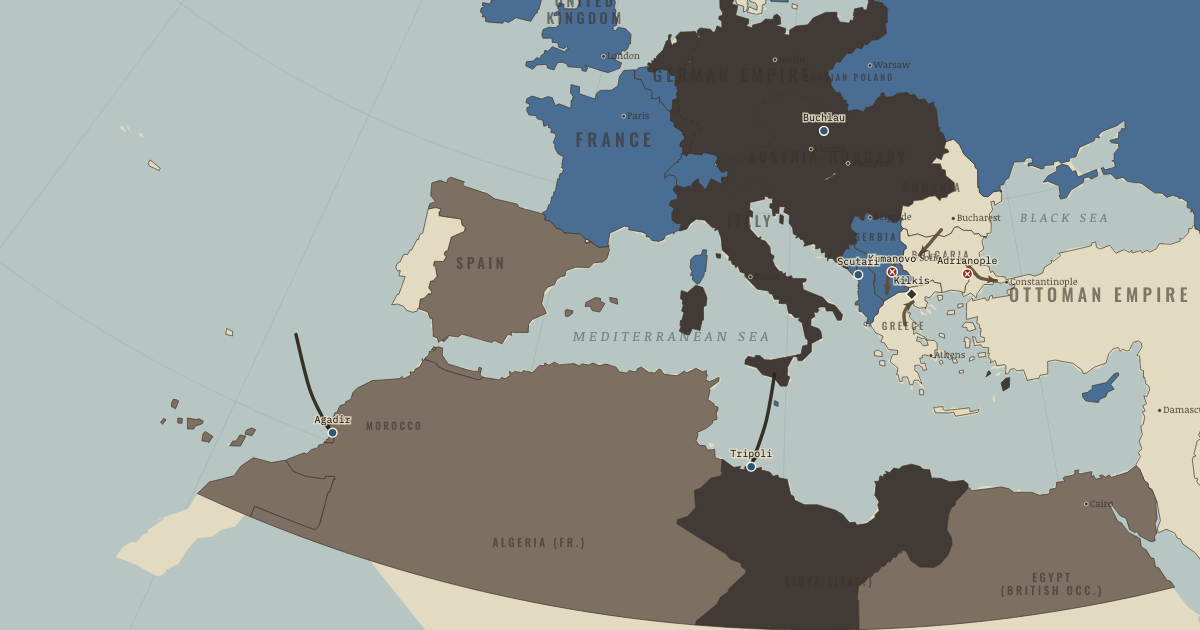
Austria-Hungary had administered Bosnia-Herzegovina since 1878, although the province remained formally Ottoman. In July 1908 the Young Turks, reforming officers, forced the Ottoman sultan to restore a constitution. Vienna feared that a revived Ottoman government might seek to reclaim Bosnia. Its foreign minister, Alois von Aehrenthal, met Russia’s Alexander Izvolsky at Buchlau castle in September. Izvolsky accepted annexation in return for Austrian support for opening the Straits between the Black Sea and Mediterranean to Russian warships. The bargain came apart when Vienna annexed Bosnia in October before Russia had secured passage through the Straits. In March 1909 Germany demanded that Russia recognize the annexation. Russia was unready for war and yielded. Bosnia turns from tan to charcoal on the map; in St Petersburg, an agreement made in private had ended in public humiliation.
From Bosnian crisis and the Balkan Wars, chapter 2 of The Great War, 1871–1923 (AUG 1913).
Teach this in 5 minutes
- Why it happened — The Ottoman retreat. The Ottoman Empire had lost Balkan territory since the Congress of Berlin. The Young Turk revolution of 1908 and Italy’s war against the empire in…
- The turn — The Bosnian crisis, September 1908 – March 1909. The bargain at Buchlau was meant to give each empire something: Austria-Hungary could annex Bosnia, and Russia could seek passage for warships…
- What it changed — The July Crisis follows the script. Sarajevo, where the assassination of June 1914 occurred, was the capital of the province annexed in 1908. Young Bosnian Serbs armed through the…
Then ask the room: Which of the three crises of 1908–1913 did most to make a general European war likely in 1914? The argued answer is on the chapter page →
The atlas that shows it
THE FREE PRINTABLE STUDY GUIDE
Get the printable study guide for WWI free. I’ll send you a few short letters, then one when a new atlas opens. That’s all. — Paul
NO TRACKING · YOUR ADDRESS IS USED FOR THE DISPATCH AND NOTHING ELSE · UNSUBSCRIBE ANYTIME