MAPS OF HISTORY · THE QUESTIONS · “The dictators intervened and the democracies…
The Road to War, 1931–1941 · 1937
“The dictators intervened and the democracies did not — that is the history of the Spanish war in one sentence.” Fair?
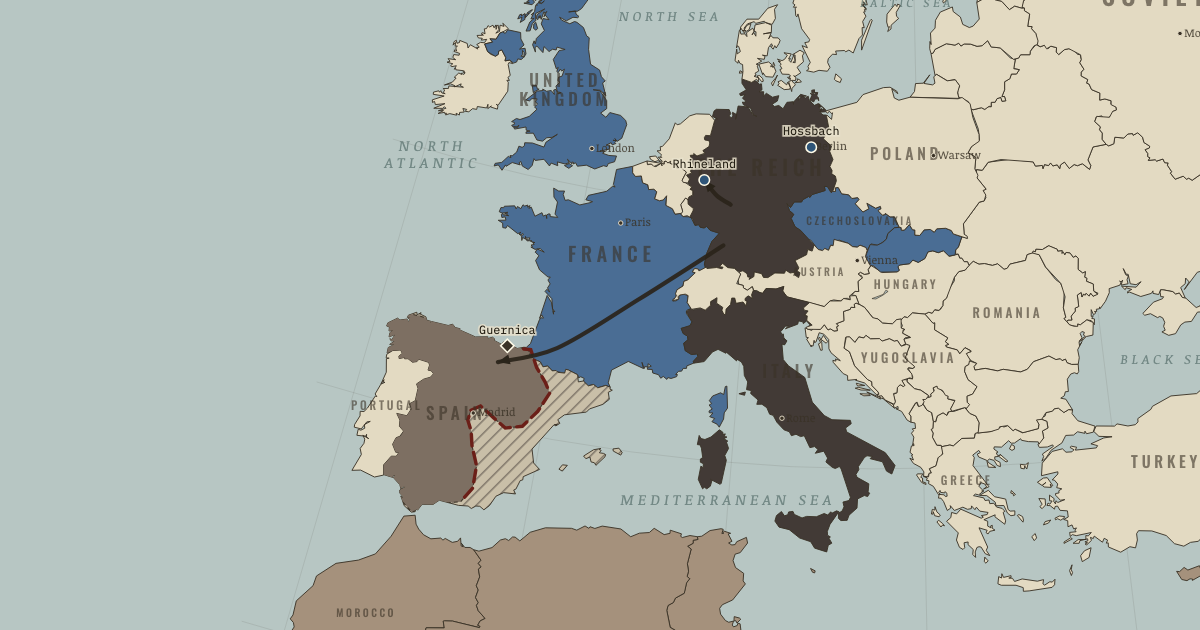
On 7 March 1936 a small German force entered the demilitarised Rhineland carrying orders to withdraw the moment France moved against it. France would not act without Britain, and it feared that even a limited response might demand a full and politically ruinous mobilisation. Britain, for its part, saw only Germans entering German soil. The bluff succeeded, and its success did more than recover territory, because it made France’s promises to defend its eastern allies far harder to keep.
THE SHORT ANSWER
- Versailles’ last physical restraint was psychological. The demilitarized Rhineland worked only as long as Germany believed violating it meant war. By March 1936 Hitler had strong evidence it did not: the Abyssinian crisis had shattered Stresa, Britain had signed away naval limits, and France — whose military doctrine was entirely defensive, built around the Maginot Line — had no plan on the shelf for a limited counter-march. He also had a legal fig leaf ready: the Franco-Soviet pact, ratified that February, was “encirclement,” so Locarno was void. Each gamble recycled the proceeds of the last.
- France would not fight alone; Britain would not fight at all. French intelligence roughly tripled the size of the German force; the general staff answered every ministerial question with “general mobilization” — political suicide weeks before an election. Britain, the co-guarantor of Locarno, made clear it would not support action; Eden proposed negotiation. The deeper cause: French security thinking had been outsourced to allies and concrete since 1918, and neither could march. It is the clearest case in the decade of a war-winning move declined at near-zero military cost.
- Spain’s war was internal first, international second. The Republic of 1931 had attempted, in five years, land reform, army reform, regional autonomy and the separation of church and state — each making mortal enemies; the February 1936 Popular Front election was won narrowly amid mutual fear. The rising of July was planned by Spanish generals for Spanish reasons. But the interventions transformed it: German and Italian arms made Franco’s victory possible, Soviet aid and the International Brigades prolonged resistance, and the war became — as everyone at the time said — the dress rehearsal in which the coming war’s sides, weapons and moral abandonments were all tried on.
- Non-intervention institutionalized the double standard. The Anglo-French embargo applied evenly to an elected government and to rebels — formally neutral, materially decisive against the side with no other legal suppliers. The policy flowed from real fears (a general war, Bolshevism in Madrid, French internal division) but its effect was to teach both dictators that the democracies would police their own citizens’ aid to a fellow democracy more energetically than fascist expeditionary corps. Blum wept when he signed; Hitler drew conclusions.
THE TURN
The Rhine bridges, 7 March 1936. Several historians place the “last chance to stop Hitler cheaply” here, and the case is strong. The operation was reversible by design, and the Wehrmacht was two years from readiness. A French division crossing the border would have forced a withdrawal. Hitler’s own generals believed the regime might not survive that humiliation. Instead, the gamble returned three dividends. Strategically, the West’s door into Germany closed while Germany’s door to the East opened. Politically, the generals who had counseled caution were discredited before their Führer. Psychologically, Hitler’s conviction that democracies always blink hardened into doctrine. The debate matters because France paid from 1939, at compound interest, the price it declined to pay in 1936.
WHAT IT CHANGED
Belgium bolts, the Maginot logic breaks. Watching Locarno die unenforced, Belgium renounced its French alliance in October 1936 and returned to neutrality — so the fortified line France had built stopped at exactly the border the Germans would come through in 1940 (Ch. 9). Deterrence failures cascade: each ally that hedges makes the next more likely to.
The Axis names itself over Spanish battlefields. Joint intervention in Spain gave Berlin and Rome their first working partnership — the “Rome–Berlin Axis” is coined in October 1936, the Anti-Comintern Pact with Japan follows a month later. The coalition of the revisionists assembles not by treaty first, but by practice.
Air terror is normalized before the war begins. Guernica, and the Japanese bombing of Chinese cities the same year (Ch. 6), put civilian bombing into the world’s repertoire while the world watched. The bomber-dread that shaped Munich — “the bomber will always get through” — was manufactured in Spain; so was the operational skill of the Luftwaffe crews who would open the next war over Warsaw.
THE FULL ANSWER, ARGUED
As a summary of state policy, nearly: Germany and Italy committed air forces, armor and (in Italy’s case) an army; Britain and France embargoed both sides, which in practice meant the Republic. But the sentence hides three complications. The USSR did intervene — arms, advisers, and the NKVD, whose imported purges against Trotskyists and anarchists (the Barcelona May Days of 1937) corroded the Republic from within and let Franco’s propaganda cast the war as Christianity versus Bolshevism. Some 35,000 International Brigade volunteers from fifty countries intervened where their governments refused, a moral datum the state-centric sentence erases. And “the democracies” were not monolithic: Blum’s France leaked aid across the Pyrenees in cycles of open and closed borders. The deeper question the war still poses — when does non-intervention become intervention on the stronger side? — has outlived every participant.
AN INTERESTING FACT
The Condor Legion’s after-action studies of Spain rewrote the German air force’s manuals: dive-bombing doctrine, fighter tactics (the loose two-plane Rotte that every air force eventually copied), and close air support were all debugged there — the legion’s young chief of staff, Wolfram von Richthofen, cousin of the Red Baron, would apply the lessons over Poland, France and Crete. Spain was also where the Luftwaffe learned to rotate crews through combat for experience: by 1939 it possessed the world’s only large corps of battle-tested airmen, a fact that cost Europe dearly in the war’s first year.
This is the study layer of Chapter 5 — The Rhineland Bluff and the Spanish Rehearsal in The Road to War, 1931–1941; the full index of the atlas is here.
SEE IT MOVE ON THE INTERACTIVE MAP →New here? Chapters 1–2 of every atlas are free to sample, and the WW2 atlas is free in full. One membership opens all thirteen — the Cartographer’s Circle.
MORE QUESTIONS FROM THE ROAD TO WAR
THE DISPATCH
One short letter when a new atlas opens — and the printable study guide for The Road to War is yours now, free.
NO TRACKING · YOUR ADDRESS IS USED FOR THE DISPATCH AND NOTHING ELSE · UNSUBSCRIBE ANYTIME