Crusades · 1291
Were the crusades worth it, or is that the wrong question?
The seminar question: “Were the crusades “worth it,” and what can that question tell us?”
By 1291 mainland Outremer was gone, Cyprus alone remained Latin and Muslim Iberia had shrunk to Granada; a Christian-held Jerusalem had lasted less than a lifetime. Their legacies include the Rhineland massacres of 1096, the weakening of Byzantium in 1204, a lasting Catholic–Orthodox grievance and a portable model of holy war.
Chapter 12 is included with every paid plan. WW2 is free in full, and chapter 1 of every atlas is free. A free account opens 3 more chapters a day. Starter, at $9 a month, opens all 21 with no daily limit — see the plans.
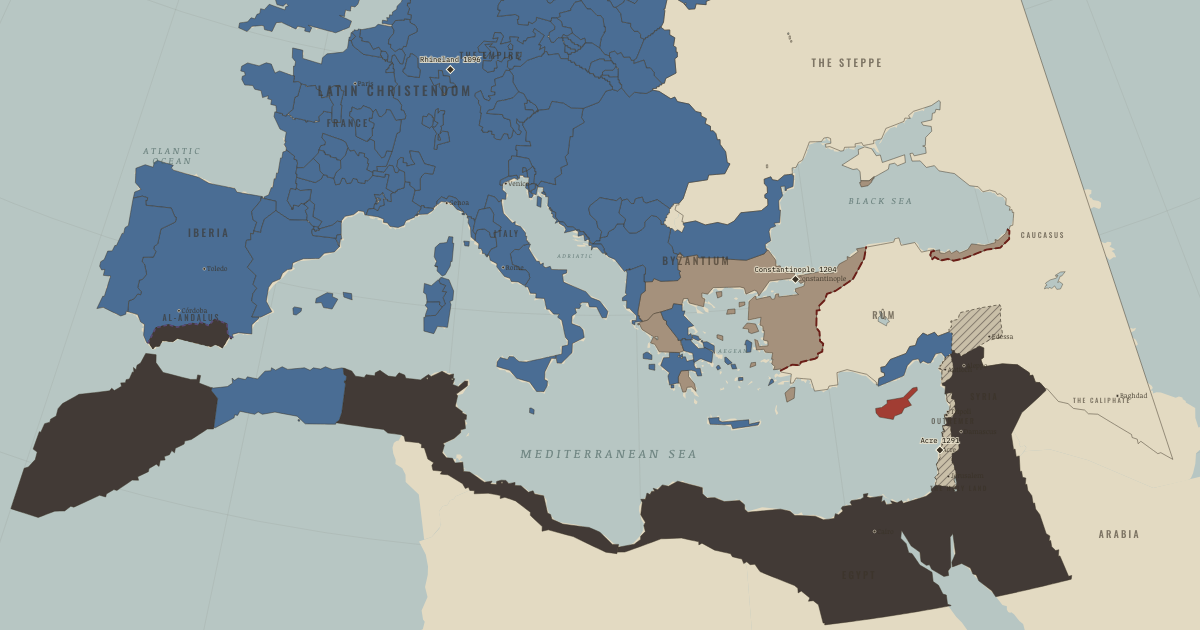
The final map shows mainland Outremer gone, Cyprus still Latin and al-Andalus reduced to Granada. Jerusalem, the object of the First Crusade, had been under Latin Christian rule for less than a lifetime across two centuries. The expeditions failed to secure it permanently. Those centuries may also have cost a million lives, but medieval death tolls are exceptionally uncertain; the cost chart must be read with that uncertainty in mind.
The short answer
- The states were always demographically hollow. The Latin states depended on a comparatively small settler population and on outside support. Divisions among neighboring powers gave them opportunities, while diplomacy, fortresses and Western expeditions helped them survive. Zengi, Nur al-Din, Saladin and later the Mamluks assembled power in different ways. As the balance changed, the coast had fewer resources of its own with which to respond.
- Islam unified; Christendom did not. Muslim rulers were not one permanently united bloc. Nevertheless, successive powers assembled substantial resources in Syria and Egypt. Western expeditions came at intervals and could be divided by rivalry. In the final campaigns, the Mamluks could draw on regional revenue and armies repeatedly, a capacity the coastal states could not match.
- The idea outgrew the place. The Holy Land had ceased to be crusading’s only destination before the mainland states fell. By 1300 campaigns had also been directed toward Iberia, the Baltic, heresy and the papacy’s political enemies (Ch. 9). Because spiritual incentives and legal privileges could be attached to different wars, the institution could continue after Outremer was lost.
THE TURNING POINT
Acre, 18 May 1291 — the end, and the beginning of memory. On 18 May 1291 Acre fell, ending the mainland crusader states. The loss prompted mourning and plans for recovery. Later generations would argue over martyrdom, conquest and what the enterprise had made. The political states were gone, but crusading and the dispute over its history continued.
What it changed
A catastrophe for Europe’s Jews. Jewish communities suffered devastating massacres in 1096 and later attacks. Christian Europe’s persecution continued long after those expeditions, through expulsions, blood libels and ghettoization. Crusading violence formed part of that wider history.
A maimed Byzantium, an advancing Islam. The Fourth Crusade’s sack in 1204 weakened Byzantium and deepened the Catholic–Orthodox divide. The restored empire survived, but later political and military developments added to its difficulties before the Ottomans conquered Constantinople in 1453. The frontier between Christian and Muslim powers moved into Europe.
A word that would not die. “Crusade” remains a metaphor in politics and ordinary speech. Its medieval meaning was more specific: an authorized campaign associated with spiritual rewards and legal privileges, directed at a changing range of places and enemies.
The full answer, argued
We can judge particular acts, but a single balance sheet has difficulty capturing what the participants thought they were doing. Many undertook a penitential act in obedience to God, hoping to save their souls, rather than investing for a worldly return. Taking that belief seriously does not prevent us from judging their violence. The expeditions failed to secure a lasting Christian-held Jerusalem. Trade and learning crossed regions, although other routes existed already; Jewish communities, Byzantium and many civilians suffered grievously. The estimate of perhaps a million deaths is uncertain. Alongside judgment, the historian has other questions: why people went, how a fragile settler society survived so long, and why it eventually fell.
An interesting fact
Saladin’s reputation has traveled across cultures. Kaiser Wilhelm II visited his Damascus tomb in 1898, laid a gilded bronze wreath and paid for a new marble sarcophagus. Western chivalric stories helped shape modern interest in the sultan, while his reputation in Muslim traditions had its own history. In 1918, twenty years after the Kaiser’s visit, Ottoman Damascus fell and T. E. Lawrence took the wreath. It is now in London’s Imperial War Museum. The object shows later visitors taking up a medieval ruler’s memory for purposes of their own.
This is the study layer of Legacy of the Crusades, chapter 12 of The Crusades, 1095–1291; the full index of the atlas is here.
Related questions
THE FREE PRINTABLE STUDY GUIDE
Get the printable study guide for The Crusades free. I’ll send you a few short letters, then one when a new atlas opens. That’s all. — Paul
NO TRACKING · YOUR ADDRESS IS USED FOR THE DISPATCH AND NOTHING ELSE · UNSUBSCRIBE ANYTIME