Crusades · 1271
Why did Europe not send a fleet to save Acre in 1291?
The seminar question: “Why did no European fleet save Acre in 1291?”
After Jerusalem was lost for good in 1244, the Mamluks, who seized Egypt in 1250 and halted the Mongols at Ain Jalut in 1260, took the crusader strongholds one by one under Baibars and his successors. Antioch fell in 1268, Krak des Chevaliers in 1271, Tripoli in 1289 and Acre on 18 May 1291, ending mainland Outremer.
Chapter 11 is included with every paid plan. WW2 is free in full, and chapter 1 of every atlas is free. A free account opens 3 more chapters a day. Starter, at $9 a month, opens all 21 with no daily limit — see the plans.
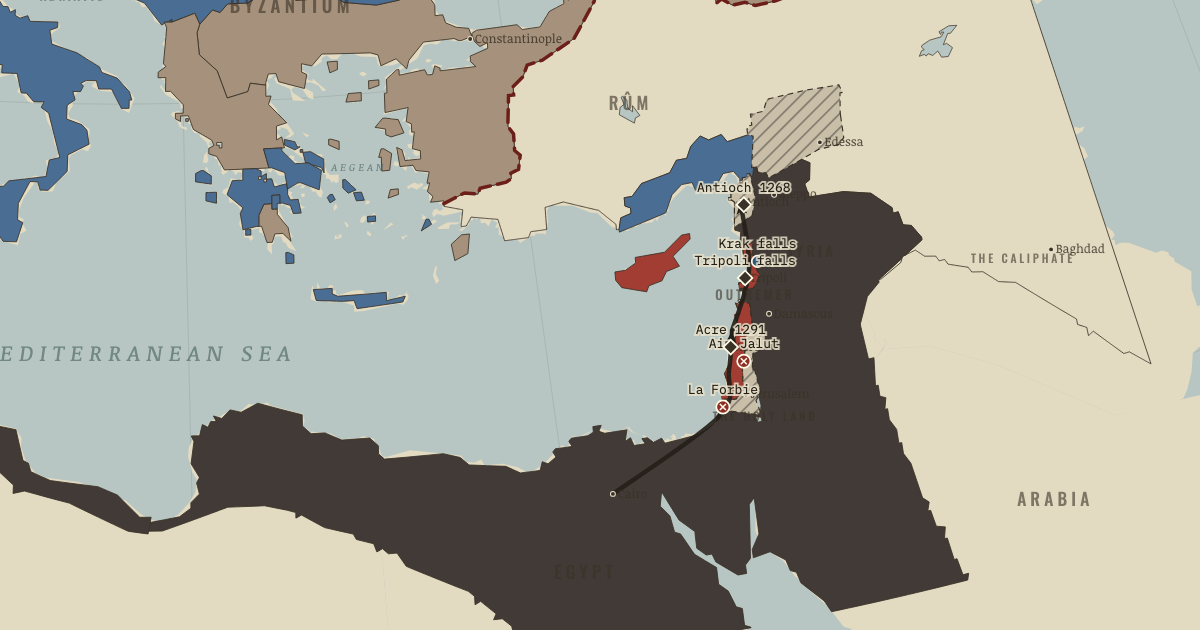
The army destroyed at La Forbie, near Gaza, in 1244 represented a chance for the Franks and their Damascene allies to resist together. Egyptian forces and Khwarezmian mercenaries, who had just sacked Jerusalem, defeated them. Jerusalem was lost, and Outremer would not again field an army of comparable size. The crusader states faced a further change in the balance of power when the Mongols destroyed Baghdad and the Abbasid caliphate. At Ain Jalut in Galilee in 1260, Egypt’s Mamluks checked a Mongol army. Their victory strengthened their position in Syria and gave the new regime prestige as a defender of Islam.
The short answer
- The Mamluk military state. The Mamluks replenished their military elite by purchasing and training young soldiers. Once freed, men could advance through service and patronage. Egyptian revenue supported armies and sieges, and rulers invoked jihad to legitimate attacks. Together these gave Egypt a regional military power able to campaign against the coast repeatedly.
- The Mongol shock, survived. The destruction of Baghdad and the Abbasid caliphate showed the reach of Mongol power and alarmed Muslim rulers and crusaders alike. Some Franks hoped for a Mongol ally against Muslim neighbors. At Ain Jalut the Mamluks checked the advance and gained prestige as defenders of Islam. Frankish–Mongol cooperation remained possible afterward, but it did not save Outremer.
- European disengagement. Western rulers had to raise money and assemble forces far from the coast. Crusade taxes were sometimes diverted, papal and imperial disputes impeded cooperation, and kings faced competing wars and obligations. Crusading in Iberia, the Baltic and Italian politics drew attention and resources too. The aid that reached Outremer never matched the Mamluks’ capacity for repeated campaigns.
THE TURNING POINT
Ain Jalut, 3 September 1260. On 3 September 1260, the Mamluks defeated a Mongol force at Ain Jalut in Galilee, checking an advance that had reached Syria. The victory gave the new Egyptian regime prestige as a defender of Muslim lands and strengthened its regional position. It did not make Outremer’s fall inevitable, but it strengthened the power Baibars and his successors would bring against the coast.
What it changed
Outremer erased. On the map, the coast turns to lost-hatch. Acre’s fall in 1291 ended the mainland crusader states born after the First Crusade in 1099; Cyprus remained under Latin rule.
The orders relocate. The orders continued after losing the mainland. The Hospitallers later established themselves on Rhodes and then Malta, and the Teutonic Knights built a Baltic state. The Templars withdrew to Cyprus; following action by the French king and the papacy, their order was suppressed in 1307–14.
Crusading survives its object. The loss of the states did not end crusading. Plans to recover the Holy Land continued for centuries, as did crusade taxes and the language of holy war. The idea had purposes beyond holding the coast.
The full answer, argued
Acre received outside help, but no force arrived that could break the siege. Raising and transporting a large expedition was costly. Kings faced other wars and obligations, papal and imperial disputes had impeded cooperation, and crusade taxes had sometimes been diverted. The failed expeditions against Egypt also showed how difficult it was to establish a lasting regional base. Even a fleet that saved Acre temporarily would have left the question of how to supply men, money and strongholds for its continuing defense. The Mamluks could draw on regional resources more readily than the remaining coastal states.
An interesting fact
The anonymous Templar of Tyre witnessed Acre’s fall and served as secretary to Grand Master William of Beaujeu. He describes Beaujeu being struck by a javelin in the breach. When men thought he was withdrawing, the master showed them his wound and answered: “I am not fleeing; I am dead,” Acre was not quite the last Latin foothold. The Templars held Ruad, a waterless islet two miles off Tortosa, until 1302–03, when its garrison surrendered and was taken into captivity in Cairo.
This is the study layer of Fall of the crusader states, chapter 11 of The Crusades, 1095–1291; the full index of the atlas is here.
Related questions
THE FREE PRINTABLE STUDY GUIDE
Get the printable study guide for The Crusades free. I’ll send you a few short letters, then one when a new atlas opens. That’s all. — Paul
NO TRACKING · YOUR ADDRESS IS USED FOR THE DISPATCH AND NOTHING ELSE · UNSUBSCRIBE ANYTIME