WW2 · NOV 1943
Why did the Allies bypass Rabaul instead of capturing it?
The seminar question: “Why isolate a fortress such as Rabaul, with its roughly 100,000-man garrison, instead of assaulting it?”
The Allied Pacific counteroffensive began at Guadalcanal in August 1942. MacArthur advanced through New Guinea and Nimitz across the Central Pacific, leapfrogging strongholds such as Rabaul, while US submarines sank much of Japan’s merchant fleet. At Leyte Gulf in October 1944 much of Japan’s remaining fleet was destroyed.
WW2 is free — every chapter. No sign-up.
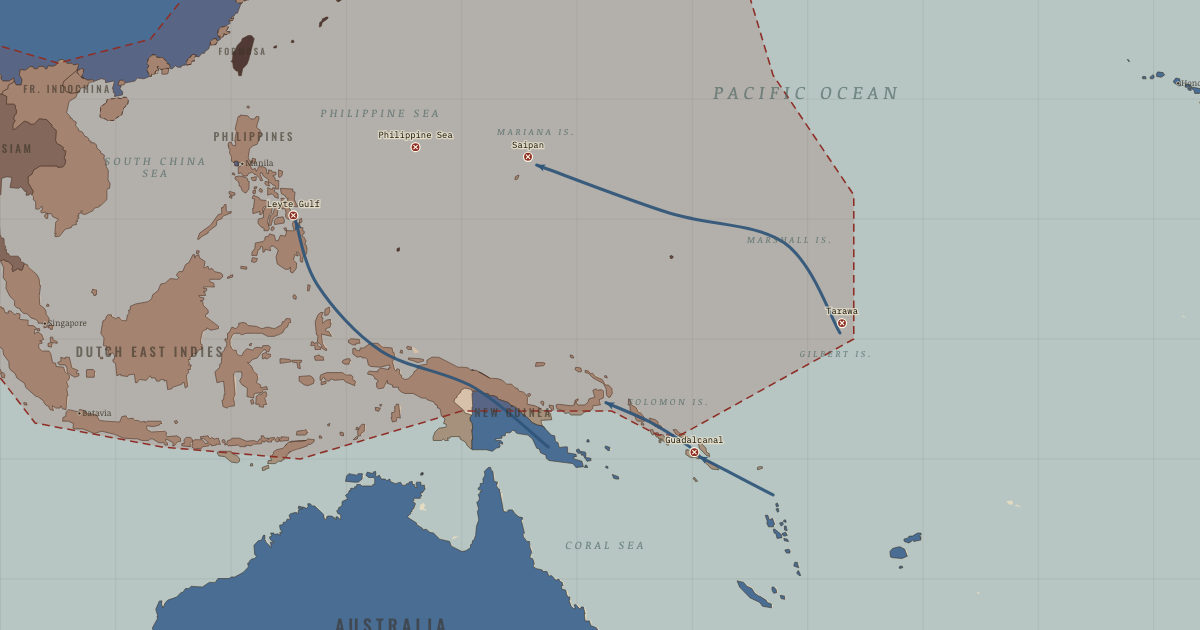
The fighting at Guadalcanal showed both what an Allied advance could achieve and what it might cost. Beginning in August 1942, the first sustained Allied ground offensive of the Pacific war drew men, ships and aircraft from both sides into six months of fighting. Tropical disease added enormously to the losses. When Japan evacuated the island in February 1943, the Allies had pushed back its perimeter. Yet a campaign that required a similar struggle for every defended island would be terribly expensive.
The short answer
- Distance and supply. A Pacific offensive needed support over immense distances. Tankers carried fuel, floating dry docks repaired ships, and Seabee battalions built airfields. America's mobile fleet-base system brought that support forward. Japan's garrisons depended on sea routes too, but without a comparable system they went short as those routes became vulnerable.
- Two routes across the Pacific. MacArthur's Army-led advance in the southwest and Nimitz's Navy-led drive through the center reflected rivalry between the services. Maintaining parallel offensives could waste effort, yet it also confronted Japan with several possible directions of attack. Defenders could not know in advance which position would be chosen.
- The submarine campaign. Japan's island empire depended on ships to carry imported resources. American submarines sank more than half its merchant marine, steadily reducing the capacity to make those journeys. By 1945 the blockade was a major part of the pressure on Japan.
THE TURNING POINT
Guadalcanal, August 1942–February 1943. Guadalcanal drew both sides into six months of fighting on land, at sea and in the air. Japan's evacuation in February 1943 gave the Allies territory back, but the struggle also showed the determination of Japanese defenders and the importance of American production and replacement capacity. Both would shape the campaigns through 1945.
What it changed
A shrinking perimeter. The red line retreats as the Allies take the Gilberts, Marshalls and Marianas in sequence. Each captured position helps expose the next. Behind that moving front, hundreds of thousands of men in bypassed garrisons face shortages and isolation; some grow food while waiting for relief.
The Marianas and Japan. The Marianas offered a base from which B-29 bombers could reach Tokyo. Their loss in June 1944 also contributed to the fall of General Tojo's government. The islands became a starting point for the endgame.
India and Burma. Japan's invasion of India was defeated at Imphal and Kohima in spring 1944 by Allied forces including Indian divisions. The defeat helped turn the fighting toward Burma and exposed the limits of Japan's claim to be Asia's liberator.
The full answer, argued
The roughly 100,000 men at Rabaul could not make their strength count against the advance once Allied air and sea power suppressed their aircraft and cut supply, movement and communications. Assaulting them would risk heavy casualties for a position the Allies could leave behind. The comparison with Stalingrad is structural: a strongpoint depends on the system supporting it.
An interesting fact
In the Solomons on 2 August 1943, a Japanese destroyer struck the torpedo boat PT-109. Its 26-year-old skipper, John F. Kennedy, helped a burned crewman toward an islet, towing him by a life-jacket strap clenched in his teeth. Two Solomon Islander scouts working with Allied coastwatchers, Biuku Gasa and Eroni Kumana, found the survivors. They carried a rescue message carved into a coconut husk through Japanese-held waters. Kennedy later kept the coconut on his Oval Office desk; it is displayed at his presidential library.
This is the study layer of Pacific island-hopping campaign, chapter 11 of The War Room — WW2, 1936–1945; the full index of the atlas is here.
Related questions
THE FREE PRINTABLE STUDY GUIDE
Get the printable study guide for WW2 free. I’ll send you a few short letters, then one when a new atlas opens. That’s all. — Paul
NO TRACKING · YOUR ADDRESS IS USED FOR THE DISPATCH AND NOTHING ELSE · UNSUBSCRIBE ANYTIME