WW2 · JUN 1940
Why did France collapse in six weeks in 1940?
The seminar question: “France had more tanks and artillery, and comparable manpower. Why did its armies collapse so quickly?”
In April 1940 Germany occupied Denmark and invaded Norway, and on 10 May it attacked the Low Countries and France. While the Allies advanced into Belgium, German armour crossed the Ardennes, forced the Meuse at Sedan and reached the Channel. About 338,000 troops escaped from Dunkirk, but France collapsed within six weeks.
WW2 is free — every chapter. No sign-up.
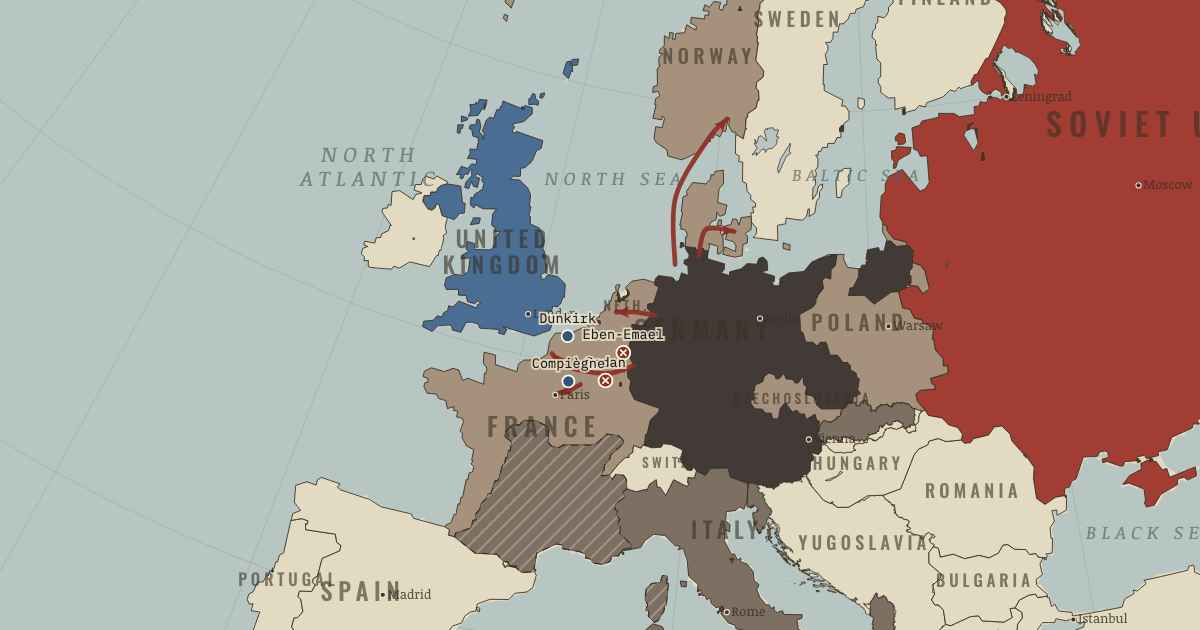
Germany’s invasion of Norway in 1940 had an immediate purpose. Swedish iron ore reached the sea through Narvik in winter, and control of Norway protected that route. Norwegian ports and airfields also gave Germany bases facing the Atlantic. The campaign brought a loss as well as a gain: the German navy lost warships that would have mattered when an invasion of Britain was considered later that year.
The short answer
- Concentrating the armor. France had many capable tanks and assigned much of its armor to infantry support. Germany brought tanks and other arms together in formations coordinated by radio, allowing force to be concentrated at a breakthrough.
- Risk through the Ardennes. The revised German plan sent its main weight along a route the Allies thought unsuitable for a large, rapid armored advance. That choice offered surprise, but crowded columns on narrow roads were exposed.
- Norway’s gain and cost. Norway protected Swedish ore shipments and offered Atlantic bases. The warships Germany lost there were unavailable to cover a later invasion of Britain.
THE TURNING POINT
The crossing at Sedan, 13–15 May. On 13–15 May German forces crossed the Meuse at Sedan under concentrated air attack. French command was too slow to organize a counterattack, and the bridgehead grew. Reserves could not seal the breach before it threatened the wider Allied position.
What it changed
Trained troops survive. A pause in the German advance and the Luftwaffe’s failure helped about 338,000 Allied troops escape from Dunkirk. Britain abandoned much equipment but kept trained personnel for the war ahead.
Britain remains at war. Defeat in France left Britain facing invasion and pressure to seek terms. Churchill’s government chose to fight on, making control of the air the next test.
Other powers move. Italy entered the war as France fell, while the USSR annexed the Baltic states and Bessarabia. Germany’s rapid victory changed what other powers could attempt in Europe.
The full answer, argued
The totals do not tell us where the forces were or how quickly they could be used. France sent its mobile reserve north and prepared for a controlled battle. Germany concentrated combined arms through the Ardennes, crossed at Sedan, and used radio communications to exploit the breach. The drive to the coast severed communications and separated the Allied armies before France could restore its front.
An interesting fact
Some 41,000 vehicles of Panzergruppe Kleist queued for the Ardennes advance, in columns stretching 250 kilometers back beyond the Rhine. For days they were exposed to air attack. Allied reconnaissance pilots reported seeing the columns, including headlights burning on the night of 10–11 May, but headquarters continued to expect that the Ardennes was unsuitable for a major tank advance.
This is the study layer of Fall of France, chapter 3 of The War Room — WW2, 1936–1945; the full index of the atlas is here.
Related questions
THE FREE PRINTABLE STUDY GUIDE
Get the printable study guide for WW2 free. I’ll send you a few short letters, then one when a new atlas opens. That’s all. — Paul
NO TRACKING · YOUR ADDRESS IS USED FOR THE DISPATCH AND NOTHING ELSE · UNSUBSCRIBE ANYTIME