MAPS OF HISTORY · THE QUESTIONS · Britain and France could probably have stopped…
The War Room — WW2, 1936–1945 · SEP 1938
Britain and France could probably have stopped Hitler cheaply in 1936–38. Why didn’t they?
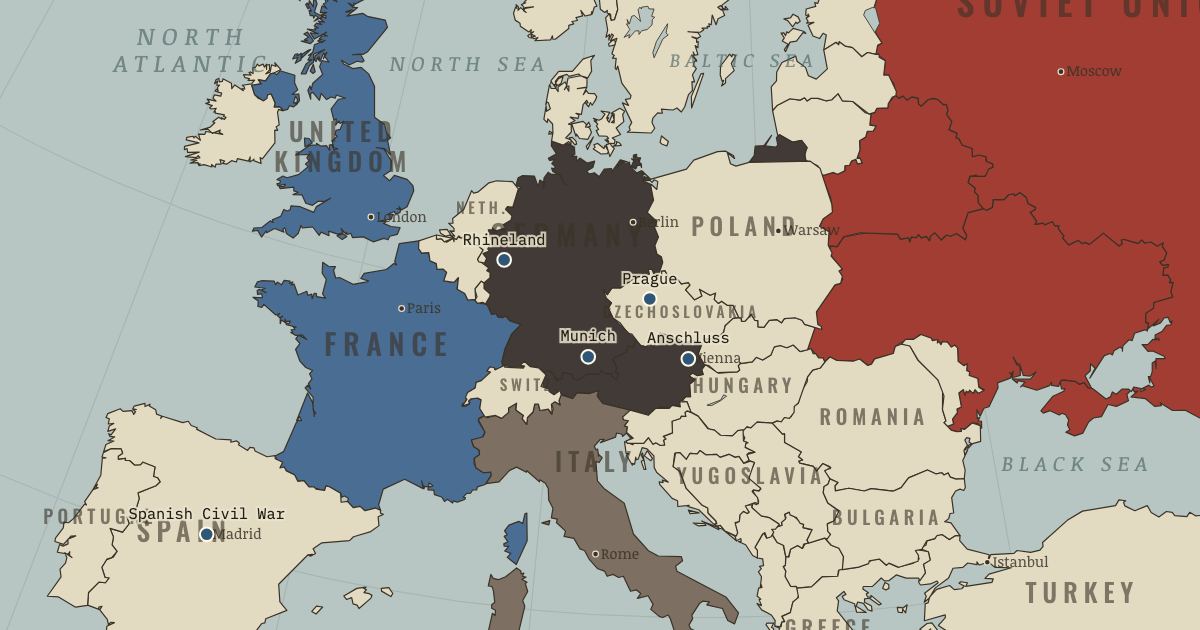
The path to war worked as a repeated experiment, in which Germany broke part of the postwar order and then waited to see whether anyone would answer with force. When German troops reoccupied the demilitarized Rhineland in 1936, France and Britain protested but did not fight, even though France had the strength nearby to intervene. Hitler drew a lesson that shaped everything after, which was that a limited and rapid move could change the facts on the ground before hesitant democracies agreed how to respond. German intervention in the Spanish Civil War taught related lessons, since it let the Luftwaffe test aircraft, crews, and tactics while presenting expansion as a crusade against communism.
THE SHORT ANSWER
- Versailles and Nazi revisionism. The 1919 settlement reduced German territory and armed strength. Nazi propaganda converted widespread resentment into support for expansion and falsely presented each breach as a limited correction.
- Depression and political weakness. Economic crisis discredited moderate parties and helped the Nazis reach power. It also constrained British and French military spending and made another major war politically difficult.
- Memory of 1914–18. Leaders and voters feared another industrial slaughter. They accepted risk now to delay war, partly because they believed additional time would improve rearmament.
- Failed collective security. Weak responses to Japan in Manchuria and Italy in Abyssinia showed that League of Nations sanctions lacked enforcement. Germany learned that rapid action could outrun collective decisions.
THE TURN
Munich, 30 September 1938. Munich changed expectations. Hitler concluded that pressure would bring further concessions. Stalin concluded that the Western powers might not form a reliable anti-German front. Both readings helped make the Nazi–Soviet Pact possible.
WHAT IT CHANGED
Czechoslovakia becomes vulnerable. The Sudetenland contained major border defenses. Its loss exposed the state and helped Germany seize the rest in March 1939, together with the Škoda arms works.
Stalin considers a German agreement. Soviet exclusion from Munich deepened distrust of Britain and France. A temporary bargain with Berlin now appeared to offer time and a security buffer.
Britain guarantees Poland. After Prague, Britain made a clearer commitment to resist further expansion. Hitler misread it as another bluff, making the next crisis far more dangerous.
THE FULL ANSWER, ARGUED
Several constraints combined: fear of another mass war, limited readiness, economic pressure, divided public opinion, and the mistaken belief that Hitler had limited aims. Appeasement also bought useful rearmament time. Its central failure was diagnostic: leaders negotiated as if the dispute concerned specific borders, while Hitler treated each concession as a step toward a larger racial empire.
AN INTERESTING FACT
Only about 3,000 German soldiers actually crossed the Rhine bridges in March 1936 — and the famous story that they carried orders to retreat at the first French shot, retold ever since, is one historians now doubt. What is documented is the perception gap: French intelligence credited Germany with nearly 300,000 men in and behind the zone, roughly ten times the reality. Hitler later called the forty-eight hours after the march the most nerve-racking of his life. Inflated numbers and weak nerves reinforced each other — they usually do.
This is the study layer of Chapter 1 — The Gathering Storm in The War Room — WW2, 1936–1945; the full index of the atlas is here.
SEE IT MOVE ON THE INTERACTIVE MAP →The WW2 atlas is free in full — no sign-up.
MORE QUESTIONS FROM WW2
THE DISPATCH
One short letter when a new atlas opens — and the printable study guide for WW2 is yours now, free.
NO TRACKING · YOUR ADDRESS IS USED FOR THE DISPATCH AND NOTHING ELSE · UNSUBSCRIBE ANYTIME