MAPS OF HISTORY · THE QUESTIONS · Why would two sworn ideological enemies —…
The War Room — WW2, 1936–1945 · SEP 1939
Why would two sworn ideological enemies — fascism and communism — sign a pact?
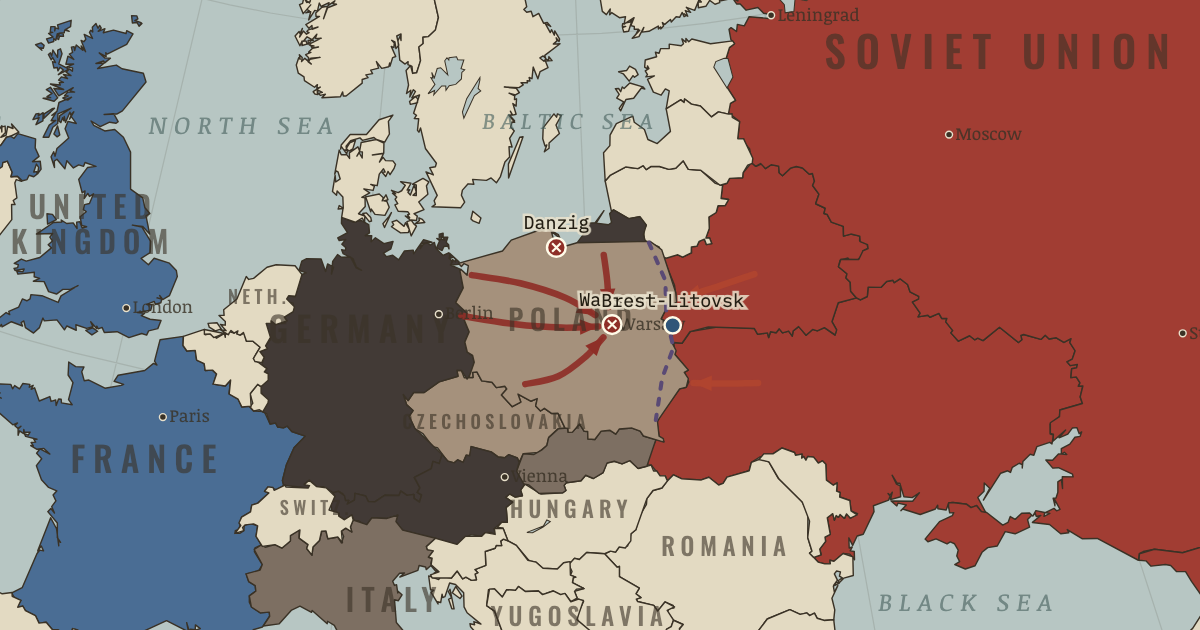
The pact was a temporary bargain between ideological enemies, and each side entered it for a concrete short-term gain. Hitler removed the danger of a war on two fronts and secured Soviet grain, oil, and metals that would blunt any British blockade. Stalin gained time to rebuild an army recently gutted by his own purges, together with territory that pushed the Soviet frontier westward as a buffer. The secret protocol drew a line through Eastern Europe, and the partition of Poland simply followed that line. Because the two regimes still meant to destroy each other, both treated the partnership as a pause rather than a peace.
THE SHORT ANSWER
- Soviet distrust after Munich. Stalin doubted that Britain and France would form an effective anti-German alliance. A deal with Germany offered time, territory, and distance from a future front.
- Hitler avoids two fronts. The pact neutralized the USSR during the Polish campaign and opened Soviet trade. Hitler expected Britain and France either to retreat again or to fight without decisive effect.
- Danzig as pretext. The status of Danzig and the Polish Corridor supplied public demands. Hitler’s wider aim was Lebensraum, or living space, and the destruction of an independent Polish state.
THE TURN
First shots, 1 September, 04:47. The battleship Schleswig-Holstein fired on the Polish depot at Westerplatte. Its 182 defenders resisted for seven days. The local defense could not reverse the invasion, but it showed that rapid strategic defeat did not mean an absence of resistance.
WHAT IT CHANGED
The Phoney War begins. Britain and France were formally at war but remained largely inactive on the western land front for eight months. Germany gained time to prepare its next campaign.
Two systems of occupation. Nazi authorities targeted Polish elites, clergy, and Jews from the beginning. Soviet authorities deported hundreds of thousands and murdered about 22,000 Polish officers and prisoners at Katyn and related sites. Poland suffered the war’s highest proportional national loss.
The USSR expands its buffer. The Soviet Union absorbed eastern Poland and then attacked Finland. Finnish resistance exposed Soviet weaknesses and encouraged Hitler’s later, mistaken confidence that the USSR would collapse.
THE FULL ANSWER, ARGUED
Short-term strategy overrode long-term ideology. Hitler gained a one-front war and raw materials. Stalin gained time, territory, and a wider buffer while Germany fought the Western powers. Both expected a later conflict. The pact shows that ideological enemies can cooperate when the immediate balance of risk rewards both.
AN INTERESTING FACT
Five weeks before the invasion, Polish military intelligence summoned British and French officers to a bunker hidden in the Kabaty woods south of Warsaw and handed each delegation a working replica of the German Enigma machine — a cipher Polish mathematicians had been quietly breaking since 1932. Bletchley Park’s wartime codebreaking was built directly on that gift. The Polish state was erased from the map within weeks; the mathematics it smuggled out that July helped destroy its occupier six years later.
This is the study layer of Chapter 2 — The Pact and the Partition of Poland in The War Room — WW2, 1936–1945; the full index of the atlas is here.
SEE IT MOVE ON THE INTERACTIVE MAP →The WW2 atlas is free in full — no sign-up.
MORE QUESTIONS FROM WW2
THE DISPATCH
One short letter when a new atlas opens — and the printable study guide for WW2 is yours now, free.
NO TRACKING · YOUR ADDRESS IS USED FOR THE DISPATCH AND NOTHING ELSE · UNSUBSCRIBE ANYTIME