Industrial Revolution · 1914
Who gained most from the Industrial Revolution?
The seminar question: “Who gained most from the Industrial Revolution by 1914, and was the price worth paying?”
By 1900 Europe and the United States made about 85 per cent of the world’s manufactured goods, while China’s share fell to about six per cent and India’s to under two. By 1914 the City of London had invested about £4 billion abroad, real wages had risen since about 1850, and organised labour had become a political force.
Chapter 12 is included with every paid plan. WW2 is free in full, and chapter 1 of every atlas is free. A free account opens 3 more chapters a day. Starter, at $9 a month, opens all 21 with no daily limit — see the plans.
Free printable Industrial Revolution study guide, sent by email ↓
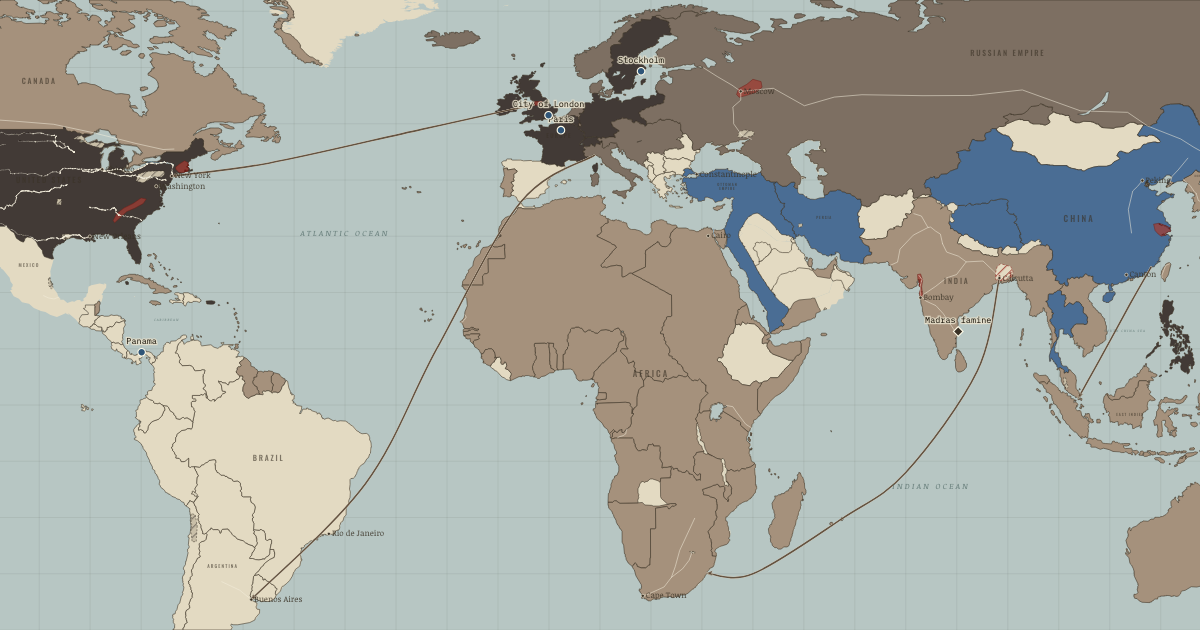
In 1750 Europe and the United States made less than a quarter of the world’s manufactured goods, according to Paul Bairoch’s estimates; China and India together made about 57 per cent. By 1900 the position had been transformed. Europe and the United States made about 85 per cent, while China’s share had fallen to about six per cent and India’s to under two. Industrial production had concentrated in a small group of countries.
The short answer
- Coal-powered productivity. Coal-powered machinery multiplied what each worker could produce. Britain mined about 287 million tons in 1913, its all-time peak, exporting about a third to fuel other countries’ ships and factories. Coal, capital and skills gave countries the means to build industrial wealth; countries without them, or prevented from using them, fell behind. Access to energy helped establish the divergence.
- Diffusion through states and markets. Countries that followed Britain did more than import its machines. Germany, the United States and Japan protected young industries, built railways and educated engineers. German investment banks supplied long-term industrial loans, while Japan’s Meiji government, the modernizing regime that took power in 1868, built model factories. By 1914 several industrial countries competed for markets, resources and colonies. Their success depended on adapting borrowed methods to local conditions.
- Empire and unequal exchange. Colonial rule and unequal treaties placed much of Asia and Africa in the position of supplying raw materials and buying manufactures. The treaties forced weaker states to accept low tariffs, or import taxes. Guaranteed returns for foreign investors and forced labor, including in the Congo Free State, King Leopold II of Belgium’s private colony, also directed gains toward industrial powers. Tan and blue on the 1914 map show the system’s reach. Political power helped determine who benefited from the technology.
- Workers and voters organised. Early industrial Britain’s losers organized to change their circumstances. Luddites smashed machines; Chartists demanded votes for working men; trade unionists and socialists built movements that helped win the vote, legal unions and early welfare laws. Similar movements spread across Europe, the United States and Japan. Their pressure helps explain why incomes became more equal after mid-century, although wealth did not. Reform came from below as well as from governments.
THE TURNING POINT
The City of London, 1914. By 1914 Britain was no longer simply the workshop of the world. Germany and the United States made more goods, but investors in the City of London, the capital’s financial district, held about £4 billion abroad, from Argentine railways to South African mines. Britain earned more from lending, shipping and insurance than it needed to pay for imports. Its industrial lead had helped make it the world’s banker. In August 1914 the interconnected powers went to war, turning their industrial capacity toward destruction.
What it changed
An industrial war. The First World War drew on steel, chemicals, railways and factories across whole economies. This was total war, using a nation’s economic resources for fighting; machine guns, heavy artillery and poison gas appeared on a scale the American Civil War had only foreshadowed. Estimates of military deaths range from about 9 to 11 million. The industrial powers had traded more with one another in 1913 than ever before. Interdependence alone had not kept the peace.
Catching up, slowly. Only in the late twentieth century did the Great Divergence between the industrial West and the rest begin to narrow. After 1945 many former colonies sought to industrialize behind tariffs, or import taxes. From the 1950s Japan, followed by South Korea, Taiwan and finally China, combined state guidance, protection and exports, as earlier latecomers such as Germany had done. Their success shows that later policy could alter conditions behind the nineteenth-century gap, including capital, technology and the power to set tariffs.
The carbon century. Coal and later oil powered the twentieth century. Atmospheric carbon dioxide rose from about 280 parts per million before industrialization to about 300 by 1914 and passed 400 in the 2010s. Arvid Högbom and Svante Arrhenius were among the first scientists to connect coal burning with a warmer planet. They worked in the industrial world on this map; the costs they glimpsed are now global.
The full answer, argued
Owners of capital and populations of the industrial core gained most clearly by 1914. They were richer, healthier and more numerous than any earlier society, and working classes had begun to share in the gains after 1850. Others paid without benefiting: enslaved people who grew cotton for the first mills, handworkers from Lancashire to Bengal who lost their trades, colonized suppliers, and those who died in famine or forced labor. Was the price worth paying? Evidence alone cannot settle that judgment, especially when those who paid and those who gained were mostly different people, often separated by continents and generations. Two considerations matter. Slavery, empire and minimal famine relief were political choices rather than inevitable features of industrial technology. The gains eventually spread far beyond the first industrial countries. Industrialization was a transformation worth having, achieved at a price far higher than necessary and paid by the wrong people.
An interesting fact
Arrhenius was not alarmed by his calculation. At the coal-burning rates of his day, he expected a doubling of carbon dioxide to take something like three thousand years. In Worlds in the Making (1908), he suggested that warming might bring milder, steadier weather and richer harvests to colder parts of the earth, including Sweden. He did not foresee the twentieth century’s growth in coal and oil use. Carbon dioxide has risen by about half in little more than a century and a half. Arrhenius got the direction right, but industry grew much faster than he anticipated, and his timetable was badly wrong.
This is the study layer of Impact of the Industrial Revolution, chapter 12 of The Industrial Revolution, 1750–1914; the full index of the atlas is here.
Related questions
THE FREE PRINTABLE STUDY GUIDE
Get the printable study guide for The Industrial Revolution free. I’ll send you a few short letters, then one when a new atlas opens. That’s all. — Paul
NO TRACKING · YOUR ADDRESS IS USED FOR THE DISPATCH AND NOTHING ELSE · UNSUBSCRIBE ANYTIME