Industrial Revolution · 1800
Was the factory a revolution in machines or in control?
The seminar question: “Was the factory system more a revolution in machines or a revolution in the control of work?”
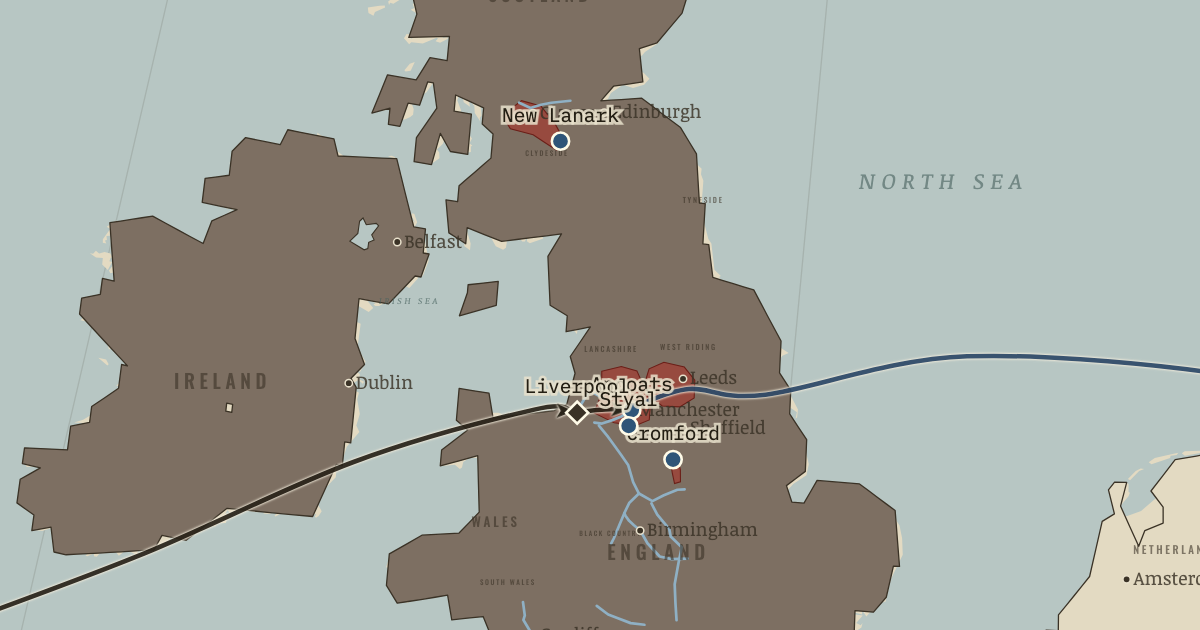
Between the 1760s and the 1780s Hargreaves’ spinning jenny, Arkwright’s water frame and Crompton’s mule mechanised cotton spinning. In 1771 Arkwright installed his machines in a mill at Cromford in Derbyshire and ran it in shifts, creating the factory, where workers tended powered machines under a manager’s rules.
WW2 is free in full, and chapter 1 of every atlas is free. A free account opens 3 more chapters a day. Starter, at $9 a month, opens all 21 with no daily limit — see the plans.
Free printable Industrial Revolution study guide, sent by email ↓
Indian calicoes gave British manufacturers a model and a problem. These light printed cloths filled English shops in the late seventeenth century, and customers wanted more. Parliament banned imports of printed calicoes in 1700 and their wearing in 1721. The Calico Acts sheltered British producers, but protection could not itself supply the cheap, strong thread they needed: hand spinning was too slow, and its thread too weak.
The short answer
- Indian cloth set the standard. Indian calicoes showed buyers a light, washable and inexpensive cotton printed in colors that did not run. To protect English wool, Parliament banned printed imports in 1700 and their wearing in 1721. British producers had an opening if they could match Indian quality and prices. Making at home what had previously been bought abroad is called import substitution; protection gave inventors room to attempt it.
- Machines that suited the fibre. Drawing and twisting cotton fibers requires repeated movements. Rollers, gears and spindles, the rods that spin thread, could perform them. The jenny multiplied spindles; the water frame made thread stronger; the mule made it finer; and carding engines prepared the fiber. Imported cotton did not compete for English farmland, so its supply could grow with the machines' output.
- Water power and modest capital. A stream, a building and a few thousand pounds could establish an early mill. A successful wigmaker, merchant or hosier, a stockings dealer, could seek that money from partners and local banks. Former wigmaker Richard Arkwright joined the Derby hosier Jedediah Strutt; Samuel Greg drew on his family's merchant and plantation wealth for Styal. Fast streams in the Pennine valleys of Derbyshire and Lancashire lay within reach of ports and markets. Those conditions drew the first factories to remote, steep valleys.
- Slave-grown cotton without limit. Eli Whitney's 1793 gin separated seeds from short-fibered cotton grown inland. Planters could expand cultivation in Georgia, Alabama and Mississippi, carrying slavery onto new land. The American South became the main source of cotton after 1793, and supply grew with Lancashire's demand. Unpaid enslaved labor kept it cheap; the enslaved population in the United States nearly tripled between 1790 and 1830.
THE TURNING POINT
Cromford Mill, 1771. Richard Arkwright's Cromford mill on the River Derwent brought powered machines, shift workers, a manager's rules and nearby housing together. Earlier silk mills and workshops had used some of these elements. Cromford offered a model that could be financed, licensed and copied as a whole. Within twenty years dozens of mills in Derbyshire, Lancashire and Scotland had followed it. Manufacturers now debated how fast to mechanize.
What it changed
Steam moves the mills to the towns. The first mills needed streams, so they stood in remote valleys. From the 1790s steam made locations supplied with coal practical. Manchester's mills gathered beside coal-bearing canals, and the district spread across south Lancashire near workers and Liverpool's port. Chapter 3 explains the engine; chapter 5 follows the towns it helped create.
Child labour becomes a public question. The working lives of Styal's pauper apprentices, destitute children sent to work for their keep, and Manchester children on twelve-hour shifts came before parliamentary inquiries from 1816. Robert Owen offered his model mill at New Lanark as evidence of another approach. Michael Sadler's 1832 committee heard workers themselves, and the Factory Act of 1833 used paid inspectors to enforce limits on children's hours. Chapter 5 follows the struggle in mills and Parliament, including the testimony that helped change the law.
The handloom weavers’ boom and ruin. At first machine-spun yarn gave handloom weavers more work and good pay, lasting until about 1805. More people entered the trade and rates fell. Then power looms spread in the 1820s and 1830s, and piece rates—the pay for each length of cloth—collapsed. Many families became poor; their anger fed the protests and machine-breaking of chapter 6. A skilled occupation could be destroyed within a working life, faster than families could retrain or move.
Lancashire depends on the plantation South. Lancashire obtained about three-quarters of its cotton from the American South's slave states by the late 1850s. This tied Britain's largest industry to one region and its system of slavery. When the American Civil War cut supplies in 1861, mills fell silent and the trade turned toward India and Egypt. Chapter 11 follows the resulting crisis.
The full answer, argued
Machinery changed the amount a worker could produce. The automatic self-acting mule spun in 135 hours what took an Indian hand spinner 50,000 hours; discipline alone could not deliver that gain. Yet owners also sought control over the pace of work. Under the domestic system, spinners and weavers worked at home for merchants. Arkwright's and Samuel Greg's rules and child apprentices, and the bells and fines of Manchester's mills, brought workers under a more regular schedule. Sidney Pollard and E. P. Thompson emphasize control; Stephen Marglin takes that argument furthest, while David Landes and Robert Allen stress technology. The strongest account connects them. Expensive machines paid when they ran without pause, and workers had to tend them steadily. The machinery and the organization of work developed together.
An interesting fact
Samuel Crompton's 1779 spinning mule made fine yarn, but he could not afford to patent it. Manufacturers promised a subscription, a fund of voluntary contributions, in return for the design; he received less than £70. To support a claim for public reward, he toured the cotton districts in 1811 and counted an estimated 4.6 million spindles, the rods that twist thread, working on mules. Parliament awarded him £5,000 in 1812, a fraction of Richard Arkwright's fortune from the water-powered frame. Crompton died in modest circumstances in Bolton in 1827. His mule remained the standard spinning machine for a century, making fortunes for others.
This is the study layer of Cotton and the factory system, chapter 2 of The Industrial Revolution, 1750–1914; the full index of the atlas is here.
Related questions
THE FREE PRINTABLE STUDY GUIDE
Get the printable study guide for The Industrial Revolution free. I’ll send you a few short letters, then one when a new atlas opens. That’s all. — Paul
NO TRACKING · YOUR ADDRESS IS USED FOR THE DISPATCH AND NOTHING ELSE · UNSUBSCRIBE ANYTIME