Industrial Revolution · 1848
Were the Luddites enemies of progress?
The seminar question: “Were the Luddites enemies of progress, or rational defenders of their livelihoods?”
Between 1811 and 1813 Luddite stocking knitters, cloth finishers and weavers broke machines in Nottinghamshire, Yorkshire and Lancashire, and the state answered with troops and hangings. Resistance then turned to politics, from the Peterloo meeting in Manchester on 16 August 1819 to the Chartists of the 1830s and 1840s.
Chapter 6 is included with every paid plan. WW2 is free in full, and chapter 1 of every atlas is free. A free account opens 3 more chapters a day. Starter, at $9 a month, opens all 21 with no daily limit — see the plans.
Free printable Industrial Revolution study guide, sent by email ↓
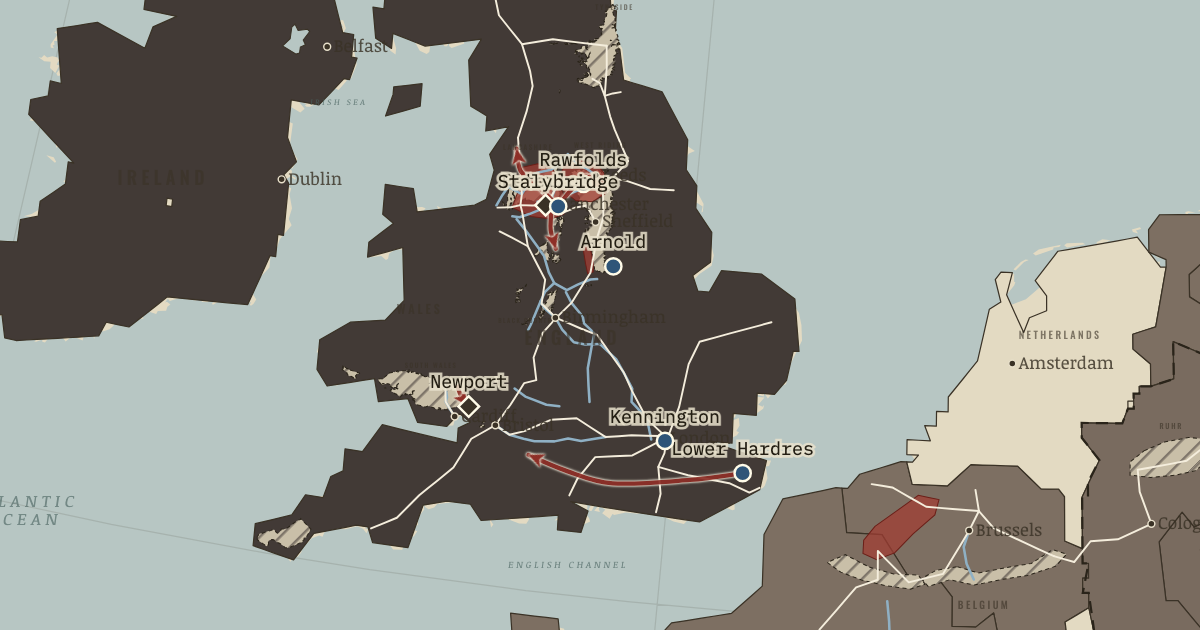
A stocking knitter in the Midlands rented the frame on which he worked at home. Pay per stocking was falling, and wide frames produced cheap, poorly finished goods. From Arnold on 11 March 1811, knitters broke the frames of employers who paid low rates while sparing those who paid fairly. Their choice of target carried a demand about the terms of work.
The short answer
- Machines threatened skilled trades. A cropper had served a seven-year apprenticeship to finish woolen cloth by hand; a weaver might have earned a craftsman's wage. Shearing frames threatened the cropper's work, steam-powered looms the weaver's, while wide knitting frames produced sheets cut and sewn into cheap, poorly finished stockings. Employers were cutting rates in a depressed wartime economy. Workers defended training, fair rates and independence as well as their immediate earnings.
- War, hunger and depression. The threat of a machine did not by itself determine when protest broke out. War, bad harvests and blocked trade made food expensive and work scarce. During the long war against France, trade with Europe and America was blocked and unemployment rose as Luddites attacked machines in 1811–13. After the war, the Corn Law of 1815 protected landowners' rents by barring foreign wheat until British prices were high, keeping bread dear. Protest peaked in the hard years of 1811–12, 1816–19, 1830 and 1842.
- Laws that silenced workers. Working men lacked votes, and the Combination Acts of 1799 and 1800 made unions illegal until 1824. Parliament also repealed laws fixing wages and protecting apprenticeships. Weavers petitioned for a minimum wage in 1808 and 1811 and were refused. With lawful bargaining and political change so difficult, direct action could appear the only means left.
- Reformers gave anger a programme. The journalist William Cobbett and the orator Henry Hunt offered a political explanation for hardship: a corrupt Parliament elected by a small minority. They argued for reform of the vote. Cheap newspapers, reading rooms and mass meetings spread that argument through industrial districts. By the 1830s the People's Charter gave local grievances a national six-point program beginning with votes for all men. Political reform promised a remedy beyond what machine-breaking could achieve.
THE TURNING POINT
Peterloo, 16 August 1819. The crowd at St Peter's Field in Manchester came peacefully to demand the vote. Perhaps 60,000 attended, many marching in disciplined ranks behind banners; the authorities answered with sabers. About 18 died and hundreds were wounded. Peterloo became a founding memory of working-class radicalism and discredited the government among many middle-class observers. The Six Acts that followed restricted public meetings and the radical press, showing how readily peaceful protest could be suppressed. The struggle increasingly centered on who could speak through Parliament.
What it changed
Reform reaches the middle classes first. In 1832 the Reform Act gave Manchester, Birmingham and Leeds their own MPs and enfranchised many middle-class men. Industrial wealth gained representation before industrial labor: almost all workers remained excluded, a betrayal that fed Chartism's demand for votes for all men. Many urban working householders gained the vote in 1867, and many county householders in 1884, after further organized pressure.
Trade unions become lawful. Repeal of the Combination Acts in 1824–25 allowed unions to grow in skilled trades, but legal protection came slowly. In 1834 six Dorset laborers from Tolpuddle were transported, shipped as convicts to Australia, for swearing a union oath. By the 1870s British unions had secure legal standing. Organization once treated as a crime had become part of industrial society's institutions.
Resistance spreads with industry. Industrial resistance appeared elsewhere in different settings. Lyon's silk weavers rose in 1831 and 1834; Silesian linen weavers rose in 1844. Later, textile workers in Japan and India struck against long hours and wage cuts. British protest was the first of many such movements, with states answering through force and reform.
The full answer, argued
The Luddites had reasons to defend their livelihoods. In 1811–13 knitters broke the frames of low-paying employers while sparing others, and croppers attacked mills installing the shearing frames that threatened their hand-finishing work. Wages were falling, food was dear and unions were illegal. Damage gave workers a way to pressure employers; Eric Hobsbawm called it collective bargaining by riot, while E. P. Thompson defended them against the condescension of later historians. The modern label for someone who fears technology misses that targeted action. They could not stop technical change. Machines eventually made cloth and stockings much cheaper for everyone, including workers. Yet those who lost their trades bore costs while many benefits went to others and later generations. Their struggle raises a question that outlasted the machines they broke: how should a society share the costs of technological change?
An interesting fact
On 27 February 1812 Lord Byron made his first speech in the House of Lords against a bill making frame-breaking—the smashing of knitting frames—a capital crime. He had seen the distress of Nottinghamshire knitters near his family's estate at Newstead Abbey. Hunger drove them to break frames, he told the Lords, and the law would not feed them. The bill passed. In 1816 his “Song for the Luddites” imagined weavers exchanging their looms' shuttles for swords. Few parliamentary voices spoke for the frame-breakers; men without votes had little reason to expect a hearing from lawmakers.
This is the study layer of Luddites, Peterloo and Chartism, chapter 6 of The Industrial Revolution, 1750–1914; the full index of the atlas is here.
Related questions
THE FREE PRINTABLE STUDY GUIDE
Get the printable study guide for The Industrial Revolution free. I’ll send you a few short letters, then one when a new atlas opens. That’s all. — Paul
NO TRACKING · YOUR ADDRESS IS USED FOR THE DISPATCH AND NOTHING ELSE · UNSUBSCRIBE ANYTIME