Industrial Revolution · 1851
Did workers gain or lose from the Industrial Revolution?
The seminar question: “Did the first industrial generations gain or lose from industrialisation?”
By 1851 just over half the population of England and Wales lived in towns, and Manchester grew from about 70,000 people in 1801 to over 300,000. Crowded housing without clean water or sewers spread disease, cholera killed about 32,000 people in 1831–32, and from the Factory Act of 1833 the state began to act.
Chapter 5 is included with every paid plan. WW2 is free in full, and chapter 1 of every atlas is free. A free account opens 3 more chapters a day. Starter, at $9 a month, opens all 21 with no daily limit — see the plans.
Free printable Industrial Revolution study guide, sent by email ↓
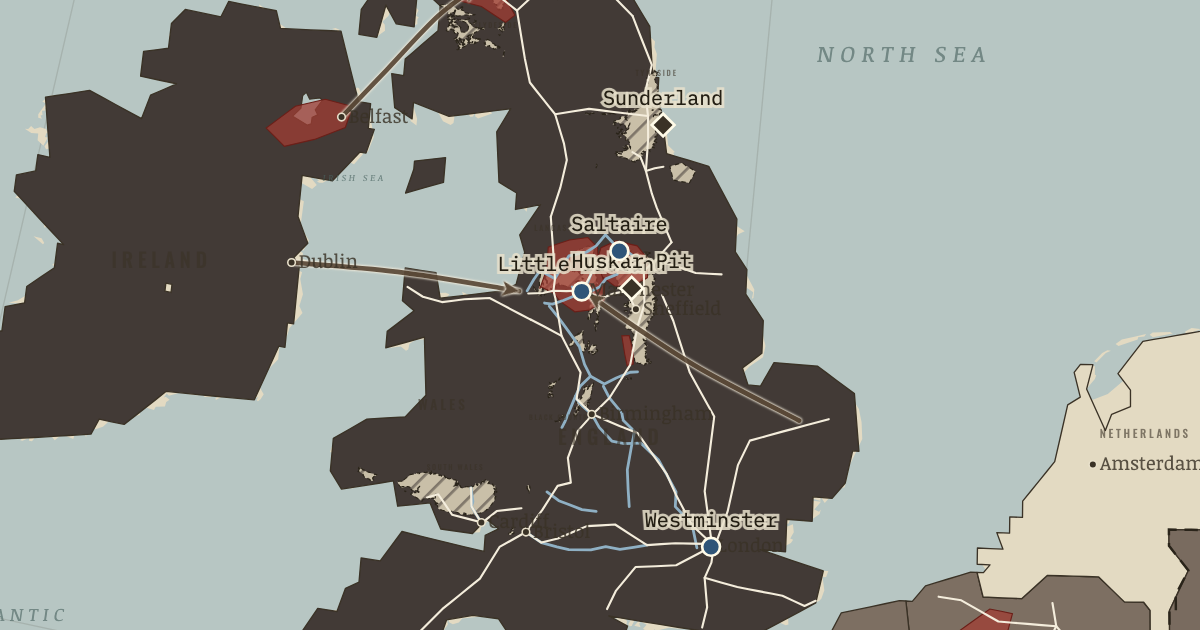
A factory needed a workforce within reach, and its jobs drew people from the countryside, Scotland and Ireland. Irish migration became especially pronounced after the Great Famine of 1845–52: the failure of the potato crop killed about a million people and drove many more abroad. On the map, arrows trace routes to Liverpool, Manchester and Glasgow. The same influx that supplied workers created an urgent demand for housing.
The short answer
- Factories pulled workers into towns. The mills offered a reason to move. Steam power allowed works to gather where coal, canals and railways met, while higher town wages attracted people from farming. In the countryside, enclosure—the fencing of common land into private farms—joined falling demand for hand spinning and population growth in leaving many underemployed. England and Wales grew from about 8.9 million people in 1801 to 17.9 million in 1851, and most of that increase went to towns.
- No one was in charge of the towns. Building houses did not automatically create a body responsible for serving them. The Municipal Corporations Act of 1835 gave old boroughs elected councils, yet many new industrial towns still lacked councils with power over building, water and drainage. Builders and landlords faced almost no regulation, while private water companies supplied those able to pay. Under those conditions rapid growth could continue for decades without sewers, until disease made inaction impossible to ignore.
- Families needed children’s wages. Rent and food had to be paid for even when a father was sick, dead or unemployed, and one adult wage rarely covered them. Families therefore relied on several earners. Jane Humphries found in working-class autobiographies that children from large or fatherless families began earliest, often before ten. Employers had uses for them, including piecing broken threads in mills, and paid them little. Family need and employers' demand brought children into work.
- Evidence made the costs visible. Reformers gained ways to bring conditions before Parliament. Censuses began in 1801, civil registration of births and deaths in 1837, and inquiries and inspectors collected testimony as well as numbers. Chadwick's mortality tables and evidence after the flooding at Huskar Pit, where 26 children drowned, made suffering that MPs might never see in a mill or mine into public evidence for action.
THE TURNING POINT
The Factory Act, Westminster, 1833. Parliament had restricted children's work in cotton mills in 1802 and 1819, yet those acts had no inspectors and were widely ignored. The Factory Act of 1833 covered most textile mills and gave its rules a means of enforcement. It barred children under nine, limited older children's hours and required two hours of daily schooling for those under thirteen. Four paid inspectors could enter mills and prosecute. The act established that the market alone would not protect workers, a principle on which later factory, mines and public health laws built.
What it changed
Protest grows from hardship. People brought together in industrial towns could organize around shared grievances. Hunger, low wages and the loss of skilled trades fed protest from machine-breaking to Chartism, the mass movement demanding votes for all men. Meetings filled the towns' moors and squares; the concentration of hardship also made collective action possible on a new scale.
Living standards rise after 1850. The clearer improvements in real wages, life expectancy and height came after about 1850, as food became cheaper, sanitation spread and hours were limited. Most workers thus received gains a generation or two after the costs. Their share depended on power as well as productivity: trade unions and the vote, won by many working men in 1867 and 1884, helped them claim more.
Regulation spreads abroad. Britain's experience gave later industrial countries examples of factory and public health legislation. Prussia, the largest German state, limited child labor in 1839, and France followed in 1841. By the end of the century most industrial countries had factory inspectors and public health boards, as chapters 7 and 8 show. Regulation of industry became a lasting legacy as other countries encountered similar problems.
The full answer, argued
The answer depends on the measure and the period. Charles Feinstein estimated a rise of less than 15 per cent in working-class living standards between the 1780s and the 1850s; Peter Lindert and Jeffrey Williamson found much larger wage gains. Yet men born from the 1820s to 1850 were shorter on average, suggesting poorer childhood nutrition and more disease, while life expectancy in the largest industrial towns fell far below the national average. Jane Humphries found that child labor intensified. Migrants nevertheless had a reason to choose towns: wages were higher than on the land. The wealth created in these years also supported later factory laws, sanitation and cheaper goods. Most historians conclude that the first generations bore heavy costs while their grandchildren enjoyed the gains. An average rise in income cannot by itself tell us who paid those costs or when the benefits arrived.
An interesting fact
The young man who wrote one of the best-known accounts of Manchester's slums earned his living in cotton. Friedrich Engels, son of a German textile manufacturer, came to work for his family's firm, Ermen & Engels, in 1842. His observations appeared in The Condition of the Working Class in England (1845). He returned in 1850, remained almost twenty years and eventually became a partner. Income from the business helped support his friend Karl Marx, the revolutionary thinker, as Marx wrote Capital, his critique of capitalism. A Lancashire cotton mill thus helped finance the two founders of modern communism.
This is the study layer of Urbanisation and the Factory Acts, chapter 5 of The Industrial Revolution, 1750–1914; the full index of the atlas is here.
Related questions
THE FREE PRINTABLE STUDY GUIDE
Get the printable study guide for The Industrial Revolution free. I’ll send you a few short letters, then one when a new atlas opens. That’s all. — Paul
NO TRACKING · YOUR ADDRESS IS USED FOR THE DISPATCH AND NOTHING ELSE · UNSUBSCRIBE ANYTIME