Industrial Revolution · 1820
Did the steam engine cause the Industrial Revolution?
The seminar question: “Was the steam engine the cause of the Industrial Revolution, or one of its results?”
James Watt’s steam engine, patented in 1769 and built from 1775 with Matthew Boulton at Soho near Birmingham, used about a quarter of the coal of Newcomen’s engines. Coke smelting at Coalbrookdale freed iron from charcoal, and canals moved coal cheaply to the towns, turning coal into power, metal and transport.
Chapter 3 is included with every paid plan. WW2 is free in full, and chapter 1 of every atlas is free. A free account opens 3 more chapters a day. Starter, at $9 a month, opens all 21 with no daily limit — see the plans.
Free printable Industrial Revolution study guide, sent by email ↓
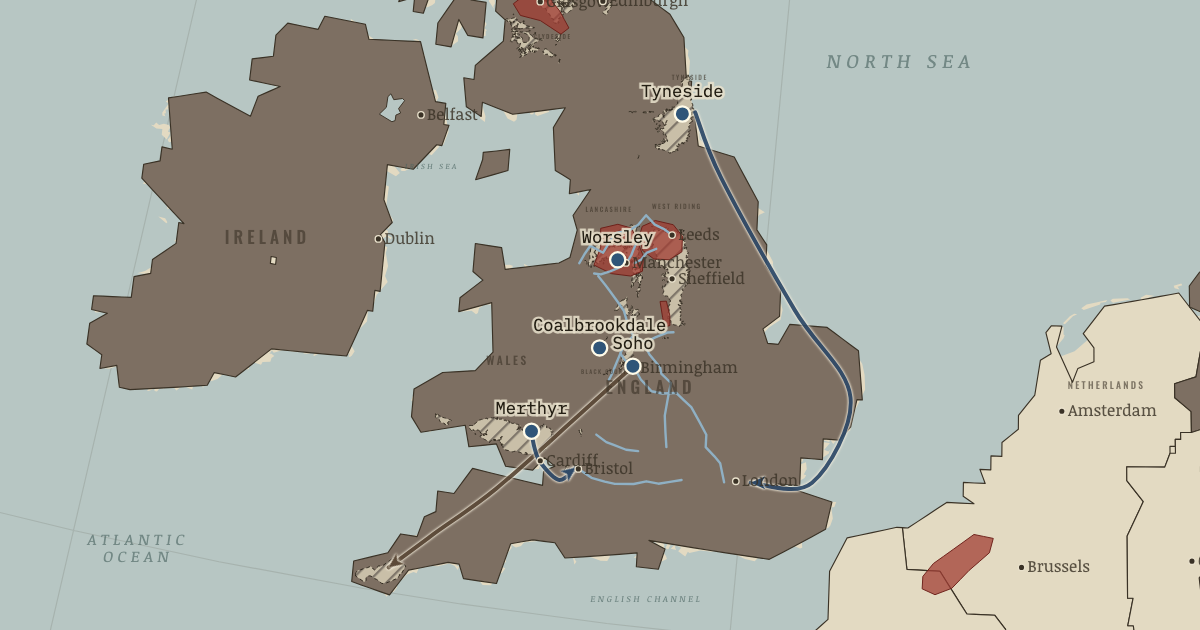
A mine could supply a town with coal, but the deeper its workings went, the more water its owners had to remove. Britain had burned coal for heat since the sixteenth century, and pits on Tyneside shipped it down the coast to London. In 1712 Thomas Newcomen built the first practical steam engine to pump water from mines. Coal was helping solve a problem created by the search for more coal.
The short answer
- Coal close to towns and the sea. Coal was useful to distant customers only if it could be carried to them. British seams lay near coasts and navigable rivers; Tyneside had shipped coal to London since the Middle Ages, while Midland and Lancashire fields lay beside growing towns. Britain mined about 15 million tons a year by 1800. Accessible, cheap fuel gave both inventors and buyers a reason to develop machines that consumed it.
- Flooded mines demanded engines. Deep mines encountered water faster than horses or water wheels could remove it. Thomas Newcomen’s atmospheric engine of 1712 used air pressure on a piston to pump it out. Coal mines could feed its wasteful appetite with free waste coal, and by 1800 hundreds worked in Britain. Cornwall’s copper and tin mines had to pay more for coal, creating a market for James Watt’s more efficient engine.
- Skilled hands and patient capital. A separate condenser could save fuel, but Watt needed more than an idea to sell a working engine. John Wilkinson supplied accurately bored cylinders from 1775, using a machine patented in 1774 for cannon. Birmingham metalworkers made parts, and Matthew Boulton brought capital, a factory and salesmanship. Parliament extended the patent in 1775 to 1800, giving the partners twenty-five years to recover their investment. Craftsmen, investors and lawmakers helped turn the invention into a product.
- Cotton and war created demand. Buyers gave the new technologies a reason to spread. Cotton mills wanted reliable power, and the wars with France in 1793–1815 required iron for cannon, shot and ships. Contracts and wartime prices encouraged owners such as the Crawshays of Cyfarthfa in South Wales to expand; mill owners who had outgrown their streams turned to steam. Each industry could become a customer for another, making investment in costly equipment worthwhile.
THE TURNING POINT
Boulton and Watt at Soho, 1775. At Soho near Birmingham in 1775, Watt’s fuel-saving idea acquired the means to reach customers. His separate condenser cooled used steam outside the cylinder; Matthew Boulton provided a factory, capital and salesmanship, John Wilkinson supplied accurate cylinders, and the patent was extended. The partners charged an annual fee equal to a third of each customer’s coal savings, connecting payment to the benefit. Watt’s rotative design in the 1780s extended steam from pumping to turning machinery. With canals delivering coal, factories could be built away from the rivers that had supplied water power.
What it changed
Locomotives grow out of colliery engines. A locomotive grew out of work at collieries, or coal mines, and ironworks, where high-pressure engines could be made light enough to move on rails. Richard Trevithick ran one at Penydarren near Merthyr in 1804. Tyneside colliery engineers, including George Stephenson, built locomotives to haul coal wagons. Chapter 4 follows them to the first public railways: within about forty years an engine for hauling coal had become part of a national system carrying goods and people.
Industry gathers on the coalfields. Moving heavy coal cost money, so industries that burned it had reason to gather near the seams. Lancashire and Yorkshire textile towns, South Wales iron towns and north-east shipbuilding towns stood on or beside coalfields. So did the Black Country, the metalworking district west of Birmingham named for its smoke. Chapter 5 follows the towns that developed there; the location of fuel helped shape where people lived and worked.
The continent copies the model. Britain’s combination of coal, iron and canals appeared in Belgium’s coal belt from Mons to Liège, the Ruhr valley in western Germany and Upper Silesia, now in Poland, often with British machines and engineers. The map shades Belgium and Switzerland as industrializing by 1820. Chapter 7 follows both borrowing and different paths: coal shaped heavy industry’s location, while coal-poor Switzerland used water power and skill.
The full answer, argued
The engine answered needs that already existed. Newcomen built it to drain mines in an established coal industry; Watt found buyers among mines and mills that were already expanding. Water supplied more power until about 1830, and N. F. R. Crafts and other economic historians find steam’s contribution to productivity small before the railway age. In those respects steam was a result of industrialization. Its later effects were considerable. By converting coal’s heat into motion, engines allowed factories and ironworks to work away from particular rivers, encouraged concentration on coalfields and in towns, and eventually powered railways. They made the mineral economy, powered by coal dug from the ground, fully productive. Steam was thus a late but decisive cause of the revolution becoming self-sustaining: its most familiar technology mattered greatly after earlier industries had created a market for it.
An interesting fact
Mine and mill owners understood what a horse could do. James Watt used that familiar measure to explain his engines, estimating the work of a horse turning a mill. He defined horsepower as 33,000 foot-pounds per minute, enough to lift 33,000 pounds one foot in a minute. The generous estimate made his engines look modest, and customers bought them rated in horses. Car engines still use the unit. Watt received another connection with the measurement of power after his death. In 1882 the British Association for the Advancement of Science, a national society of scientists, named the scientific unit of power the watt in his honor. He devised one unit to sell engines; the other bears his name.
This is the study layer of Steam power, coal and iron, chapter 3 of The Industrial Revolution, 1750–1914; the full index of the atlas is here.
Related questions
THE FREE PRINTABLE STUDY GUIDE
Get the printable study guide for The Industrial Revolution free. I’ll send you a few short letters, then one when a new atlas opens. That’s all. — Paul
NO TRACKING · YOUR ADDRESS IS USED FOR THE DISPATCH AND NOTHING ELSE · UNSUBSCRIBE ANYTIME