Industrial Revolution · 1750
Why did Britain industrialise first: resources or people?
The seminar question: “Did Britain industrialise first because of what it had, such as coal and colonies, or because of what its people did with them?”
In 1750 China made about a third of the world’s manufactured goods and the Indian subcontinent about a quarter, while Britain made under two per cent. Britain industrialised first partly because it combined dear labour with cheap coal: London labourers earned roughly twice the real wages of workers in Vienna.
WW2 is free in full, and chapter 1 of every atlas is free. A free account opens 3 more chapters a day. Starter, at $9 a month, opens all 21 with no daily limit — see the plans.
Free printable Industrial Revolution study guide, sent by email ↓
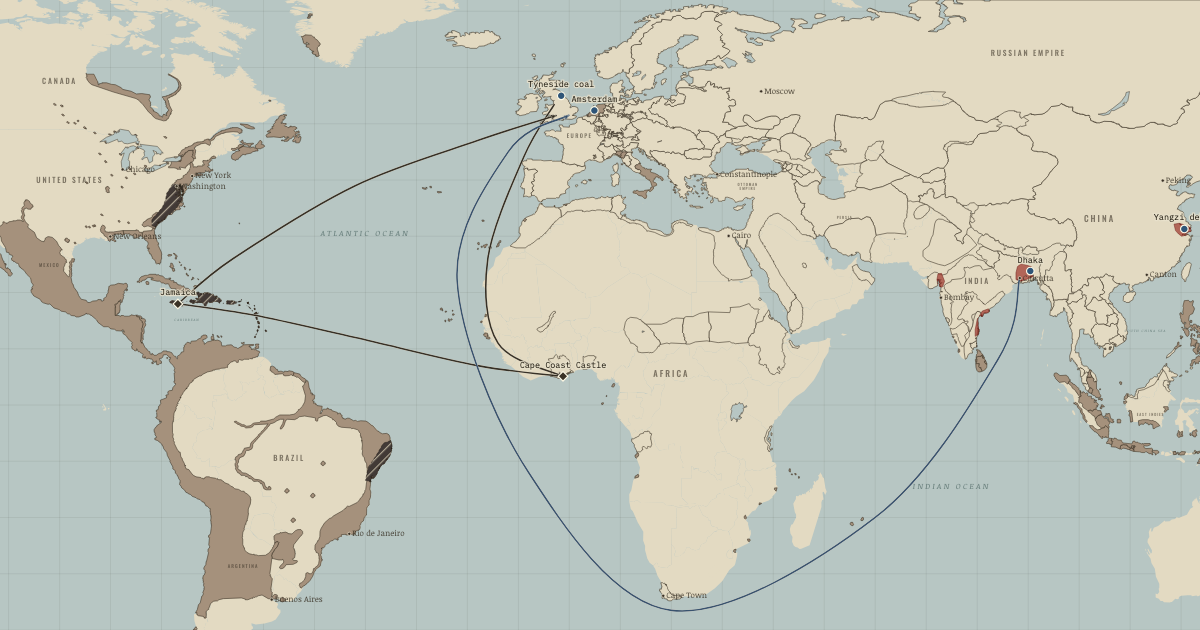
To see what changed, begin in the manufacturing districts of Asia. Around Suzhou in the Yangzi delta, millions of rural households spun and wove cotton and silk for Chinese markets. Bengal supplied about two-thirds of the textiles the English East India Company bought in Asia around 1750. This private company held a royal monopoly of Britain's Asian trade and had an army of its own.
The short answer
- Dear labour and cheap coal. British trading growth had raised wages, while Tyneside and Midlands coal offered exceptionally cheap energy. Investors could recover the cost of a machine that replaced expensive work with fuel more quickly in Britain than in France, India or China. That prospect encouraged experiments; improvements later made the machines attractive elsewhere.
- An Atlantic economy built on enslaved labour. Britain's North American and Caribbean plantations depended on enslaved Africans. Between the sixteenth and nineteenth centuries about 12.5 million people were embarked on Atlantic slave ships, and British ships carried more than any other nation's in the late 1700s. The plantations sold sugar and cotton and bought British cloth and iron. Their trade also built ports, merchants and banks, whose capital and skills later served industry.
- A culture of useful knowledge. An idea had to reach the people who could build with it. London's Royal Society and provincial philosophical societies, or science clubs, brought gentlemen scientists into contact with instrument makers, clockmakers and millwrights, who built mill machinery. Cheap print and traveling lecturers carried knowledge further; an expensive, slow patent system allowed inventors to sell ideas. Joel Mokyr calls this network the Industrial Enlightenment and argues that it sustained improvements beyond individual discoveries.
- Farms, markets and a strong state. English farms fed a large population with a declining share of workers, leaving people for crafts and trade. By 1700 more than 40 percent of men worked in manufacturing, mining or building. Coastal shipping, rivers and turnpike roads, maintained with private tolls, connected a national market without internal customs barriers. The Glorious Revolution of 1688 made Parliament supreme over the monarch. Its property owners taxed heavily but predictably, borrowed cheaply and funded a navy to protect trade. Douglass North associated these conditions with secure investment.
THE TURNING POINT
Tyneside’s coal, c. 1750. Coal was familiar long before it became the foundation of industrial power. By the 1750s colliers carried it from the River Tyne at Newcastle to London, while steam engines pumped water from deep pits. Its significance becomes clearer beside wood: a ton of coal gave roughly as much heat as an acre of forest grows in a year. Coal could supply energy without requiring another acre for each year's wood. It helped Britain move beyond the land constraint of an organic economy and, alongside high wages, encouraged machinery. Without cheap coal Britain might have remained a rich commercial economy like the Dutch Republic, today's Netherlands. The steam engines, railways and steel mills ahead all depend on the fuel.
What it changed
Indian cloth becomes the target. Indian calicoes established the standard: cheap, washable printed cotton. Britain's Parliament banned them in 1700 and 1721, protecting a home market in which British producers could imitate them. Chapter 2 follows machines developed to spin cotton as fine as Bengal's; eventually they allowed Europe to out-produce Asia in its own specialty.
Coal meets the steam engine. Early mine-pumping engines used so much fuel that a pithead, the top of a mine shaft, was a sensible place to run them: coal there was almost free. James Watt worked to make engines efficient enough for use farther away. Chapter 3 follows his engine, the canals carrying coal and iron made with coke, a fuel baked from coal. Cheap fuel supported the first engines, whose improvement extended their uses.
Slavery expands with the machines. British mills' growing appetite for cotton helped expand plantation slavery across the American South. Its enslaved population rose from about 700,000 in 1790 to almost four million in 1860. More cotton meant more land under cultivation and more forced labor. Chapter 2 follows the cotton to Lancashire; chapter 11 takes the story to the American Civil War.
A divergence begins. Industrial Europe and North America came to make most of the world's manufactured goods within a century and a half, while Bengal and the Yangzi delta lost textile export markets. The gap between rich and poor regions widened into what historians call the Great Divergence. Chapter 11 examines it and the epilogue asks who paid. The rich world's lead and the poor world's grievances date from these decades and continue to shape judgments between nations.
The full answer, argued
Britain's resources made a strong difference. Robert Allen's prices suggest that its early machines could pay where they could not elsewhere; Kenneth Pomeranz argues that the comparably advanced Yangzi delta lacked nearby coal and overseas land. But resources had to be put to use. China had coal, and Britain had mined it for centuries before the steam engine. Inventors, mechanics, investors and institutions turned opportunities into machinery, assisted by the culture Joel Mokyr calls the Industrial Enlightenment. Britain's colonial advantage also involved choices: its navy, merchants and planters seized Caribbean territory and exploited enslaved people. Most historians combine the explanations. Endowments, or starting advantages, shape incentives; people and institutions decide how to respond. Geography and prices make possibilities available, while choices affect when and where they are realized.
An interesting fact
The Birmingham Lunar Society timed its monthly dinners to help members get home. From the mid-1760s to about 1813, it met on a Sunday or Monday near the full moon, whose light helped riders on unlit roads. The circle included manufacturer Matthew Boulton, engineer James Watt, potter Josiah Wedgwood, chemist Joseph Priestley and physician Erasmus Darwin, Charles's grandfather. Calling themselves the Lunarticks, they discussed chemical experiments and business plans at the same table—a meeting of science and industry in practice.
This is the study layer of Why Britain industrialised first, chapter 1 of The Industrial Revolution, 1750–1914; the full index of the atlas is here.
Related questions
THE FREE PRINTABLE STUDY GUIDE
Get the printable study guide for The Industrial Revolution free. I’ll send you a few short letters, then one when a new atlas opens. That’s all. — Paul
NO TRACKING · YOUR ADDRESS IS USED FOR THE DISPATCH AND NOTHING ELSE · UNSUBSCRIBE ANYTIME