Industrial Revolution · 1913
Was India impoverished by industry or by imperial rule?
The seminar question: “Was the impoverishment of regions such as India the result of industrial competition or of imperial rule?”
After 1850 steamships, the telegraph and the Suez Canal, opened in 1869, joined the world into one economy organised around the industrial countries. Britain opened markets through what historians call the imperialism of free trade, while most of Asia and Africa became colonies or were bound by unequal treaties.
Chapter 11 is included with every paid plan. WW2 is free in full, and chapter 1 of every atlas is free. A free account opens 3 more chapters a day. Starter, at $9 a month, opens all 21 with no daily limit — see the plans.
Free printable Industrial Revolution study guide, sent by email ↓
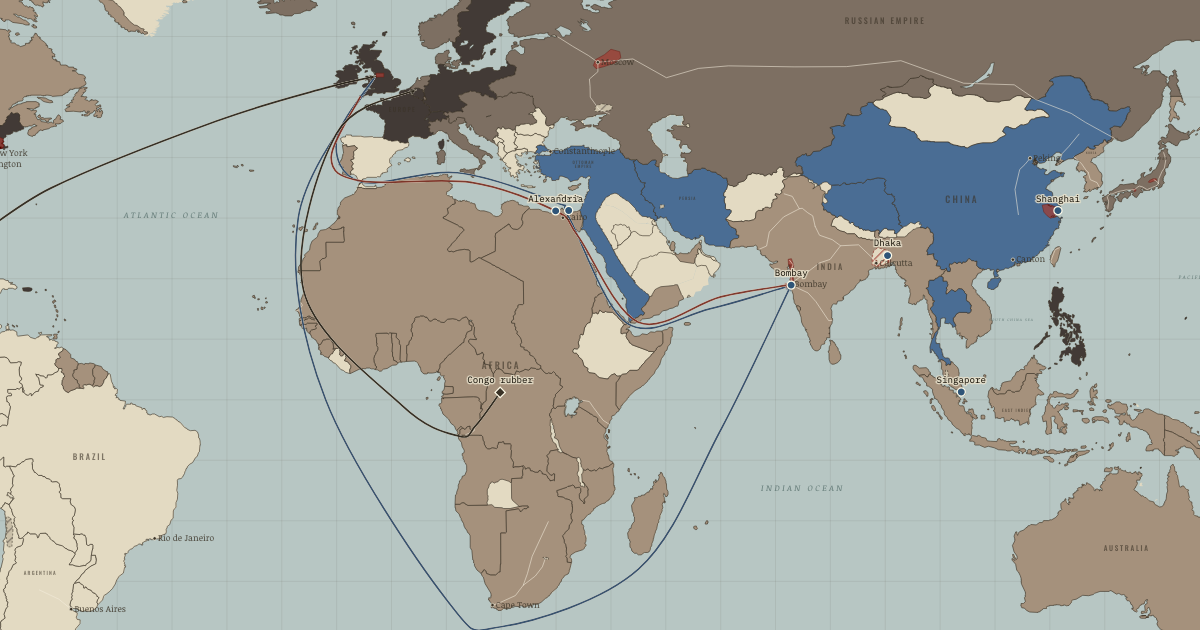
A voyage between London and Bombay once required a long passage around Africa. The opening of the Suez Canal on 17 November 1869 reduced the route from about 10,700 to 6,300 nautical miles. Steam made the shorter route practical: from the 1860s iron steamships with compound engines used steam twice to save coal, and coaling stations such as Singapore supplied them along the way. Ships could make long journeys more cheaply and reliably.
The short answer
- Steam and cable shrank distance. Distance had once shielded local producers from some competition because moving goods and news was expensive. Steam and cable reduced that protection. Compound engines used steam twice and saved coal; iron and later steel hulls made ships larger, while stations from Gibraltar to Singapore supplied fuel. Undersea telegraph cables were insulated with gutta-percha, latex from Malayan trees. Grain and cotton could now be traded profitably across oceans, extending worldwide a change railways had brought to Britain.
- Industry demanded raw materials. Factories needed supplies beyond those available locally. Cotton, jute, wool, rubber, copper, tin, palm oil and grain came from distant regions. West African palm oil supplied lubricants and soap for industrial Europe, Bengal jute made sacks for the world’s grain, and Congo and Amazon rubber went into tyres. Demand drew these regions into the industrial economy as suppliers, often with little power over the terms.
- Free trade backed by force. Free trade meant commerce with few barriers, but markets could be opened by force. Britain fought the Opium War after China tried to stop British opium sales, opening China in 1842. Treaties imposed low import taxes on the Ottoman Empire, Egypt, Persia, Siam (now Thailand) and Japan; India’s colonial government kept taxes on British imports low. Gallagher and Robinson called the combination of trade and treaties, backed where necessary by conquest, the imperialism of free trade.
- Capital from London. British investors held about £4 billion in overseas assets by 1914. Much went into railways, ports, mines and government bonds, or loans to governments. In India the colonial government guaranteed railway companies a return of about five per cent, paid from Indian taxes, so British investors bore little risk. Capital followed profit and political security into routes for exporting raw materials; relatively few factories were built that might compete with Britain’s.
THE TURNING POINT
The Suez Canal, 17 November 1869. The canal opened on 17 November 1869 and shortened the voyage between Britain and India by about 40 per cent. Its narrow passage and the Red Sea winds made it difficult for sailing ships, so the new route particularly favored steamships. Within a year the telegraph to Bombay ran alongside it. Britain’s stake in this connection grew: it bought the Egyptian ruler’s shares in 1875 and occupied Egypt in 1882. The route that joined markets had become a focus of political control.
What it changed
Nationalism grows from economic grievance. The loss of Indian wealth became an argument for political change. Dadabhai Naoroji charged that British rule drained the country, and the Indian National Congress, founded in 1885 as a party of educated Indians and later a leader of the independence movement, took up the claim. In 1905 Bengal’s swadeshi movement—“of one’s own country”—urged Indians to buy Indian goods and boycott British cloth. A product associated with economic loss became a means of resistance.
A world of migrants. Steam shortened a voyage that had taken six weeks under sail to about ten days, making passage cheaper. Tens of millions of Europeans crossed the Atlantic; Indian and Chinese workers traveled to plantations and mines across the tropics, many under indenture, contracts binding them to employers for years. The epilogue’s arrows trace these journeys and ask who gained and who left home under pressure from debt and coercion. Labor moved where capital sought it, changing the populations of whole continents.
The Great Divergence hardens. By 1900 Europe and the United States made about 85 per cent of manufactured goods, and the income gap between the industrial core and much of Asia and Africa had grown enormously. This Great Divergence became embedded in the world economy. Historians dispute how much industrial competition and empire each contributed. A difference that had been modest in 1750 now separated manufacturing countries from many suppliers; it would take a century to begin closing.
The full answer, argued
Lancashire’s machines made cloth cheaply enough to take Bengal weavers’ export markets. Clingingsmith and Williamson argue that India’s share of world manufacturing would have fallen steeply even under Indian rule: droughts and the fragmentation of the Mughal empire, which had ruled most of India, had already raised food prices and wages. Competition presented a serious challenge. Imperial rule affected the choices available in response. The colonial government kept taxes on British imports low, taxed Indian mill cloth from 1896 and paid guaranteed returns to British railway investors from Indian taxes. It also funded an army and administration that nationalists such as Naoroji called a drain. Tirthankar Roy warns against treating the result as total ruin: hand weaving adapted and Indian-owned mills grew. Industrial technology made a decline in Indian hand industry likely, while empire removed tools such as import taxes and an investing state that Germany, the United States and Japan used to industrialize. Competition posed the problem; political power shaped who could answer it.
An interesting fact
Nellie Bly’s journey around the world in 1889–90 took 72 days. The American journalist beat Phileas Fogg’s fictional record in Jules Verne’s Around the World in Eighty Days (1872), following routes visible on this map: steamers through the Suez Canal to Ceylon (now Sri Lanka), Singapore and Hong Kong, a Pacific crossing to San Francisco, and a train across the United States. Verne’s imagined circuit depended on new infrastructure too: the canal opened in 1869, and a railway first crossed India from Bombay to Calcutta in 1870.
This is the study layer of Great Divergence and global trade, chapter 11 of The Industrial Revolution, 1750–1914; the full index of the atlas is here.
Related questions
THE FREE PRINTABLE STUDY GUIDE
Get the printable study guide for The Industrial Revolution free. I’ll send you a few short letters, then one when a new atlas opens. That’s all. — Paul
NO TRACKING · YOUR ADDRESS IS USED FOR THE DISPATCH AND NOTHING ELSE · UNSUBSCRIBE ANYTIME