WW2 · JUN 1942
Was the US victory at Midway luck or calculated risk?
The seminar question: “Was the American victory at Midway a matter of luck or calculated risk?”
After the Doolittle Raid of April 1942, Japan planned to seize Midway atoll and lure the surviving American carriers to their destruction. US codebreakers had partly read Japan’s naval code, so Admiral Nimitz set an ambush instead. On 4 June 1942 American dive-bombers sank four Japanese fleet carriers for the loss of one.
WW2 is free — every chapter. No sign-up.
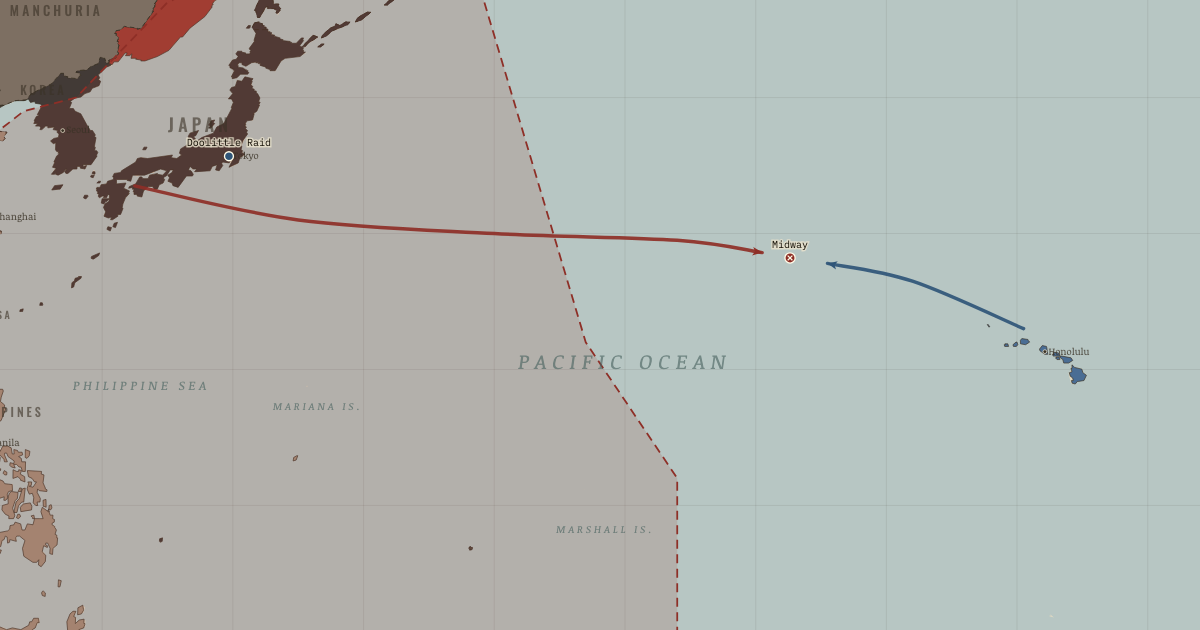
Japan had planned an operation against Midway before the Doolittle Raid made it more urgent. In April 1942, sixteen American bombers took off from a carrier and struck Japan. Their material damage was small, but the home islands had been reached, embarrassing the navy sworn to protect them. Taking Midway could extend Japan’s defensive perimeter and draw the American carriers into the decisive battle Japanese commanders wanted.
The short answer
- The Doolittle Raid. American aircraft had reached Japan, even though the Doolittle Raid did little material damage. That embarrassment strengthened the case for extending the defensive perimeter and seeking the decisive carrier battle Japanese commanders wanted.
- Reading the target. HYPO’s partial reading of JN-25 pointed to a target called “AF.” A false report that Midway lacked fresh water helped establish its identity. Japan planned to trap the Americans; Nimitz could prepare an ambush of his own, though intelligence offered a chance rather than a guarantee.
- A dispersed operation. Six months of conquest preceded Japan’s ambitious plan, which dispersed forces across a vast area and depended on surprise. The Aleutians operation formed another part of it. American foreknowledge put Japan’s assumption that it could choose the terms of the encounter in doubt.
THE TURNING POINT
The carrier strikes, 4 June 1942. Around 10:20–10:25 a.m. on 4 June 1942, American dive-bombers attacked Akagi, Kaga and Sōryū, mortally damaging all three within minutes. The aircraft had arrived after separate searches and costly torpedo attacks that disrupted Japanese defenses. A fourth carrier was struck later that day.
What it changed
A counteroffensive begins. Four fleet carriers were gone, weakening Japan’s ability to support further expansion, and its perimeter stopped growing. Two months later, in August, US Marines landed at Guadalcanal. The counteroffensive had begun, although the struggle for the initiative continued.
Replacing the losses. Ships were only part of Japan’s loss. Veteran pilots took years to train, and Japan lacked a mass training pipeline comparable to that of the United States. As Japan struggled to replace its experienced aviators, American supplies of pilots, aircraft and carriers expanded.
Another 1942 turning point. At Midway, intelligence placed the American force where timing and chance could give it an opportunity. The next chapter’s turning point, Stalingrad, shows Soviet commanders striking a different vulnerability in an advancing enemy.
The full answer, argued
Both. Codebreaking and Nimitz’s deployment put American carriers in position; navigation, timing and disruption of Japanese defenses helped open the way for the dive-bombers. Preparation made that opportunity usable, without determining every event. Without intelligence there was no ambush, and different timing might have produced a different result.
An interesting fact
The Japanese public learned little of the defeat at the time. Radio announced a victory. Wounded sailors were brought ashore at night and isolated in guarded hospital wards as “secret patients”; many survivors went straight to distant garrisons, where they could not talk about the battle. Even much of the army high command was kept unaware that four carriers had been lost.
This is the study layer of Battle of Midway, chapter 8 of The War Room — WW2, 1936–1945; the full index of the atlas is here.
Related questions
THE FREE PRINTABLE STUDY GUIDE
Get the printable study guide for WW2 free. I’ll send you a few short letters, then one when a new atlas opens. That’s all. — Paul
NO TRACKING · YOUR ADDRESS IS USED FOR THE DISPATCH AND NOTHING ELSE · UNSUBSCRIBE ANYTIME