Industrial Revolution · 1890
Was US industrial success built on resources or people?
The seminar question: “Was America’s industrial success built more on its resources or on its people?”
Between the Civil War and the First World War the United States became the world’s largest industrial economy, drawing on a protected market, vast resources and immigrant labour. The first transcontinental railway was completed at Promontory Summit, Utah, on 10 May 1869, its western section built largely by Chinese workers.
Chapter 9 is included with every paid plan. WW2 is free in full, and chapter 1 of every atlas is free. A free account opens 3 more chapters a day. Starter, at $9 a month, opens all 21 with no daily limit — see the plans.
Free printable Industrial Revolution study guide, sent by email ↓
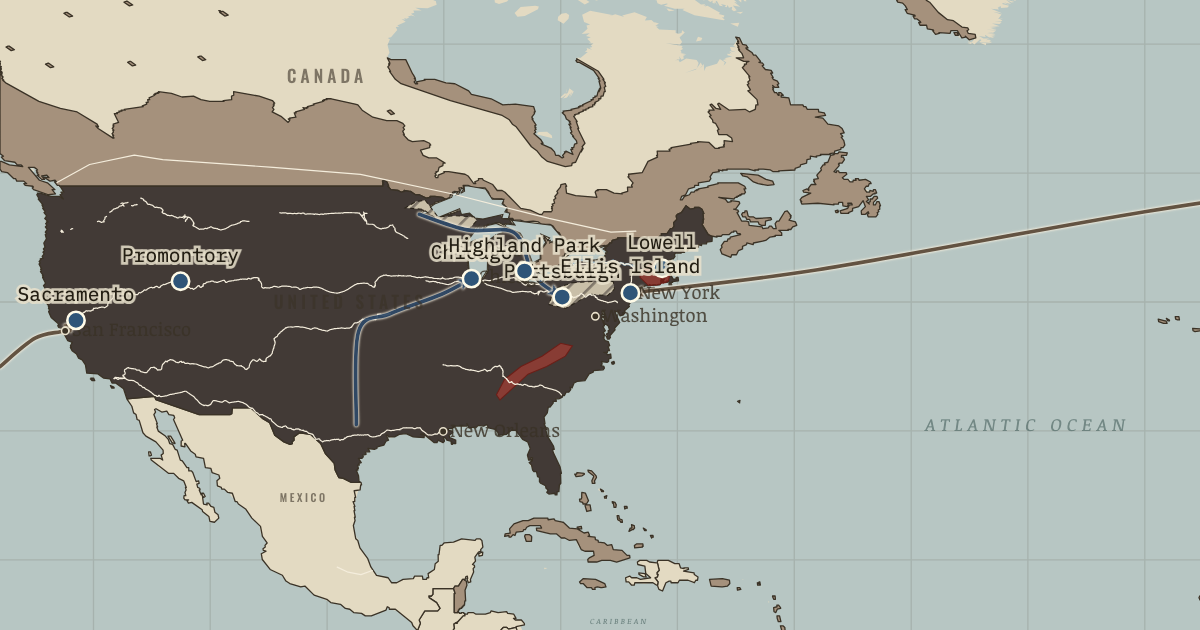
Long before the United States led the world in manufacturing, its cotton industry connected British machinery to the labor of enslaved people. Samuel Slater memorized Richard Arkwright's spinning machines in England and began spinning cotton in Rhode Island in 1790. In 1823 Boston merchants opened mills in the planned Massachusetts town of Lowell. They hired young women from New England farms; those women struck against wage cuts in 1834 and again in 1836.
The short answer
- A continent of resources. Pennsylvania's coalfields and the Lake Superior iron ranges appear as hatched patches on the map; their resources fed Pittsburgh's industry. Coal, iron ore, copper and oil were present in some of the world's largest deposits. Vast forests and farmland, taken from Native American nations by treaty and war, added to this abundance. Cheap materials encouraged technologies that consumed them freely, making American industry especially hungry for energy and resources.
- A huge protected market. A large plant needs many buyers. The American population grew from about 31 million in 1860 to 92 million in 1910, and railways connected those buyers without taxes on trade between states. Manufacturers could spread the costs of enormous plants across millions of customers. They also benefited from protection against British and German competitors. High tariffs, or taxes on imports, rose during the Civil War and remained afterward. This was the kind of shelter for young industries that the German economist Friedrich List had recommended for Germany.
- Immigrant and coerced labour. Mines, mills and railways drew workers from Europe, China, Mexico and the American countryside, often at low wages and in dangerous conditions. Immigration kept wages lower than they otherwise would have been, though they remained higher than in Europe and continued to attract migrants. In the South, Black people freed from slavery grew cotton that remained a leading export; debt and segregation constrained their lives and work.
- Capital, organisation and the state. Building railroads required money before the lines could earn it. British and European investors supplied capital, while federal loans and land grants reduced companies' risks. Railroads also pioneered firms managed by salaried employees. Alfred Chandler called their coordination the visible hand: managers planned activities previously coordinated by markets. Steel, oil and meat firms copied the organization. Government affected the distribution of gains as well. Courts and officials generally sided with employers, issuing injunctions—court orders banning strikes—and sending troops. Such support helped hold down labor costs and maintain profits, creating conditions in which private enterprise could flourish.
THE TURNING POINT
Promontory Summit, 10 May 1869. At Promontory Summit the meeting tracks joined the Atlantic and Pacific economies. Goods, settlers and migrants could now cross in about a week instead of months. Four more lines followed within twenty-five years. This connection brought the Great Plains grasslands into the world market and opened the West to farms, ranches and mines. It also accelerated the destruction of Native American nations and the bison herds on which they lived. Chinese and Irish workers built much of the line, creating wealth for a country that did not always welcome them.
What it changed
America overtakes Britain. American steel output passed Britain's around 1886; by 1913 the United States made about a third of the world's manufactured goods. Its production methods traveled beyond its borders. In the twentieth century Europe and Japan adopted interchangeable parts—standard components that fit any copy of a product—and the assembly line. Americans, earning the world's highest wages, became the first mass market for cars and electrical goods. The lead in mass production had crossed the Atlantic from Britain's workshop of the world.
Grain and migrants remake Europe. From the 1870s railways and steamships delivered cheap American grain to Europe. Lower bread prices helped workers, but many farmers were ruined and millions of rural Europeans were pushed to emigrate. Germany and France protected farmers with tariffs on imported grain; Britain maintained free trade and allowed its farming to shrink. Ships and railways carried grain east and migrants west, linking the two changes.
The labour question goes national. At Homestead in 1892 strikers fought off guards from the Pinkerton detective agency, but Pennsylvania's state militia broke the strike. Federal troops broke the Pullman railway-car strike in 1894. Such confrontations made corporate power a national political question. Progressive Era reformers in the 1900s and 1910s sought to curb that power. Laws addressed monopolies, firms dominating a whole market, and unsafe food; states restricted child labor, while unions grew slowly. Political action had become part of the response to industrial power.
The full answer, argued
The resources set the direction of much American industry. Coal, ore, oil, timber and land, much taken from Native American nations, supplied cheap inputs; Gavin Wright's evidence shows their importance in manufactured exports. Yet deposits and forests could not extract or transport themselves. Inventors and managers organized large corporations, and about 22 million immigrants arrived between 1880 and 1914. Chinese workers built railways and were later barred from the country. Formerly enslaved people and their children grew cotton that remained a leading export. Institutions shaped the rewards of their work: import taxes, federal land grants and employer-friendly courts directed wealth toward industry and held down labor costs, amid fierce conflict. Abundant resources helped determine the direction of technology; access to labor and capital from across the world helped determine the speed of growth. Both mattered, and exclusion and conflict reveal how unevenly the costs and gains were shared.
An interesting fact
A traveler consulting American railroad timetables before 1883 encountered dozens of local times. On Sunday 18 November that year, railroads in the United States and Canada switched to standard time zones, four across the United States. Many eastern towns set their clocks back, so noon struck twice: it became known as the day of two noons. Most towns adopted railway time immediately, but Congress made the zones law only in 1918. For thirty-five years a private industry had set the nation's clocks.
This is the study layer of Industrial Revolution in America, chapter 9 of The Industrial Revolution, 1750–1914; the full index of the atlas is here.
Related questions
THE FREE PRINTABLE STUDY GUIDE
Get the printable study guide for The Industrial Revolution free. I’ll send you a few short letters, then one when a new atlas opens. That’s all. — Paul
NO TRACKING · YOUR ADDRESS IS USED FOR THE DISPATCH AND NOTHING ELSE · UNSUBSCRIBE ANYTIME