Decolonization of Africa · APR 1994
Why did South Africa’s transition to democracy hold?
The seminar question: “The South African transition nearly collapsed in violence more than once. What helped it hold, and what can its experience teach us about ending entrenched conflicts?”
Between 1990 and 1994 South Africa’s government and the ANC negotiated through the CODESA talks amid severe violence, including the Boipatong massacre of 1992 and Chris Hani’s assassination in April 1993. On 27 April 1994 about twenty million people voted, most for the first time, and a government of national unity followed.
Chapter 11 is included with every paid plan. WW2 is free in full, and chapter 1 of every atlas is free. A free account opens 3 more chapters a day. Starter, at $9 a month, opens all 21 with no daily limit — see the plans.
Free printable Decolonization of Africa study guide, sent by email ↓
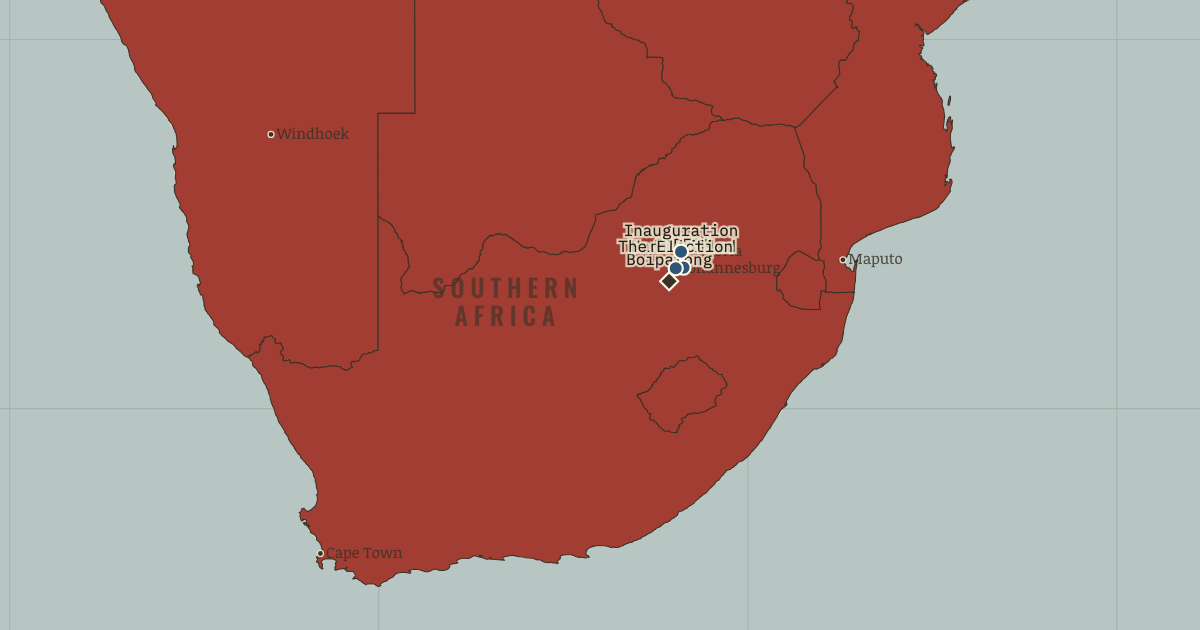
Neither the apartheid government nor the ANC could obtain the future it wanted by force alone. The ANC could mobilize mass resistance and make the country ungovernable, but it could not seize the state. The government controlled the security forces and bureaucracy, yet could neither govern the excluded majority indefinitely nor restore the economy. Each could obstruct the other. That made negotiation worth attempting, although it gave neither side reason to trust the other with unchecked power.
The short answer
- Two sides that could obstruct but not win. The ANC could make apartheid ungovernable through mass resistance, but could not simply take a state guarded by powerful security forces. The government held those forces and the bureaucracy, yet faced an excluded majority and an economy under pressure. Neither could impose a durable victory. Both therefore had reason to bargain, and Mandela and de Klerk had to persuade their supporters that compromise was safer than continued conflict.
- The third force and the strategy of chaos. Hostel killings, train massacres and the arming of factions undermined confidence in the talks. Investigations traced some covert support for violence to elements of the security establishment. Such violence could make majority rule appear to mean anarchy and weaken trust between negotiators. Its sources and purposes were multiple, but the participation of people inside institutions responsible for protection made the threat to the settlement especially grave.
- Hani’s murder and the response. The killer of Chris Hani in April 1993 hoped to ignite racial war. The country came close to the edge, arguably nearer than at any time since 1960. Mandela appealed to the nation for calm, while the ANC gave its supporters a political objective: a definite election date. Restraint was a deliberate response to the murder and its intended consequences.
- The choice of truth and conditional amnesty. Apartheid left crimes and generations of dispossession to confront, while the old security forces retained weapons and influence. The Truth and Reconciliation Commission combined public testimony with amnesty for applicants who met conditions including full disclosure. The arrangement sought a stable settlement and a shared future, but its cost in accountability remains a subject of debate.
THE TURNING POINT
The election, 27 April 1994. On 27 April 1994 about twenty million people voted, most for the first time. Many queued for hours to exercise a right denied to the Black majority under apartheid. Four days later the count confirmed Mandela’s victory, and the last charcoal territory on the map turns red. From Ghana’s independence in 1957 to these queues, the atlas has followed struggles over who would rule. The peaceful handover in South Africa came after negotiations repeatedly threatened by violence.
What it changed
The map completes. The vote brings the atlas’s tide of independent, majority-ruled states to 100 percent. From Libya in 1951, nearly fifty years of political change appear as one rising color. The classification captures that transformation, though it cannot answer every question about remaining territories or political freedom.
A government of national unity. The interim settlement provided for five years of power-sharing and left much of the civil service and security establishment in place. Officials whose cooperation mattered had a stake in a stable handover, reducing the danger of collapse or a coup. The same continuity constrained the speed of transformation while apartheid’s inequalities endured. South Africans continue to debate the trade-off.
The debate over reconciliation. The Truth and Reconciliation Commission became an influential example of transitional justice. Public testimony and conditional amnesty were intended to address abuses while reducing the danger of renewed conflict. Critics continue to ask whether enough truth emerged and whether too much accountability was sacrificed. The epilogue considers what political liberation leaves unresolved.
The full answer, argued
The ANC and the government could obstruct each other without imposing a durable victory, so both had reason to seek an agreement. That did not decide its terms. Mandela and de Klerk had to persuade supporters to accept compromise, and after Boipatong and Hani’s murder, restraint and political pressure kept a route to settlement open. Temporary power-sharing and continuity for officials gave people in the old state a stake in the handover. The later amnesty process sought testimony about political crimes, at a contested cost in accountability. The experience suggests how leadership, credible guarantees and ways of addressing violence and the past can help a settlement survive; none makes survival certain.
An interesting fact
The 27 April 1994 ballot listed nineteen parties with names, symbols, colors and photographs of their leaders, helping voters identify their choices where apartheid had restricted education. Inkatha agreed to participate only a week before the vote, after tens of millions of ballots had been printed. Its entry was added by hand as a sticker at the foot of each paper.
This is the study layer of End of apartheid, chapter 11 of The Decolonization of Africa, 1945–1994; the full index of the atlas is here.
Related questions
THE FREE PRINTABLE STUDY GUIDE
Get the printable study guide for The Decolonization of Africa free. I’ll send you a few short letters, then one when a new atlas opens. That’s all. — Paul
NO TRACKING · YOUR ADDRESS IS USED FOR THE DISPATCH AND NOTHING ELSE · UNSUBSCRIBE ANYTIME