Decolonization of Africa · JUL 1962
What caused the Congo Crisis?
The seminar question: “Was the Congo catastrophe caused mainly by Belgian misrule, by Cold War intervention, or by the Congo’s own divisions — and why does it matter which?”
The Belgian Congo became independent on 30 June 1960 without a single African army officer or senior administrator. The army mutinied, Belgian troops returned, and on 11 July Katanga seceded with Belgian mining backing; Prime Minister Patrice Lumumba was killed in January 1961, and the West later helped install Mobutu.
Chapter 6 is included with every paid plan. WW2 is free in full, and chapter 1 of every atlas is free. A free account opens 3 more chapters a day. Starter, at $9 a month, opens all 21 with no daily limit — see the plans.
Free printable Decolonization of Africa study guide, sent by email ↓
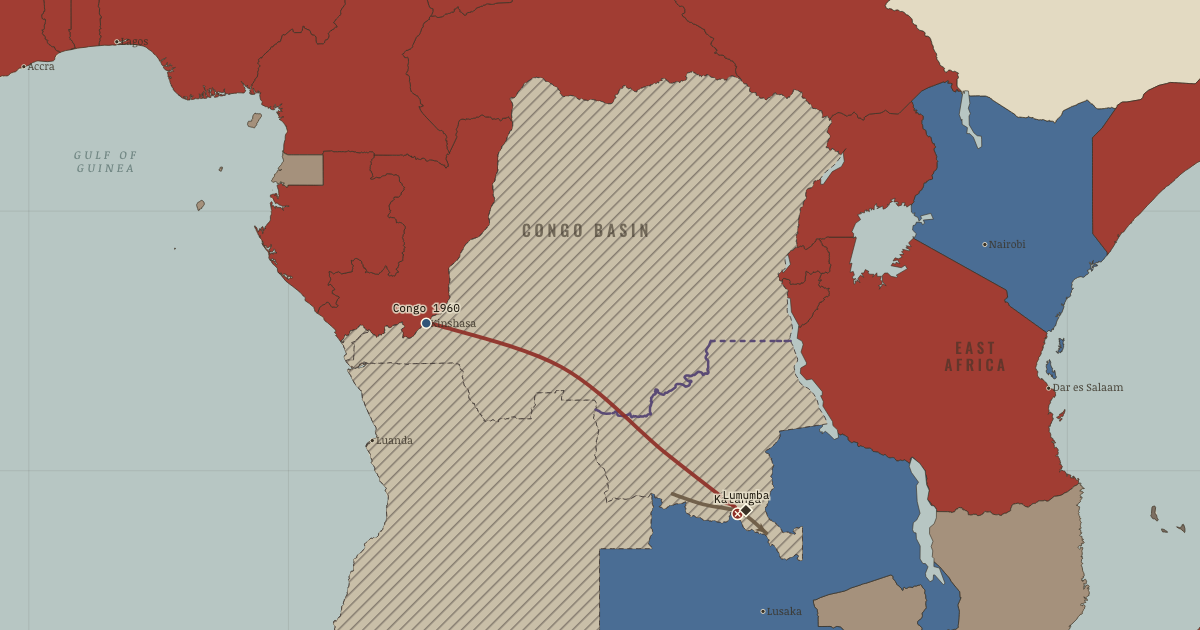
The Congo became independent on 30 June 1960, but the institutions handed to its leaders had been built to serve Belgian rule. Belgium had restricted African education and political life and kept senior positions for its own officials. The new government had sovereignty without the preparation to exercise it. In the Force Publique, Belgian officers still commanded the colonial army; its soldiers mutinied, and Belgium used the disorder as grounds to send troops back.
The short answer
- A colony left unprepared. Belgian rule restricted African education and suppressed political life in the belief that a contented, uneducated population would not demand self-rule. Then Brussels panicked and rushed independence in 1960. Congolese leaders took over without trained administrators, officers or politicians, while an army prone to mutiny remained under Belgian command. The weakness exposed at independence had been produced by the way the colony was governed, an extreme case of the continent’s under-preparation.
- Katanga and the mines. The mines gave Katanga an importance far beyond its provincial boundaries: its copper, cobalt and uranium were central to Congolese wealth. Union Minière preferred a compliant breakaway government to a nationalist central government that might control those resources. Tshombe’s secession received arms and money from Brussels and support from white mercenaries. Those interests help explain the corporate-colonial enclave that presented itself as a separate nation.
- The Cold War enters the crisis. The UN initially declined to reconquer Katanga for Lumumba, so he asked Moscow for help. Western governments saw a Soviet asset to be removed. His search for an ally had placed the nationalist premier inside a global contest, in which decisions at Washington, Brussels and Moscow mattered as much as those at Léopoldville. The Cold War’s subordination of African self-determination would recur across the atlas.
- The UN’s difficult mandate. ONUC, the 20,000-strong UN force, arrived where there was no settled peace to keep. Its initial mandate forbade it to take sides or end the secession, leaving it unable to save the premier or fight the breakaway province. Hammarskjöld died while seeking a settlement. The UN’s first war revealed limits of peacekeeping that would trouble the organization for decades, and arguably still do.
THE TURNING POINT
Katanga secedes, 11 July 1960. On 11 July 1960, eleven days after independence, Tshombe declared mineral-rich Katanga a separate state. Union Minière supplied money; Belgian officers and white mercenaries gave support. The loss deprived the new nation of its wealth and invited foreign intervention. Lumumba’s search for help took him toward Moscow and, through the ensuing confrontation, toward his death. Fragile independence became a four-year war. Katanga shows how colonial economic interests, presented as self-determination, could tear apart a new state from within.
What it changed
Lumumba’s murder. The elected premier’s removal and killing involved Western powers and made him a martyr across the Third World. To African leaders his fate showed the limits of sovereignty when Cold War or corporate interests were threatened. Lumumba’s name became shorthand for the strangling of decolonization. This is a history of memory as well as events, and it remains central to how Africa remembers 1960.
Mobutu’s long rule. Joseph Mobutu emerged from the crisis with Western help and continued to receive support as an anti-communist bulwark. He renamed the country Zaïre and ran it as a personal kleptocracy for thirty-two years. The durable dictatorship illustrated a pattern repeated elsewhere in Cold War Africa: backing a “friendly strongman” in the name of stability.
A warning to other states. The speed with which the Congo came apart frightened African leaders. Some used it to justify strong central government and one-party control. The UN learned the dangers of peacekeeping; the OAU, founded three years later, treated the inviolability of borders and non-interference as near-sacred, largely to prevent another Katanga. The crisis helped shape the political conservatism considered in the next chapter.
The full answer, argued
All three forces mattered, but they played different parts. Belgian misrule created the precondition: the denial of education, officer training and political preparation left the new state structurally incapable of surviving the shock of sudden independence, making collapse likely. Foreign economic and Cold War interests accelerated the disaster. Union Minière supported Katanga, while American and Belgian decisions removed the elected premier and permitted his murder. Intervention turned crisis into catastrophe and imposed thirty years of Mobutu. Internal divisions were real, but the first two forces largely produced and then weaponized them. This order changes the judgment. The claim “Africans could not govern themselves” treats the effects of colonial rule and outside intervention as a cause of failure. It leaves out how those effects were created and exploited.
An interesting fact
From captivity Lumumba wrote a last letter to his wife Pauline: “history will one day have its say… it will not be the history that is taught in Brussels, Paris, Washington or the United Nations… Africa will write its own history.” The letter was smuggled out and published after his murder, becoming a founding text of postcolonial memory. His daughter Juliana later petitioned the Belgian king. In June 2022, sixty-one years after his death, Belgium returned his only surviving remains, a single tooth, to his children at a state ceremony.
This is the study layer of Congo Crisis, chapter 6 of The Decolonization of Africa, 1945–1994; the full index of the atlas is here.
Related questions
THE FREE PRINTABLE STUDY GUIDE
Get the printable study guide for The Decolonization of Africa free. I’ll send you a few short letters, then one when a new atlas opens. That’s all. — Paul
NO TRACKING · YOUR ADDRESS IS USED FOR THE DISPATCH AND NOTHING ELSE · UNSUBSCRIBE ANYTIME