Decolonization of Africa · MAR 1956
How was the Suez Crisis a defeat for Britain and France?
The seminar question: “Suez was a clear military victory for Britain and France. In what sense was it one of the most important defeats in the history of empire?”
Libya became independent in 1951 and Sudan on the first day of 1956, and Tunisia and Morocco won independence from France the same year. In July 1956 Nasser nationalized the Suez Canal; Britain, France and Israel won the opening battles of the Suez war but folded when the United States opposed the invasion.
WW2 is free in full, and chapter 1 of every atlas is free. A free account opens 3 more chapters a day. Starter, at $9 a month, opens all 21 with no daily limit — see the plans.
Free printable Decolonization of Africa study guide, sent by email ↓
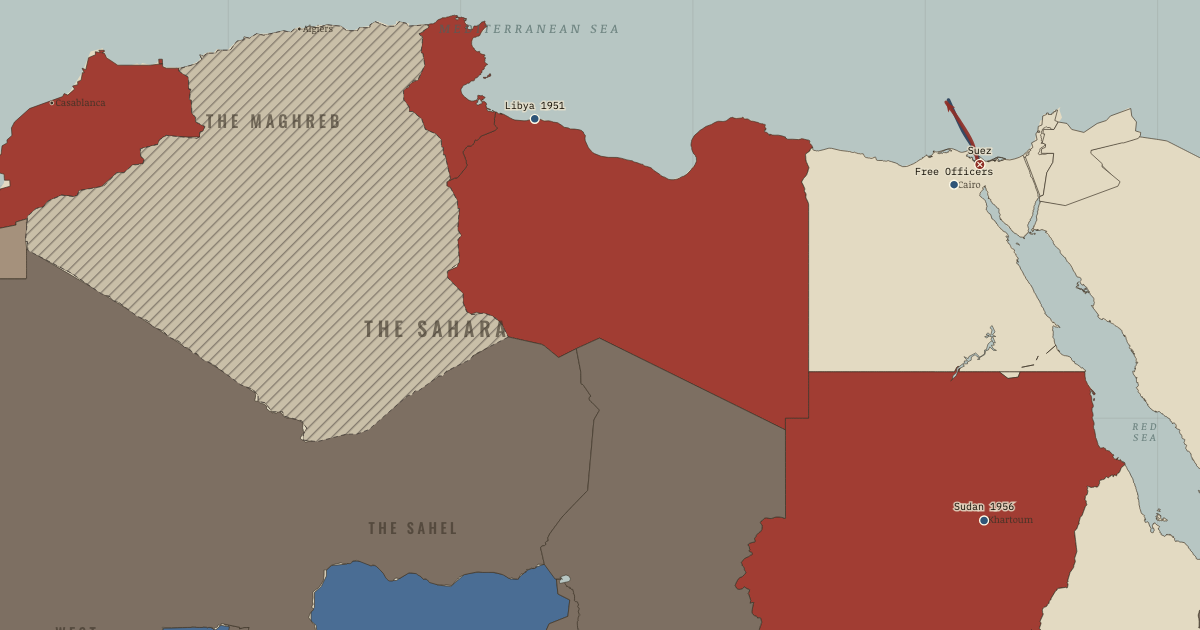
The dispute over Suez began with a project upstream. After Washington withdrew its loan for the Aswan Dam, Nasser nationalized the canal in July 1956 so that its revenues could help pay for it. The decision also asserted Egyptian control over Egyptian territory. Britain and France saw a threat to their route to Asia, oil and remaining possessions, and to their standing as great powers.
The short answer
- The canal and Egyptian authority. Washington’s withdrawal of its Aswan Dam loan left Nasser seeking another source of money. Nationalizing the canal offered revenue for the project and asserted Egyptian authority over Egyptian territory. Britain and France saw their prestige, oil supplies and route to Asia at stake. Control of the waterway thus became a test of whether European powers could still command events in the postcolonial world by force.
- Financial pressure on Britain. Eisenhower opposed an invasion that had been concealed from Washington, and feared it would drive Arab states toward Moscow. British forces could succeed in the field, but Britain needed support for sterling and emergency oil. As the pound came under speculative pressure, the United States withheld both. Faced with currency collapse, Britain folded within days. Military strength had not removed its financial dependence on its ally.
- France concentrates on Algeria. France granted independence to Tunisia and Morocco in 1956 after relatively little struggle. Both were protectorates rather than settled French soil. Releasing them freed troops and legitimacy for the fight over Algeria, which Paris would not yield: it consisted of three French départements and housed a million pieds-noirs. French leaders gave up two possessions to concentrate on a third.
- Nasser’s example travels. Three armies attacked Egypt, yet Nasser remained in power. His survival turned battlefield defeat into political victory and made him almost overnight a hero across the Arab and African world, and a model of militant, non-aligned nationalism. Radio Cairo’s “Voice of the Arabs” carried the example abroad. Egypt became a training ground and megaphone for liberation movements from Algeria to Angola.
THE TURNING POINT
Suez, November 1956. In November 1956 the invaders’ military plan worked flawlessly, but the political result was disastrous for them. Within a week their senior partner had forced them into a UN-supervised retreat. Historians treat Suez as the precise moment when the British and French empires ceased to be independent great powers. London and Paris thereafter had to reckon with Washington’s ability to end a colonial venture, and the pace of withdrawal accelerated.
What it changed
A lesson for London. Harold Macmillan had been Chancellor during Suez. As prime minister three years later, he told South Africa’s parliament that “the wind of change is blowing through this continent.” The subsequent British retreat from Africa reflected part of the crisis’s lesson: fighting to hold colonies against that tide could put the nation’s finances at risk.
Different exits in the Maghreb. France’s possessions in the Maghreb followed sharply different paths. Tunisia and Morocco became independent in 1956; Algeria was already two years into a war that lasted until 1962. The presence and political strength of settlers help explain the contrast, which returns in the next chapter.
A non-aligned alternative. Nasser, Nehru, Tito and Sukarno helped make the “Third World” a bloc outside both Cold War camps, offering allegiance in exchange for aid and arms. Over the next thirty years both superpowers courted, armed and subverted decolonizing African states. Their rivalry would make several later chapters of this atlas Cold War battlefields.
The full answer, argued
The canal was only part of the objective. Britain and France also sought to demonstrate that European powers could enforce their will in the postcolonial world. They retook the canal, then surrendered it under pressure from their own ally. American financial pressure left Britain unable to sustain the operation. Colonized peoples could see the metropole’s dependence on Washington; European cabinets could see that using force to retain empire could threaten national finances. The intended demonstration of authority had failed, and the pace of decolonization was visibly different before and after 1956.
An interesting fact
In May 1949 the Bevin–Sforza plan proposed dividing former Italian Libya into UN trusteeships administered by Britain, France and Italy. Its clause on Tripolitania fell one vote short of the General Assembly’s required two-thirds, and the plan collapsed. The vote most often credited with defeating it was cast by Haiti’s delegate, Émile Saint-Lôt. Two years later Libya became the first state created through the United Nations. An heir of the Haitian Revolution, from the world’s first Black republic, had helped open the way.
This is the study layer of Suez Crisis and North Africa, chapter 2 of The Decolonization of Africa, 1945–1994; the full index of the atlas is here.
Related questions
THE FREE PRINTABLE STUDY GUIDE
Get the printable study guide for The Decolonization of Africa free. I’ll send you a few short letters, then one when a new atlas opens. That’s all. — Paul
NO TRACKING · YOUR ADDRESS IS USED FOR THE DISPATCH AND NOTHING ELSE · UNSUBSCRIBE ANYTIME