Decolonization of Africa · JAN 1945
Why did colonial rule in Africa fall so fast after 1945?
The seminar question: “If colonial rule was so thin and cheap, why did it endure before 1945, and why did it unravel so quickly afterward?”
In 1945 nearly all of Africa was ruled from Europe, yet colonial states were thin: Britain governed Nigeria’s roughly thirty million people through about 1,200 officials. Around a million Africans served in the Second World War, and the 1945 Pan-African Congress in Manchester demanded independence outright.
WW2 is free in full, and chapter 1 of every atlas is free. A free account opens 3 more chapters a day. Starter, at $9 a month, opens all 21 with no daily limit — see the plans.
Free printable Decolonization of Africa study guide, sent by email ↓
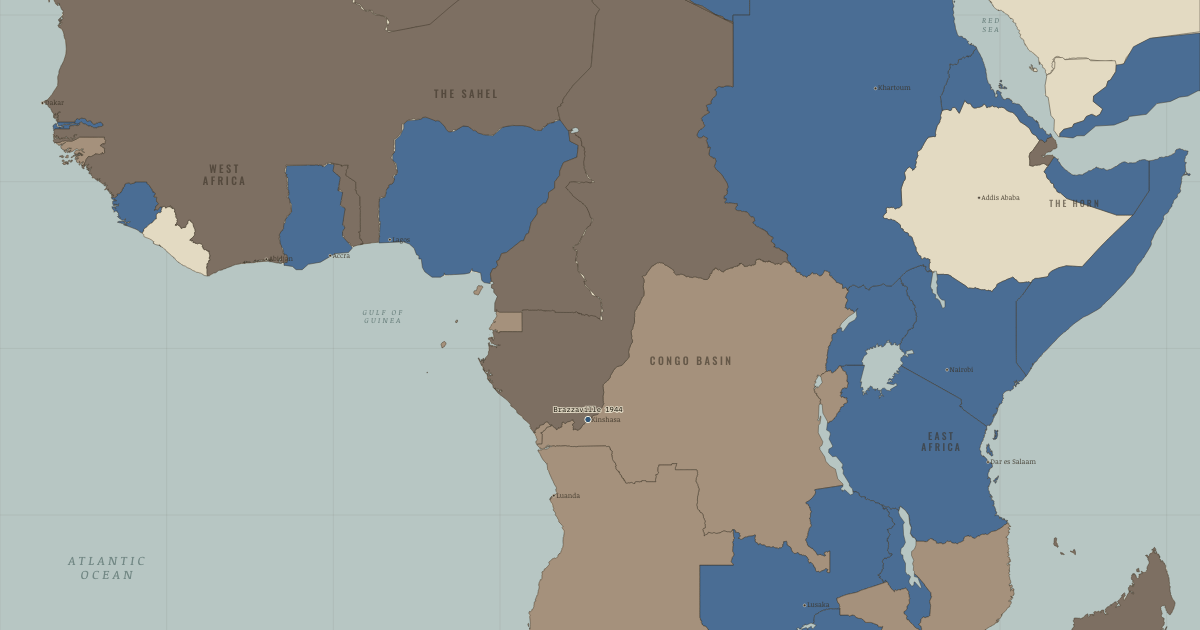
Britain could not have administered Nigeria’s roughly thirty million people with about 1,200 officials had those officials tried to govern alone. Chiefs and emirs did much of the daily work under indirect rule. This arrangement made a large territory comparatively cheap to administer, but it also left European authority dependent on African intermediaries.
The short answer
- Rule by a handful, through intermediaries. Frederick Lugard’s doctrine of indirect rule placed existing chiefs and emirs between British officials and the people they governed. Their work made a small, inexpensive administration possible. It also meant that officials depended on intermediaries who might cooperate under coercion or for local advantage. Organized refusal could make colonial decisions much harder to enforce.
- An economy built for extraction, not development. A railway from a mine to a port was useful to an economy exporting raw materials and importing finished goods, even if it left African towns poorly connected. Investment in African education and industry was limited. At independence, the Belgian Congo had only a handful of African university graduates for thirteen million people. The demand for change therefore concerned the organization of the economy as well as political authority.
- The war as solvent. The war of 1939–45 mobilized African soldiers, cash crops and forced labor. The fall of France and Singapore exposed the vulnerability of European powers; veterans returned having seen that weakness and having killed white men. The Atlantic Charter gave nationalists a further resource: a language of self-determination taken from the Allies’ own statement of their aims.
- Pan-Africanism finds its leaders. The Manchester Congress of 1945 carried the inheritance of Du Bois, Padmore and Garvey into a political program for independence. Among its delegates were Nkrumah, Kenyatta and Hastings Banda, who would later govern. Ideas developed across borders could now be taken into struggles for power at home.
THE TURNING POINT
Brazzaville, January 1944. De Gaulle’s Free French depended on African territory and troops during the war. At Brazzaville in January 1944 they planned reforms to the postwar empire, promising citizenship, representation and an end to forced labor. But the conference declared that “any idea of autonomy, any possibility of evolution outside the French bloc, is to be discarded.” France proposed to change how empire was governed while keeping its ultimate authority. That settlement would come under growing pressure over the next fifteen years.
What it changed
A generation of leaders in waiting. The generation that would lead independent states had acquired experience in places as different as the King’s African Rifles, the Sorbonne, Lincoln University and London’s Pan-African circles. Its members entered the independence struggles with political experience and an idea of the nation-state.
Two roads out of empire. The route to independence depended in part on who stood to lose power. In Ghana and Nigeria, where relatively few white settlers lived, independence could be negotiated. In Algeria, Kenya, Rhodesia and South Africa, settlers with homes and property to defend formed an entrenched source of resistance.
The colonizers underestimate the clock. In 1945, leaders in London and Paris expected reform to stretch over generations. Fifteen years later the map looked radically different. Few people on either side of colonial rule had anticipated such speed, and both sides were poorly prepared for the changes that followed.
The full answer, argued
Small administrations could endure because chiefs, clerks, soldiers and others carried out their orders, while European power seemed difficult to defeat. Before 1945 no coordinated challenge had overturned that arrangement. The war weakened several supports at once: it consumed imperial resources, mobilized and radicalized African populations, and exposed European defeats that challenged claims of white supremacy. Nationalists could invoke self-determination and look to the United States and the USSR, both of which had reasons to encourage them. The machinery still depended on cooperation, but the conditions that sustained it had changed.
An interesting fact
W. E. B. Du Bois, who organized the first Pan-African Congress in 1919, chaired the Manchester Congress at seventy-seven. In a plain English town hall he met a younger generation that would go on to govern. Most delegates were trade unionists, workers and students, unlike the exiled intellectuals prominent at earlier congresses. The Atlantic Charter also reached an audience beyond the one Churchill intended: in 1941 he told the Commons that self-determination applied only to Nazi-occupied Europe. African editors nevertheless printed the words. Nnamdi Azikiwe’s West African Pilot in Lagos was among the papers that held the Allies to them.
This is the study layer of Colonial Africa after World War II, chapter 1 of The Decolonization of Africa, 1945–1994; the full index of the atlas is here.
Related questions
THE FREE PRINTABLE STUDY GUIDE
Get the printable study guide for The Decolonization of Africa free. I’ll send you a few short letters, then one when a new atlas opens. That’s all. — Paul
NO TRACKING · YOUR ADDRESS IS USED FOR THE DISPATCH AND NOTHING ELSE · UNSUBSCRIBE ANYTIME