Road to WW2 · 1931
How far did economics rather than ideology cause WW2?
The seminar question: “How far was the road to war laid by economics rather than ideology?”
From 1929 the Great Depression cut world trade by roughly a third and discredited governments that defended free trade. Japan’s silk exports roughly halved and its farm villages fell into destitution, while in Germany the slump drove the Nazi vote toward a mass following. Yet many countries weathered it without turning to war.
WW2 is free in full, and chapter 1 of every atlas is free. A free account opens 3 more chapters a day. Starter, at $9 a month, opens all 21 with no daily limit — see the plans.
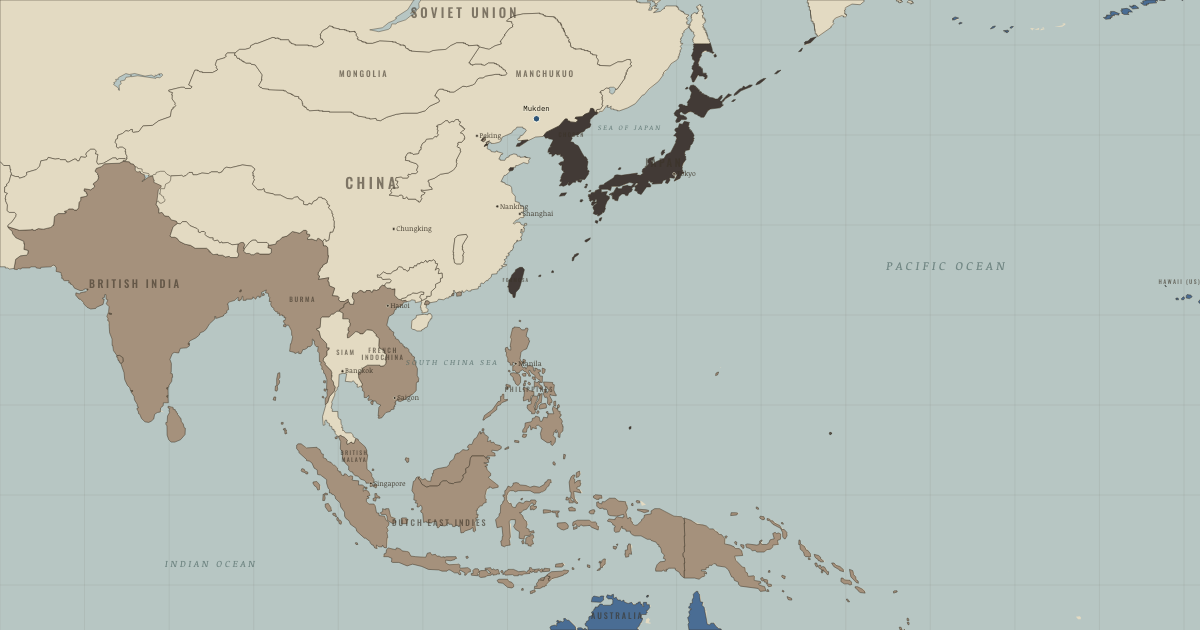
Before the Pacific map changes, Japan already possesses an empire. In two generations it has acquired Korea, Taiwan and islands across the Pacific. Those possessions have not made its economy self-sufficient: industry needs imported oil and metals, and exporters need customers abroad. Nearby lie the colonial territories of Britain, France, the Netherlands and the United States, including British Malaya and the oil-producing Dutch East Indies. China is nominally unified under Chiang Kai-shek, but warlords and a communist insurgency limit his government’s reach.
The short answer
- The Depression and a closing world. World trade’s dollar value fell by roughly two-thirds between 1929 and 1933. Governments also raised barriers: the United States passed Smoot–Hawley in 1930, and Britain adopted imperial preference in 1932. Japan already possessed an empire, yet its leaders saw competitors controlling markets and raw materials elsewhere. If trade was being organized into protected blocs, some reasoned, Japan needed a larger bloc of its own. Manchuria became a ‘lifeline’; Hitler would later call the east ‘living space.’
- The Washington order and its limits. The Washington treaties of the 1920s offered rules for the Pacific: naval ratios, the Open Door in China and consultation among powers. Their force depended on governments respecting them or acting when they were broken. The League had no army, and Britain and the United States were unwilling or unable to commit force to reverse the seizure of Manchuria. China could appeal to agreements, but the agreements did not automatically bring protection.
- The army and the cabinet. Japan’s army claimed a direct relationship with the Emperor rather than ordinary subordination to the prime minister. That left Tokyo with a difficult problem when officers in the field disobeyed. Kwantung Army officers guarding the Manchurian railway concession assassinated the warlord Zhang Zuolin in 1928 and escaped effective punishment. In 1931 the army minister sent a general to check another plot, but word of the visit reached the officers concerned. Civilian weakness would matter when they acted.
- China’s divided position. Chiang Kai-shek’s Nationalists had nominally unified China in 1928, but their government faced rival warlords and communist bases in the south. Catastrophic Yangtze floods added to its troubles in 1931. Japanese radicals expected Nanking to seek legal help abroad rather than offer effective immediate military resistance. They were less attentive to what repeated concessions and humiliation could do over time: resentment could strengthen Chinese nationalism.
THE TURNING POINT
Mukden, the night of 18 September 1931. At the ✕ near Mukden, an explosion damaged the Manchurian railway only slightly on 18 September 1931. The Kwantung Army used it as a pretext for seizing territory. The agreements meant to protect the postwar order were now tested: protests followed, but conquest was not reversed. The next chapter follows the incident; this one has established the fears and institutions that gave the officers their opportunity.
What it changed
A pretext takes shape. In the summer of 1931, Kwantung Army staff officers Ishiwara and Itagaki prepared a railway incident, choosing where to place the explosive charge. The next chapter follows their plan into the night of the explosion.
The Weimar center weakens. The European map shows another political consequence of the slump. Weimar’s last majority government fell in 1930, and by late 1932 the Nazis were the largest party in a fragmented Reichstag, though they had no majority. Chapter 3 follows the bargain that brought Hitler to office.
The democracies and defense. Economic pressure also affected the democracies’ defenses. They reduced military spending, while Britain’s ‘ten-year rule’ assumed that a major war was not imminent. As threats grew, those decisions left the democracies less prepared; the advantage to an aggressor varied with the country and theater.
The full answer, argued
The Depression changed politics dramatically: the Nazi vote rose from 2.6% in 1928 to 37% in July 1932, and Japanese military radicals gained support amid rural hardship. But distress did not select the goals of those movements. Other countries suffered without invading their neighbors, and internationalist alternatives remained available in both Germany and Japan. Historians often call the Depression an enabling condition: it weakened confidence in existing arrangements and made expansionist promises more persuasive. Ideology supplied aims and enemies; institutions and choices helped determine who could act, from Japan’s army beyond effective civilian control to German conservatives willing to bring Hitler into government.
An interesting fact
Before the invasion of Manchuria, Japan was a founding member of the League of Nations with a permanent Council seat. Its diplomat Nitobe Inazō had served as a League under-secretary-general, and his portrait later appeared on a 5,000-yen note. After the Manchurian crisis, Japan became the first major power to leave the League. Later fears of ‘ABCD encirclement’ named America, Britain, China and the Dutch as opponents.
This is the study layer of Great Depression and causes of WW2, chapter 1 of The Road to War, 1931–1941; the full index of the atlas is here.
Related questions
THE FREE PRINTABLE STUDY GUIDE
Get the printable study guide for The Road to War free. I’ll send you a few short letters, then one when a new atlas opens. That’s all. — Paul
NO TRACKING · YOUR ADDRESS IS USED FOR THE DISPATCH AND NOTHING ELSE · UNSUBSCRIBE ANYTIME