Road to WW2 · 1935
Why did so few statesmen take Mein Kampf seriously?
The seminar question: “Hitler wrote his program in Mein Kampf a decade before power. Why did so few statesmen believe him?”
Hitler became chancellor on 30 January 1933, and emergency decrees and the Enabling Act soon made his government a dictatorship. Germany left the League, regained the Saar by plebiscite in 1935 and announced conscription. Britain, France and Italy condemned the rearmament at Stresa, but their front soon broke.
Chapter 3 is included with every paid plan. WW2 is free in full, and chapter 1 of every atlas is free. A free account opens 3 more chapters a day. Starter, at $9 a month, opens all 21 with no daily limit — see the plans.
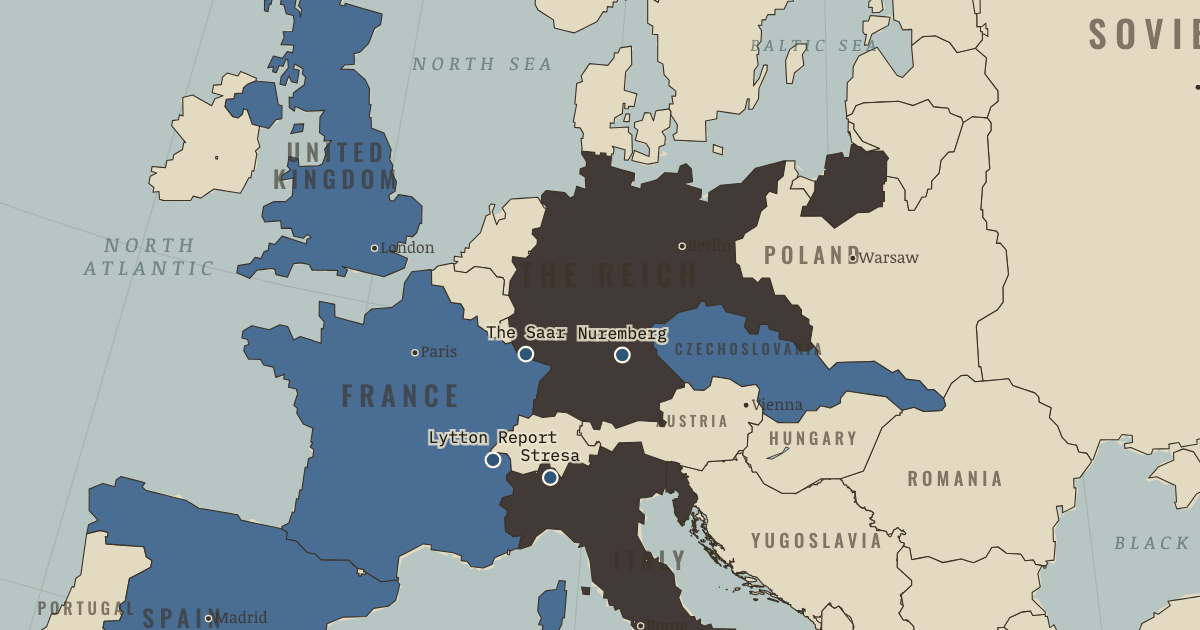
The men who brought Hitler to power thought they had solved a political problem. His movement had mass support, and conservative politicians wanted to turn it against the left. They supported his appointment as chancellor on 30 January 1933, believing that they could control him in office. After the Reichstag fire, emergency decrees curtailed civil liberties; intimidation and the Enabling Act helped the new government remove the republic’s constitutional restraints. The bargain had given Hitler the office from which to build a dictatorship.
The short answer
- The men who appointed Hitler. From 1930, Weimar chancellors increasingly governed through presidential emergency decrees. The conservatives around Hindenburg, particularly Franz von Papen, hoped that bringing the Nazi mass movement into government would give them its support without surrendering control. Papen was reported to have promised, “Within two months we will have pushed Hitler so far into a corner that he’ll squeak,” The Nazis had never won a majority in a free national election. Their access to the chancellorship depended on elites who preferred an authoritarian bargain to government by the left.
- The grievances of Versailles. Many Germans resented the 1919 settlement, and much of Weimar politics sought to revise it. Germany also retained the population and industrial potential to become a major European power. Hitler’s ambitions went much further than revision, but early demands for equality of armaments, the Saar and later the Rhineland could be presented as questions of fairness. Another government might accept one grievance without accepting his wider aims. The difficulty was that each concession could strengthen his position for the next demand.
- Disarmament and security. The Versailles settlement presented German disarmament as a first step toward general disarmament. At the world conference of 1932–33, France, twice invaded by Germany within living memory, wanted security before it reduced its arms; Britain pressed for reductions. The disagreement helped defeat the wider project. Hitler left claiming that Germany alone had been denied equality, and could present rearmament at home and abroad as catching up with powers that had failed to disarm.
- Different powers, different priorities. The powers that might have restrained Germany had different concerns. Britain weighed its global empire and finances, France its exposed border, and Italy its Mediterranean and African ambitions. The Soviet Union remained outside the League until 1934; the United States stayed outside it. Hitler could address governments separately: a 1934 pact reassured Poland, while the 1935 naval agreement offered Britain a limit. Each arrangement answered a particular concern and made a united response harder to sustain.
THE TURNING POINT
Stresa, April 1935. In April 1935, Britain, France and Italy met at Stresa on Lake Maggiore. They condemned German rearmament and reaffirmed Austria’s independence. The declaration left their other interests unresolved. Within ten weeks Britain signed a separate naval agreement with Germany; within six months Mussolini invaded Abyssinia, and Britain and France supported League sanctions against Italy. The breach helped bring Italy closer to Berlin. Historians disagree over whether the Stresa Front could have lasted, but its rapid collapse exposes the distance between a shared declaration and a shared policy.
What it changed
An unequal rearmament timetable. One estimate puts German army spending in 1936 at perhaps ten times Britain’s, though the comparison depends on what is counted. Britain and France accelerated their own rearmament in 1936–37. Spitfires, radar defenses and French armored formations matured on different schedules, so a decision to rearm did not immediately supply the forces. That timing mattered to the balance in 1938–39 and to Hitler’s assessment of his opportunities.
Italy turns toward conquest. Mussolini pursued his plans for Abyssinia while the powers at Stresa were divided. Britain’s naval agreement weakened their partnership; Italy’s invasion and the sanctions that followed damaged it further. The next chapter follows the African war.
The Rhineland comes into view. The return of the Saar, the absence of military intervention against conscription and the weakening of Stresa changed the setting for Hitler’s next challenge. The demilitarized Rhineland was a physical restraint on Germany imposed by Versailles and reinforced by the Locarno agreements.
The full answer, argued
Hitler’s early diplomacy offered statesmen reasons to treat individual demands as limited. He signed pacts, invoked equality and accepted a plebiscite. Taking his stated ambitions as a guide to policy also meant confronting costly choices about rearmament and the risk of war, under political and financial constraints. The larger question remains disputed. In Origins of the Second World War (1961), A.J.P. Taylor emphasized improvisation and the opportunities offered by opponents. Intentionalists including Trevor-Roper and Hillgruber point to Mein Kampf, the Hossbach conference and the eastward drive as evidence of a program. The record of 1933–35 permits a synthesis: fixed ambitions pursued with opportunistic timing. A negotiable move could serve aims that went much further.
An interesting fact
The League assembled an international force of about 3,300 British, Italian, Dutch and Swedish troops for the January 1935 Saar plebiscite. No German troops were stationed near the vote, and secret ballots and international counting helped protect the choice. A large majority chose to return to Germany. The League had helped conduct a fair vote that brought the territory under Hitler’s rule; thousands of Saarlanders who opposed him or organized against reunion fled across the French border in the ensuing period.
This is the study layer of Hitler’s rise and German rearmament, chapter 3 of The Road to War, 1931–1941; the full index of the atlas is here.
Related questions
THE FREE PRINTABLE STUDY GUIDE
Get the printable study guide for The Road to War free. I’ll send you a few short letters, then one when a new atlas opens. That’s all. — Paul
NO TRACKING · YOUR ADDRESS IS USED FOR THE DISPATCH AND NOTHING ELSE · UNSUBSCRIBE ANYTIME