Cold War · OCT 1962
Was the Cuban Missile Crisis resolved by judgment or luck?
The seminar question: “Kennedy’s advisers split between airstrike and blockade. The airstrike faction lost — and later evidence suggests the airstrike would likely have triggered nuclear use. Was the outcome good judgment or good luck?”
Once the botched Bay of Pigs landing pushed Cuba to Moscow, Khrushchev secretly placed missiles ninety miles from Florida. A U-2 photographed the sites in October 1962, and Kennedy chose a naval quarantine over airstrikes. The crisis ended with a US pledge not to invade Cuba and a secret US withdrawal of missiles from Turkey.
Chapter 6 is included with every paid plan. WW2 is free in full, and chapter 1 of every atlas is free. A free account opens 3 more chapters a day. Starter, at $9 a month, opens all 21 with no daily limit — see the plans.
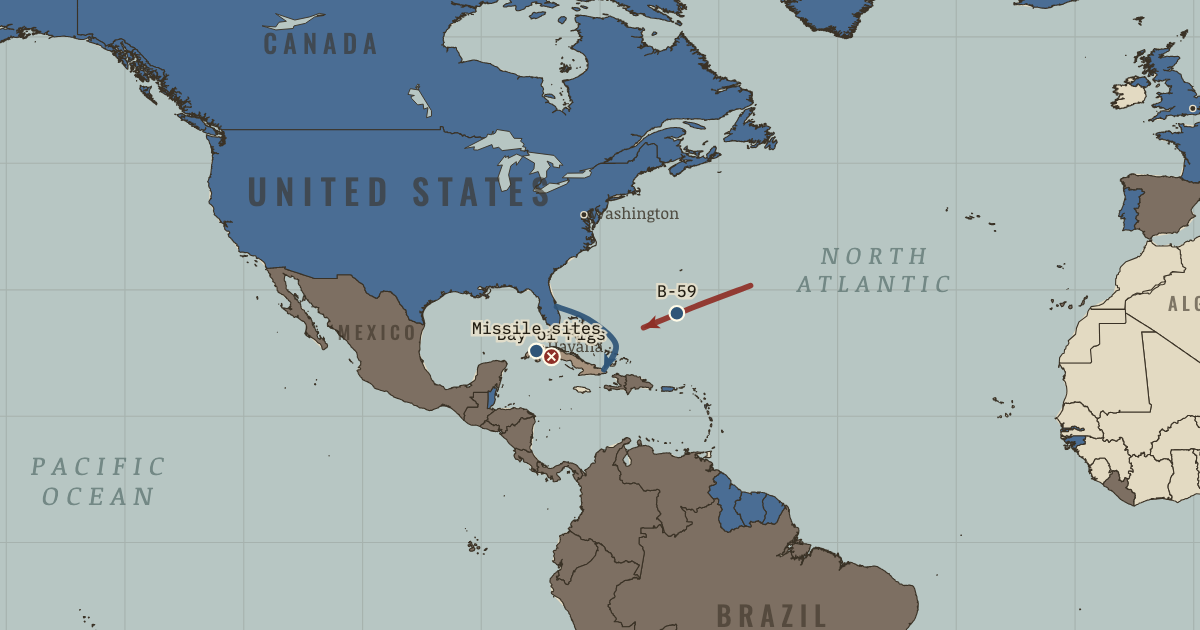
Cuba offered Khrushchev an answer to two problems. After the revolution, American hostility and the failed Bay of Pigs landing in 1961 had pushed Castro toward Moscow, yet another invasion seemed possible. Soviet missiles could help protect the island. They could also change the strategic balance: the USSR had many medium-range missiles, and from Cuba, ninety miles from Florida, those weapons could reach the United States.
The short answer
- Why Khrushchev sent the missiles. Moscow faced a strategic imbalance: it had 26 reliable ICBMs against hundreds of American bombers and missiles, including weapons stationed from Turkey to Britain. The Soviet Union possessed many medium-range missiles, but they could not reach the United States from Soviet territory. Cuba changed their reach. Khrushchev also feared a second, more serious invasion of the island and saw the deployment as protection for Castro. Both purposes depended on keeping the operation secret long enough for the missiles to become effective. With some 40,000 troops and 100-foot missile trailers exposed to aerial surveillance, that was a fragile plan.
- What the Bay of Pigs taught the leaders. The failed April 1961 invasion left Castro expecting another attack and looking for protection. Khrushchev drew a different lesson: Kennedy could be pressured. Their Vienna summit reinforced that impression; Kennedy later said, “he savaged me,”. Kennedy had his own reason to reconsider confident advice after the Bay of Pigs. In October 1962 his advisers did not know that Soviet tactical nuclear weapons were already on Cuba, where an invasion urged by the chiefs could have encountered them.
- Pressure with time to decide. An airstrike would probably kill Soviet soldiers immediately, putting Moscow under pressure to respond. The blockade worked at a different pace. Soviet ships could approach, and Khrushchev would have to choose whether to challenge the line; meanwhile both sides could consider alternatives. Washington called it a “quarantine,” since a formal blockade raised the legal problem of an act of war. ExComm could adjust pressure while leaving an exit open. Compare the Yalu in Chapter 4, where the momentum of military success helped shape policy. Here the speed of events was itself a choice.
THE TURNING POINT
27 October, aboard B-59. For days B-59 had been out of radio contact. Its batteries were failing, the temperature reached 45°C, and crew members fainted. American practice depth charges shook the submarine; the crew could not know they were meant as signals. The captain ordered a nuclear torpedo readied: “We’re going to blast them now! We will die, but we will sink them all.” Three officers had to agree to launch. Flotilla commander Vasili Arkhipov, aboard because of his position, withheld consent. Far from either capital, an exhausted officer’s decision had become part of the crisis’s outcome.
What it changed
A link and a limit on tests. After the crisis, both governments sought ways to handle future confrontations. The direct teletype link agreed in June 1963 made faster communication possible. In August the Limited Test Ban Treaty ended atmospheric nuclear testing among its parties. These measures helped establish an arms-control practice that later included SALT, the ABM Treaty, and INF. The arms race went on, but its participants had begun to agree on limits to particular dangers.
The rivals draw different lessons. Washington saw grounds for confidence in resolve backed by flexible options. Moscow saw the disadvantage of negotiating from weakness. A Soviet diplomat told an American counterpart, “you Americans will never be able to do this to us again,”. The USSR expanded its naval and missile forces and reached approximate strategic parity by 1970. That buildup contributed both to stability in the 1970s and to the cost of the arms race in the 1980s.
Castro’s course after the settlement. The settlement protected Cuba from invasion, but Castro learned of the missile withdrawal from the radio. He had urged Khrushchev to accept nuclear war rather than retreat, and he resented being left out of a decision affecting his country. In the decades that followed he supported revolution abroad, from Bolivia to Angola, sometimes moving ahead of Moscow’s wishes. Soviet assistance did not make Cuba’s aims identical to those of its patron.
The full answer, argued
Both. Kennedy had read The Guns of August, and the Bay of Pigs had given him reason to doubt unanimous expert advice. By slowing the confrontation and privately offering to remove the Jupiters from Turkey, he gave Khrushchev an exit while accepting political cost himself. Yet neither president controlled every danger. Arkhipov happened to be aboard B-59; the stray U-2 escaped; and Khrushchev chose on Saturday night to accept the deal despite its humiliation. McNamara later said, “we lucked out”. The process was designed to give restraint more opportunities, but chance still mattered. How many comparable vulnerabilities might exist in nuclear arsenals today?
An interesting fact
The famous “red telephone” never existed. The hotline established after the crisis used a teleprinter: both sides distrusted spur-of-the-moment speech and wanted time for typing and translation. Its cable passed through London, Copenhagen, Stockholm, and Helsinki. Washington’s first test message, on 30 August 1963, was the typist’s pangram “THE QUICK BROWN FOX JUMPED OVER THE LAZY DOG’S BACK 1234567890”; Moscow replied with a lyrical description of the evening sun over its capital. The link first served in a real crisis during the Six-Day War of 1967.
This is the study layer of Cuban Missile Crisis, chapter 6 of The Cold War, 1945–1991; the full index of the atlas is here.
Related questions
THE FREE PRINTABLE STUDY GUIDE
Get the printable study guide for The Cold War free. I’ll send you a few short letters, then one when a new atlas opens. That’s all. — Paul
NO TRACKING · YOUR ADDRESS IS USED FOR THE DISPATCH AND NOTHING ELSE · UNSUBSCRIBE ANYTIME